How to Use Learn Turkish with Seda: A Complete Guide to the Lessons, Books, Videos, and Free Resources

Updated: Oct 2
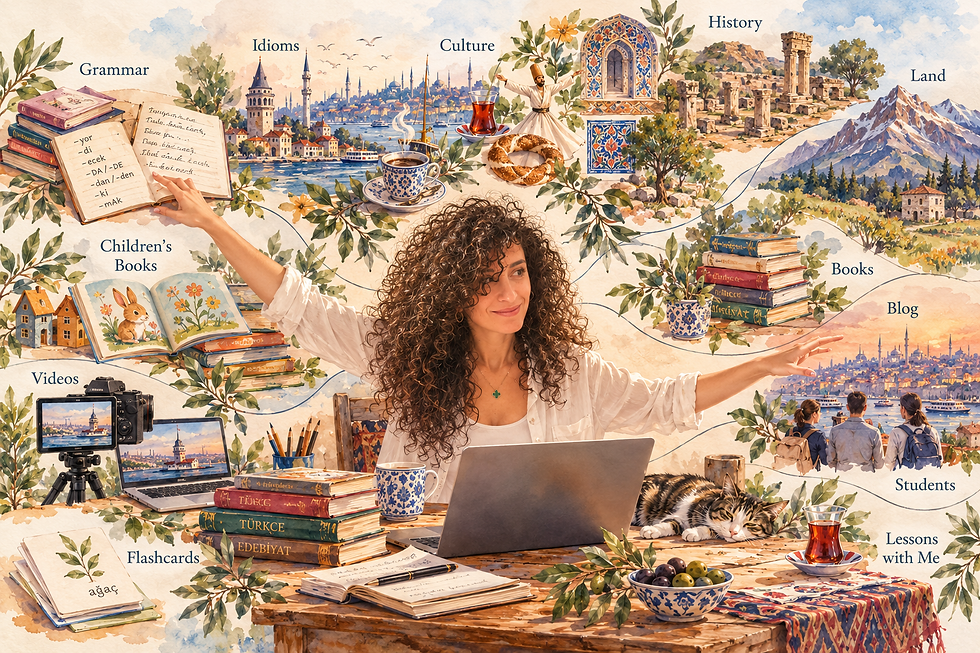
For readers in a hurry: Learn Turkish with Seda is a free Turkish grammar library from A1 to C1, with downloadable lesson PDFs, plus a Heritage collection of idioms, authors, literary works and places in Türkiye, a long blog on language, history, food and everyday life, and two free starter resources (a beginner guide and 500 illustrated flashcards). My own study books and children's books are on Amazon, a separate page recommends books by other authors, the larger video library lives on my YouTube channel, and one-to-one lessons are booked through the site. If you only have five minutes, open the beginner's guide to learning Turkish or go straight to the grammar levels. If you have a free evening, the Land section has a fir tree that grows only in Türkiye. The rest of this page is a map of everything else.
When I started Learn Turkish with Seda, I had a much smaller plan. I wanted to create a clear, free grammar resource that I could recommend to my own students.
It soon became a much bigger project than I had expected. Teaching Turkish as a foreign language is still a relatively young field compared with teaching a language such as English. Resources do not always organize the language in the same way, and different books and programs make different choices about what to introduce and when. I needed a structure I could work with consistently, so I decided to use the Turkish Ministry of National Education (MEB) curriculum as the main framework and began building the grammar section from there.
That alone became a large undertaking. The grammar pages now extend from A1 to C1, but I still find things I want to add or explain differently. I return to older pages, revise them and update them. I do not think of that part of the site as finished.
The blog began much more casually. I thought I would occasionally write about Turkish culture alongside the grammar pages. Then my own background in comparative literature and history began to take over. I started writing about whatever I was reading, thinking about or encountering that seemed connected to Turkish language and culture.
That gradually led to literature, authors, books, idioms and proverbs. Some subjects became large enough to need their own sections.
Then plants found their way into the site. I had spent years learning about them, partly through a university Agricultural Technology program and partly through courses and my own reading. I wanted to write about a wild flower of eastern Anatolia, the ters lale.
Stopping with flowers seemed rather arbitrary, so I began writing about the places around them as well. That was how Land began.
Meanwhile, the practical side of the site kept growing too. I made study guides, downloadable PDFs and eventually a set of 500 illustrated Turkish flashcards. I added my books and videos, and later the stories of some of the people I have taught.
I do not know where the site will go next.
After building the site piece by piece for this long, I thought it was probably time to see what was actually here. Some sections are easy to find from the main menu.
Others are a few clicks away, and I suspect even regular readers have missed a few.
Somewhere along the way, a grammar website became a place where I was also writing about Ottoman coffeehouses, poems, my students and Anatolian flowers. So this is my attempt to put everything in one place and show you around.
If you usually come here for grammar, you might find something unexpected. And if you arrived because of a coffeehouse or a flower, there is quite a lot of Turkish waiting nearby.
If you are just beginning Turkish
The page I would give a complete beginner is How to Learn Turkish: A Beginner's Guide to Getting Started. It explains the approach I recommend in plain terms and answers the questions beginners ask most often (how difficult Turkish is, how long it takes, whether self-study works, when a teacher helps), with links to longer articles on each. It also holds the two free starter resources.
The first is a nine-page PDF called Getting Started with Turkish, labeled on the site as the Beginner Guide. You can download the beginner guide directly without signing up for anything. It explains how Turkish builds meaning through suffixes and where to begin, then shows how to set up a short daily routine. It suggests five flexible study sessions of about 25 to 30 minutes, each with a different emphasis: grammar, listening, writing, idioms and sentence deconstruction. It also describes a small personal notebook for sentences you write yourself and a way of choosing vocabulary from your own life. A later section looks realistically at what AI tools can and cannot do for Turkish, a language that is less represented in their training data than English or Spanish.
The second is the set of 500 free illustrated Turkish flashcards. These are everyday Turkish words and expressions with English meanings and an illustration on each card, delivered as a PDF. This one asks for your name and email, and the PDF arrives in your inbox.
The two do different jobs. The guide is something you read at the start and perhaps again after a month when your routine starts to drift. The flashcards are something you return to in small amounts. If you already know some Turkish, the flashcards also work as a quick check on what you still have.
A third resource suits learners a little further along. The article on how to organize your Turkish study week describes a weekly cycle of meeting new material, retrieving it, using it, getting feedback and returning to it. It includes a free one-page PDF, Your Turkish Study Week: A Weekly Self-Check, meant to be filled in at the end of each week. The beginner guide sets up your days, and the self-check looks back at your weeks.
The How to Learn Turkish page also introduces an AI avatar of me, which you can use to ask general questions about Turkish. It is marked as a beta and it can make mistakes, so it is best kept for quick questions. It does not replace a grammar page or a teacher's correction.
The free grammar library
The Turkish grammar section is organized by the CEFR levels used in European language teaching: A1, A2, B1, B2 and C1. All of it is free to read, and each level index lists its lessons in the order I would study them.
The levels differ in size and in character. A1 opens with the Turkish alphabet, vowel harmony and consonant harmony, moves through basic word order, plural formation with -lAr and yes/no questions with mi, and then covers the case endings one by one, including the locative -DA, the dative -(y)A, the ablative -DAn and the accusative -(y)I.
The accusative page starts from the contrast between Kitap okuyorum (I am reading a book) and Kitabı okuyorum (I am reading the book). The rest of A1 covers pronouns, personal endings, possessive suffixes, the two present tenses, the verb "to be" and adjectives.
A2 covers the main past and future tenses: the simple past with -di, the evidential past with -miş, the future tense and the past continuous. It also covers ability, possibility, necessity, negation and postpositions like için, gibi and kadar.
B1 moves into subordinate clauses and verb voice. It includes relative clauses, verbal nouns with -mAk and -mA, reported speech, conditionals, and the passive and causative voices.
B2 turns toward written Turkish and the way it packs information into noun phrases. Lesson titles include Nominal Density in Turkish, From Clause to Phrase, Register Shift: Spoken to Written Turkish and Processing Long Sentences.
C1 deals with advanced structures and precise usage, much of it in formal and institutional Turkish. It covers advanced converbs such as -dIkçA for proportional change, the formal -mAktaydı, strategic hedging and irony and diplomatic evaluation.
What a lesson page looks like
The lesson pages share a general shape, though beginner and advanced pages differ in detail. The locative case page at A1 starts with what the suffix does, shows its four forms (-da, -de, -ta, -te), explains the vowel harmony and voicing rules that choose between them, and then works through examples such as Ben evdeyim (I am at home) and Kitap masada (The book is on the table). It continues with the locative in questions, common locative expressions, short notes and a FAQ.
Higher-level pages are organized around function and form. The B1 page on relative clauses moves from function to forms, morphology, syntax and usage, with examples like Okuduğum kitap çok ilginç (The book that I read is very interesting). The C1 page on hedging sets a plain sentence, Enflasyon yükselecek (Inflation will rise), beside a long institutional version full of qualifiers, so you can see exactly which suffixes and phrases do the softening.
Lesson pages have a Download button for a PDF version of the lesson, which you can print or keep offline.
The library works in two ways. You can use it as a reference: if a suffix in a sentence confuses you, find the lesson for it and read that one page. You can also use it as a course, moving through a level index from top to bottom. If you use it as a reference, the level label on each page tells you roughly where the structure sits in the overall system.
Some grammar topics also have longer blog articles that explain the logic behind them, among them how Turkish suffixes work, vowel harmony as a system and how one verb becomes active, passive and causative. The lesson page gives you the rule and its forms, and the article gives you the reasoning around it.
This part of the site is still growing. I have a rather long list of grammar notes on my desk, along with ideas for lessons and blog posts I have not written yet. So if you come back in a few months, there will probably be more here.
Vocabulary
Vocabulary on the site comes in a few forms, and they suit different moments.
The 500 illustrated flashcards are for review. Each card holds one word or expression, its English meaning and a picture, which makes them quick to go through in short sessions. They work well for keeping words active and less well for learning how those words behave in sentences.
My study books are for longer, structured work. On the Books for Learning Turkish page I describe the Everyday Turkish Vocabulary Builder series: four beginner workbooks, each built around 30 basic words and phrases from one everyday topic. A workbook lets you stay with one area of life for a while and meet the same words again through different tasks. Two notebooks sit beside them, the Turkish Vocabulary Notebook for collecting and reviewing your own words and the Turkish Verb Conjugation Notebook for organizing verb forms.
I would like this series to keep growing. I already have ideas for the next books. Now I just need to find the time to make them.
The third form is scattered across the site. Many blog posts and some Heritage entries end with a short Vocabulary section, and the words there come with their context attached. The article on amca, dayı, hala and teyze explains family words together with the family structure behind them. The piece on Turkish loan words traces where ordinary words came from, and untranslatable Turkish words like hüzün and gurbet looks at words that need a paragraph of explanation in English.
My books
All of my books are listed under Books, which divides into study books for adults and children's books. The books are sold on Amazon, and each listing on the site links to its Amazon page.
Study books for adult learners
The Study Books page presents them as a growing series called Everyday Turkish, focused on practical vocabulary and natural sentence patterns, with cultural context around them. The books on the page are:
Love Sentences Explained: Turkish learned through love phrases.
Sentence breakdown: grammar understood through sentence analysis.
Vocabulary notebook: for organizing and reviewing new Turkish words.
Verb practice book: guided practice for recalling verbs.
Numbers and math terms for beginners, Weather vocabulary and grammar, Family and relationships and Essential greetings and phrases: thematic books for beginners, each focused on one everyday area.
The thematic books suit beginners who want a contained area to work on. The sentence breakdown book and Love Sentences Explained suit learners who already know some grammar and want to see how suffixes combine in real sentences. The notebook and the verb book go with any course of study, including the free grammar pages.
Children's books
The Children's Books page holds Tiny Polyglots, my series of bilingual Turkish-English books for young children. Alongside a bilingual story book and a Turkish alphabet book, the series has picture books on animals, fruits, vegetables, colors, numbers and emotions. Several of these come with a matching coloring book. They are written for families introducing Turkish at home.
Books by other authors
Books by other writers have their own page, kept separate from my publications. Books for Learning Turkish lists my own titles first and then course books and reference works by other authors.
For a course that takes you from the beginning, it lists Complete Turkish: Beginner to Intermediate Course by Asuman Çelen Pollard and David Pollard, which covers roughly A1 to B1 or B2, and the Yeni İstanbul series for international students, which runs from A1 to C1. Basic Turkish Grammar for Foreigners by Muhammed Ensar Erensayın is aimed at A1 and A2 learners. Turkish Grammar in Practice by Yusuf Buz is a practical grammar reference for beginner to intermediate learners, organized in short units you can return to when one structure needs work. For reference, there is Aslı Göksel and Celia Kerslake's Turkish: An Essential Grammar and The Larger Redhouse Portable Dictionary by Serap Bezmez and C. H. Brown. The page also points to two free online dictionaries, the TDK Güncel Türkçe Sözlük and Kubbealtı Lugatı.
For children, Turkish Children's Books: English Translations and Bilingual Books by Age groups books from toddlers to fourteen-year-olds. It names Turkish authors whose work is available in English or in bilingual editions, among them Aytül Akal, Feridun Oral, Aziz Nesin, Behiç Ak and Gülten Dayıoğlu, with Geoffrey Lewis's translation of The Book of Dede Korkut for older children. Each age group links to a curated Amazon list, and there is a section for librarians. My Tiny Polyglots books appear there in their own labeled section.
For school-age children, the Turkish Ministry of National Education's PİKTES project offers free downloadable materials on its textbook page. They include Turkish coursebooks for foreign students from primary school to high school, a basic-level illustrated dictionary for ages 6 to 12 and for learners 13 and older, word cards, and graded Turkish story books from A1 to B2, among them the Salih and Aslı story series.
A few blog posts also point to outside material. The teacher's guide to Turkish TV series by genre recommends dizi to learn from, and the post on what to bring home from Türkiye suggests objects like tea glasses and a cezve. Some recommendations use Amazon affiliate links, which is disclosed on the site.
Videos and the YouTube channel
The Videos page shows a selection of my videos: short lessons on grammar, suffixes, vocabulary and everyday expressions. It pulls from my YouTube channel and updates automatically. The videos shown there include lessons on vowel harmony, where to place the question suffix, noun cases, pronouns with case endings, the Turkish alphabet, how to say "must" in Turkish, and a common mistake with Turkish verbs.
The full collection is on my YouTube channel, Learn Turkish with Seda, which some longtime readers may remember by its former name, Turkish Tales of Wonder. The Videos page sends readers there for the full collection of lessons, reading practice and Turkish language videos, so if you want to browse everything, the channel is the best place to go.
Grammar videos and grammar pages cover some of the same ground. A video on vowel harmony and the vowel harmony lesson page explain the same rule in two ways.
The blog
The blog is where most of the longer articles live, and it is probably the part of the site where I feel most free. I can start with almost anything that makes me curious and see where it leads. Sometimes it is a word I have used all my life and suddenly want to know more about. Sometimes it is an object on a Turkish table, a historical detail I come across while reading, a place, a book, or something a student asks me during a lesson. I love the whole process: finding the subject, doing the research, following references I had not expected to follow, and eventually turning all those notes into an article.
That freedom is also why the blog has become so varied. The categories include Turkish, Turkish Cuisine, Ottoman Empire, Modern Türkiye, Turkish TV Series and Layers of Anatolia, but I do not worry too much about keeping every subject neatly inside one category. Language constantly leads into history and everyday life anyway.
I still have a long list of things I want to research and write about, which may be my favorite problem to have. What follows is only a selection of what is already there.
Learning Turkish
These are the practical articles. Is Turkish hard to learn and how long it takes to learn Turkish answer two questions beginners often ask. Both draw on institutional figures such as the Foreign Service Institute's estimates, and the second breaks expectations down by CEFR level. How to learn Turkish online in 2026 is a guide to building a self-study plan, and how to practice speaking Turkish when you have no one to talk to draws on research on private speech.
For readers planning a move, there is a first-year guide to moving to Türkiye, a realistic cost guide to learning Turkish in Türkiye, and a post on finding work in Türkiye with English only.
The language itself
Some posts look at Turkish as a language among other languages. Which languages are closest to Turkish covers the Turkic family, and Turkish and Arabic sorts out a common confusion. Does Turkish change the way you think? looks at language and perception. A smaller cluster deals with Turkish and artificial intelligence, including why AI keeps getting Turkish wrong and how AI tokenizes Turkish suffixes, useful if you use AI in your study and want to know where to trust it.
Another series takes one everyday phrase at a time and places it in the moment it belongs to. Geçmiş olsun is said to someone after illness or trouble, Başın sağ olsun in a house of mourning, and Afiyet olsun at the table. Kolay gelsin is offered to anyone at work, and bakarız and hallederiz are two small words about how the future gets handled in conversation.
Food, celebrations and everyday life
Food writing runs through the blog. A practical piece explains how to make a Turkish breakfast at home, with substitutions for ingredients that are hard to find outside Türkiye. How Türkiye became a tea country covers the recent history of çay, from the twentieth-century plantations of Rize to ordering it demli or açık. There are longer histories of lokum and yoğurt.
The religious holidays each have a post, Ramazan Bayramı and Kurban Bayramı, with the everyday language that surrounds them, and the national days have their own articles, from 23 Nisan to 30 Ağustos. The long article on Turkish wedding traditions follows customs from Central Asia to modern Türkiye.
The shorter, observational pieces are often about one object or one habit. The tea saucer you never really looked at is about a small object on every Turkish table. Diş kirası explains why Ottoman hosts gave their guests gifts after dinner. A Turkish summer moves from the yayla to the yazlık and the evening cool, and what to bring home from Türkiye goes through kolonya, the peştamal, copper and çini, with a vocabulary list at the end. Istanbul's cats have a post of their own, and so does Yaren the stork, whom a village in Bursa waits for each spring.
History and literature on the blog come further down, in their own sections.
Student stories and learning experiences
One series on the blog is written by my students. Each post begins with a short introduction from me, and then the student tells their own story in their own words.
Eliza started learning in 2013 to talk with her husband's mother and has kept Turkish going for more than a decade through family conversation and lessons, with yearly trips to Türkiye. Georgina taught herself from books and websites in Athens and felt confident, until a visit to Istanbul showed her the difference between recognizing words on a screen and following people who speak to you. Haris writes from Atlanta about a ten-year path. Jeffrey writes about learning Turkish after moving to Ordu, and JF about learning in Texas and in Türkiye. Rocio came to Turkish through television, music and friendship, and Jonathan started learning around a hair transplant in Türkiye. There are a few more stories I would happily add here, if I can persuade their owners to write them. :)
Someday I would also like to write one from the other side, about what I have learned from my students.
The starting points in these stories have little in common. A companion article, How People Actually Learn Turkish, describes common learner situations without naming anyone: the learner with very little time, the learner living in Türkiye who still feels limited, the learner abroad with too many resources, and the learner who understands far more than they can say.
Heritage speakers have a separate article. Why heritage speakers struggle to relearn Turkish is written for people who grew up hearing Turkish at home and now want it back. It explains why a beginner's classroom often fits them badly and which parts of grammar tend to erode first, and it looks at research on Turkish-German returnees and what it shows about recovery.
Heritage
The Heritage section is where the site documents Turkish in its cultural setting. Its own introduction describes it as bringing together "the cultural layers that shape Turkish beyond grammar." It has four parts: Idioms, Authors, Literature and Land.
In Turkish I would call this section my gözbebeğim, literally “the pupil of my eye,” the thing you treasure most. It is also the section I know I will probably never consider finished.
Idioms grow fastest because I keep hearing expressions that make me think, I should write about that one. Authors and Literature take me longer. There are writers I have loved for years, others I want to return to before writing about them, and many books still waiting on my list.
So what you see there now is only the beginning of what I want this section to become. I want to keep adding writers, literary works, places and expressions as I have time to research them properly. This is one part of the site I am very happy to let grow slowly.
Idioms
Entries in the Idioms section usually give the literal translation first. Then come the meaning and how it is used, example sentences, a cultural note and a FAQ. A short grammar paragraph points to the suffixes inside the phrase and links to the matching lesson pages.
Leyleği havada görmek is a good example of a full entry. Literally it means "to see the stork in the air," and it is said, usually as a teasing question, to someone who is never at home. The cultural note traces it to an old folk belief that whoever saw a stork in flight in spring would travel that year, explains why storks were called hacı leylek (pilgrim stork), and links to the blog story of Yaren. The grammar note shows leylek becoming leyleği as a direct object and hava taking the locative in havada.
Bir fincan kahvenin kırk yıl hatırı vardır, "a cup of coffee is remembered for forty years," comes with a note on coffee in Turkish social life, including the salted coffee a bride-to-be may serve during kız isteme, and a link to the Ottoman coffeehouse article. Other entries include Atı alan Üsküdar'ı geçti, Acı patlıcanı kırağı çalmaz, Eşref saati, Gemileri yakmak, Kervan yolda düzülür and İçinin yağları erimek.
Authors
The Authors section introduces writers who shaped Turkish, from the thirteenth century to the present. Yunus Emre is there, and his entry looks at how his Turkish stays close to speech while carrying Sufi thought, and how he bent Arabic and Persian words into Turkish grammar (hikmet becoming hikmetli). Twentieth-century prose is represented by Halide Edib Adıvar, Sabahattin Ali, Ahmet Hamdi Tanpınar and Yaşar Kemal. The poets include Orhan Veli Kanık and Nazım Hikmet, and contemporary fiction is represented by İhsan Oktay Anar and Elif Şafak.
Literature
The Literature section looks at individual works. Some entries are poems. Anlatamıyorum by Orhan Veli is given in full in Turkish with an English translation, and the entry pays particular attention to kifayetsiz, an Ottoman-era word that carries more weight than the plain words around it. Aşkın aldı benden beni is by Yunus Emre, and Yaşamaya Dair is Nazım Hikmet's poem written in prison in 1947 and 1948. Other entries are novels: Sinekli Bakkal, Kürk Mantolu Madonna, İnce Memed, Saatleri Ayarlama Enstitüsü, Puslu Kıtalar Atlası and Pinhan.
For a learner at B1 or above, these pages show literary Turkish, which reads differently from textbook dialogue. A poem like Anlatamıyorum is short enough to read in the original with the translation beside it. The novel entries give context before you start a book or while you read it.
Land
The Land section is the newest part of Heritage, and I may have created a small problem for myself with this one. The more I add, the longer my list becomes. There are mountains I want to write about, and lakes, islands, ancient sites, endemic plants, forests and places whose names carry their own histories. Every time I research one place, I seem to find two more. At this point, I am fairly certain I do not have enough years to write all the entries I have in mind.
Each page uses the Turkish name as its title, with the English name beside it. Some entries are plants: the Anadolu sığla ağacı, or oriental sweetgum, whose resin was traded across the Mediterranean, and the erguvan, which turns the Bosphorus purple in spring. The Kazdağı göknarı, or Trojan fir, is endangered and grows mainly on Kazdağı, with smaller populations elsewhere in northern Türkiye. The ters lale, the crown imperial, grows wild in the mountains of eastern Anatolia, and its flowers hang downward, which gives it its Turkish name.
Other pages take me into terrain and water: Ağrı Dağı, the fairy chimneys of Kapadokya, the travertine terraces of Pamukkale, Salda Gölü and İznik Gölü. Then there are places where human history and the land are hard to separate: Efes, now cut off from the sea by its own silted harbor, Olimpos on the Lycian coast, the island of Bozcaada, and Polonezköy, the Polish village.
The İznik Gölü entry is a good example of why I enjoy making these pages so much. I can begin with a lake and its birds, find myself reading about a late antique basilica that disappeared beneath the water after an earthquake in 740 and was located through aerial photographs in 2014, and eventually end up with the name itself: how Greek Nikaia became İznik, and how göl takes the possessive suffix to become gölü. This is exactly the kind of wandering research I love, and the Land section is going to keep me busy for a very long time.
History and cultural history
History appears across the site, mostly on the blog. The Layers of Anatolia category collects articles on the civilizations that lived on this land before and alongside the Turks. It begins with Göbeklitepe and Karahantepe and includes two Hittite articles, one on a civilization afraid of its gods and one on the peace treaty they wrote down. It continues with what archaeology found at Troy, the Seven Sleepers of Ephesus, Hıdırellez and an early image of Christ in İznik. Byzantine Istanbul appears in the hidden Byzantine ruins of Istanbul and in a Viking's name for the city, Miklagard.
Ottoman history has its own group. The Ottoman coffeehouse looks at a social institution, and Hürrem Sultan is a portrait of a single life inside the palace. Evliya Çelebi is approached through his attention to language. The Empire of Many Tongues asks why the Ottoman state never required its subjects to speak Turkish, and İznik tiles and the lost coral red is the history of a single color.
The transition to the Republic is the subject of Democracy Did Not Begin in 1923, which traces Ottoman reform and women's rights. Language history has its own articles: the origins of the Turks, from the steppe to the Turkish language and what it means to be an Anatolian Turk.
These articles are written for readers interested in Türkiye itself, and none of them requires any Turkish. Once you have read about the Ottoman coffeehouse, the proverb about a cup of coffee and forty years makes more sense.
Studying on your own with the site
The site has no fixed program, and that is intentional. There is a path if you want one: the grammar library is organized by level from A1 to C1, the beginner guide gives you a place to start, and the PDFs, flashcards and weekly self-check can give some structure to your study. You can work through the grammar pages in order or come back to them when something you meet in Turkish sends you looking for an explanation.
But I do not think of learning a language as something that happens only inside a sequence of lessons. I have always seen things as connected, and that naturally found its way into this site. I cannot separate Turkish from the place where it is spoken or a word from the history and daily life around it. A grammar question can lead to an idiom, a novel, a lake in Anatolia or something said over breakfast. Sometimes following that path is part of learning too.
So there are no shortcuts here and I do not try to turn Turkish into a game you can finish. There are levels and guides when you need direction, but there is also room to wander. Read something that is slightly difficult. Stay with a sentence for a while.
Watch Turkish even when you do not understand every word. Go down a historical rabbit hole because a place name made you curious. Come back to the grammar when you need it.
My approach, in the end, is quite simple: spend time with the language and the culture around it and be patient with both. Self-study can take you a long way that way. If at some point you want individual feedback on your pronunciation or a clearer sense of what to work on next, that is where lessons can help.
Learning with me directly
Everything on the site can be used independently, but I also teach one-to-one online.
The current lesson options, packages and prices are on the Book a Lesson page, while the How It Works page explains the practical side of studying with me.
My lessons are very individual, and I mean that quite literally. I do not have a folder of prepared lessons that I simply assign according to level. I make the lesson for the person in front of me. Over time I learn what they do for work, what they read, what they find funny, where they travel, what they keep forgetting in Turkish and what they can already do without thinking. All of that eventually finds its way into the material I prepare.
This means I spend a considerable amount of time outside the lesson itself reading, researching and making materials. A student interested in social history may find an old photograph or a piece of Yeşilçam in a lesson. Someone preparing to spend time with a Turkish family may work with the language of an actual dinner table. Another student may need us to stay with one small structure until it finally settles. I like this part of teaching enormously. Getting to know someone well enough to know what will make Turkish click for them is part of the work for me.
The Turkish Strategy Session grew from the same approach. Sometimes a learner does not need another general resource. They need someone to look carefully at what they already know, where things are getting tangled and what would be useful to concentrate on next. After the session, I put that into a written report that they can use with me or take away for their own study.
Regular lessons go further into that individual work, while Speaking Practice gives learners who already have some Turkish a place to use it with another person. I keep the details on the booking pages because the options may change. What stays the same is that each lesson is prepared for the individual student.
About me

I am Seda Sürel, a Turkish teacher, although it took me quite a few different roads to arrive here. I studied comparative literature and later history, lived in the United States for some time, and have worked in education in very different settings. I have taught children and adults, in classrooms and online, individually and in larger programs.
More recently, my students have included machines as well: I also worked in AI as a trainer and evaluator, helping to improve language models. Before and alongside teaching, I also worked in publishing and other fields, and all of those experiences have shaped the way I work now.
Over the years, teaching gradually became the place where many of my interests came together. Literature and history were already part of my academic life. Living abroad gave me another experience of language from the learner's side, of trying to understand a place through the way people speak and live. Working with students of different ages and backgrounds taught me that the same explanation or the same pace will never work equally well for everyone.
I later formalized that experience with a certificate in teaching Turkish as a foreign language from Istanbul University-Cerrahpaşa and a TESOL certificate from Arizona State University. But Learn Turkish with Seda probably tells you more about me than a list of qualifications does. It has ended up containing nearly everything I am interested in: language, literature, history, teaching, books, research, and the places and ordinary things I keep becoming curious about.
There is more of the formal background on my About page, and the Discover page has my certificates and what students have written about working with me.
How the parts connect
People find this site in different ways. Someone may arrive because they are trying to understand a Turkish suffix. Someone else may be looking for an idiom they heard in a television series, a book for their child, or the name of a flower they saw in Anatolia.
They may stay on that one page and leave, or one thing may lead them somewhere completely different.
That is actually very close to the way I see life. I tend to see connections between things that may appear separate at first. Language, people, history, belief, culture and the land they live on all shape one another over time. A word can carry traces of another language or another century. A river can lead you to an ancient settlement, a plant to an old trade route, and a poem to the world in which it was written.
The more I learn, the more connections I find, and I think that is one of the reasons I never seem to run out of things I want to research. Perhaps that is also why I keep building this site in so many directions. I am one person, here for a very small amount of time, and there is far more to learn than I could ever fit into one lifetime. I cannot document every word, read every book or write about every place that interests me.
But I can learn what I can, connect some of it, and leave it here for another person to find.
The internet can feel quite harsh to me sometimes. I come across anger and hostility more often than I would like, and much of modern life seems increasingly organized around speed, attention, and what can be gained from other people. I do not want to add more of that. I would rather make a small place built around curiosity, sharing what we know, and the possibility that people can continue to grow throughout their lives.
There is a line by the 16th-century Ottoman poet Bâkî that I have known for a very long time:
Âvâzeyi bu âleme Dâvûd gibi sal
Bâkî kalan bu kubbede bir hoş sadâ imiş.
Roughly, he is saying: let your voice be heard in this world like the voice of David, because what remains beneath this dome is a hoş sadâ, a pleasant voice or echo.
There is a wordplay in the original. Bâkî is the poet's name, but it also means lasting or remaining.
And my name is Seda.
So yes, I admit I take this particular couplet a little personally.
I have no idea how much of what is in my head I will actually get to make. Probably a small part. But if I can keep following these trails, share some of what I find and leave a hoş seda behind, that would make me happy.
Maybe that is the real center of Learn Turkish with Seda. The grammar pages, books, stories, and all those places in Türkiye are simply where my curiosity has taken me so far.
Where to find everything
Start here: How to Learn Turkish · Beginner Guide (PDF) · 500 Free Turkish Flashcards · Your Turkish Study Week
Heritage: Overview · Idioms · Authors · Literature · Land
Reading: Blog
Videos: Videos page · YouTube channel
Lessons: Book a Lesson · How It Works · Turkish Strategy Session
About: About Seda · Discover


Comments