with Seda
Olimpos (Olympos)
The City That Never Stopped Burning
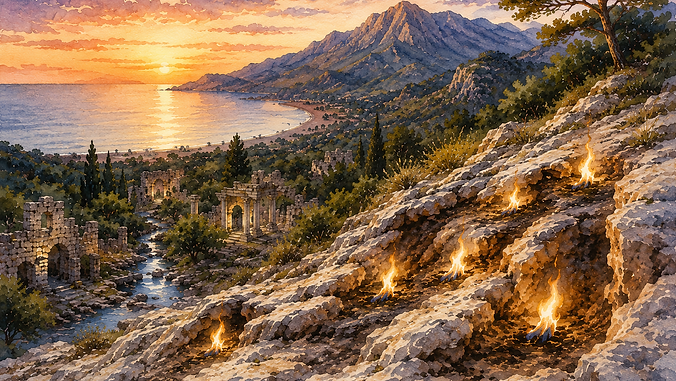
Climb the hillside above Çıralı after dark and you will find fire coming straight out of bare rock. No woodpile, no torch, no fuel of any kind that the eye can find. Small flames stand a few centimetres above the stone in dozens of separate spots, scattered across a slope of white outcrop, and by most estimates they have been burning for something close to twenty five centuries. Sailors once steered by this light. Poets once turned it into a monster. Neither the sailors nor the poets knew what actually fed it. Modern geochemical surveys over the last two decades have traced the mechanism in far more detail than earlier accounts allowed.
What It Looks Like
The valley opens from the mountains to the sea. A stream called the Akçay cuts through its centre, and on both banks of that stream lie the remains of a Roman and Byzantine port city, now half buried in pine, plane, and fig. Columns lean against tree trunks. A theatre seat is wedged under a root. The temple gate still stands south of the river, its lintel legible enough to read a dedication carved under Marcus Aurelius. Walking the site means crossing the water more than once, since the ruins sit on both sides and there has never been a reason to dry the ground out.
The valley ends at a pebble beach where the river meets the Mediterranean, backed by dune vegetation and pine. Loggerhead turtles, Caretta caretta, dig their nests along this shore each summer. Above the whole valley, on the slopes to the southwest, sits the second landmark that gives the place its name: Yanartaş, the burning stone, where the gas seeps that ancient writers called the fires of Chimaera still burn across roughly five thousand square metres of exposed rock.
Where It Is
Olimpos sits in the Kumluca district of Antalya province, on the southern coast of Türkiye, within the borders of the Beydağları-Olympos National Park. Distances quoted from central Antalya vary depending on the road taken, reported anywhere from about seventy to ninety kilometres. The nearest village, Çıralı, lies just east of the ruins along the same beach. Above the valley rises Tahtalı Dağı, a peak of roughly 2,375 metres that ancient sources knew as Mount Olympus of Lycia, one of several mountains across the Aegean and Anatolian world that carried the same name. The Lycian Way, the long distance trail that follows the old coast road of Lycia, passes directly through the site.
A Harbor with Three Votes
Olimpos was a member of the Lycian League, the federation of city states that Strabo, citing the geographer Artemidorus, described as holding an assembly with weighted representation. The largest cities held three votes each. Six cities carried that weight: Xanthos, Patara, Pinara, Myra, Tlos, and Olimpos. Every one of the other five sat in western or central Lycia. Olimpos was the only city in the eastern half of the region granted the same standing, a detail that says something about how much trade passed through its harbor.
The city's own coinage for the League appears by the middle of the second century BC, though the date it was actually founded is not recorded. Its position on the coast made it wealthy, and that wealth made it a target. In the first quarter of the first century BC, Olimpos fell under the control of a Cilician pirate leader named Zeniketes, who used the harbor as a base and was expelled, along with his city, from the Lycian League for it. Rome sent a commander, Publius Servilius Vatia, to put an end to the piracy. Zeniketes chose to set fire to himself and his household rather than be taken. Olimpos lost its League membership until the Roman Imperial period, when it was readmitted and rebuilt along a more regular plan, its baths, its bridge, and much of its surviving temple dating to this second flourishing. The emperor Hadrian is recorded visiting the city around 130 AD.
Christianity reached Olimpos early. Methodios, a theologian who wrote some of the first sustained responses to anti-Christian polemic, served as the city's first bishop and its first bishop for all of Lycia, before his martyrdom around 311 AD. Later bishops of Olimpos are named in the records of church councils held at Ephesus, Chalcedon, and Constantinople across the following two centuries, evidence of a small city that stayed connected to the wider Christian world for a long time after its political importance had faded.
By the seventh century, Arab raids along the Lycian coast had emptied most of its harbor towns, Olimpos among them. Genoese, Venetian, and Rhodian forces built fortresses on the same headland during the medieval centuries that followed, holding a coastline that had largely stopped being lived in. By the fifteenth century there was nothing left for the Ottomans to take. The site was rediscovered for European scholarship by the British naval officer Francis Beaufort in 1811, and the Antalya Museum began its first excavations there in 1991. A team from Koç University continues that work today.
The Monster in the Rock
Above the ruins, on the slope that faces the sea, sit the flames of Yanartaş, described in antiquity as Mount Chimaera. Homer gives the earliest surviving account of the creature the place was named for: lion at the front, goat in the middle, serpent behind, and breathing fire. Bellerophon, riding Pegasus, is the hero credited with killing it. The historian Ctesias is the earliest writer known to have connected this myth to an actual location, an identification later repeated by Pliny the Elder, who placed the monster's lair at the site of the permanent gas fires above Olimpos.
Beneath the flames, archaeologists have found the remains of a sanctuary to Hephaistos, the smith god of fire, its altars and statue bases dated to the Roman period. The choice of god was not arbitrary. Whoever built that sanctuary was standing on ground that burned on its own, without any fuel a blacksmith would recognize, and gave that fact a name and a patron rather than an explanation.
The Chemistry Underneath
The explanation came from geology, not mythology, and it took until the twenty first century to work out fully. Yanartaş sits on an outcrop of peridotite, part of the Tekirova ophiolite, a slab of oceanic mantle rock roughly three kilometres thick that was thrust up onto the Lycian coast in the Late Cretaceous. Peridotite reacts with water in a process called serpentinization, and that reaction produces hydrogen. The gas rising through roughly fifty separate vents at Yanartaş is a mixture, close to 87 percent methane, between 7.5 and 11 percent hydrogen, the rest mostly nitrogen with a trace of heavier hydrocarbons. About twenty of the fifty vents burn at any given time, with individual flames reaching up to about seventy centimetres. Ruthenium present in the rock is thought to act as a catalyst, allowing methane to form at temperatures far below what the reaction would normally require. The site is one of the largest known emissions of abiogenic methane found anywhere on land.
Researchers studying the seep have also found microbial life thriving in the fluids the reaction produces, evidence that a chemical process with no need for sunlight can still support living things. Systems like this are one of the reasons serpentinization is studied as a possible model for how life might survive, or begin, in places that never see the sun, icy moons with subsurface oceans among them.
None of this makes the older explanation foolish. The people who built a temple to a fire god here and the geochemists who later sampled the gas reached the same basic judgement from opposite directions. People agreed on one thing. The fire belonged to the place itself. They disagreed about why.
The Words the Fire Left Behind
Yanartaş breaks into yanar, burning, and taş, stone. Yanar comes from the verb yanmak, to burn, put through the aorist suffix -ar, which in Turkish does not just mark the future or the habitual the way English grammar books sometimes describe it. It marks a thing that reliably does something, again and again, as its nature. Yanar is not "will burn." It is "the kind of thing that burns." A yanar taş is a stone whose nature includes fire, which is exactly the point of the place.
Çıralı, the village at the mouth of the valley, carries its own small history inside it. Çıra is resinous pinewood, split into strips and burned as a torch or kindling long before matches existed, a word that reached Turkish from Persian çerâğ, lamp, itself descended from an older Middle Persian word for the act of burning or giving light. The suffix -lı does the same work it does everywhere in Turkish: it attaches to a noun and produces an adjective meaning "having" or "characterized by" that noun, the same suffix that turns tuz, salt, into tuzlu, salty, and pairs with its opposite, -sız, which turns diş, tooth, into dişsiz, toothless. Çıralı means, plainly, the place with resin pine, a village named for the fuel its forest supplied before the forest supplied tourists instead.
Tahtalı Dağı, the mountain above the valley, is harder to pin down, and it is worth saying so honestly rather than guessing. Tahta means board or plank, and with -lı attached, tahtalı would mean wooded, or made of boards. The same sound also sits close to taht, throne, which would give the mountain a different reading: the one with a throne, or belonging to one. Nothing in the record confirms which word the name actually preserves.
Beydağları, the name of the national park that holds the whole valley, is more straightforward and shows how much work Turkish can pack into a compound. Bey means lord or chieftain. Dağ is mountain. Add the plural -lar and the third person possessive -ı, and dağları becomes "their mountains," the same possessive compound marker that turns göl into Salda Gölü or Van Gölü, except stacked here on top of a plural. Beydağları reads, suffix by suffix, as "the mountains of the lords," a single word carrying a noun, a plural, and a possessive relationship all at once.
Olimpos itself resists this kind of analysis, and that resistance is worth naming rather than papering over. The name is Greek, not Turkish, and its root is older than Greek. What it originally meant, no one can say with certainty. It was shared by mountains from Thessaly to Mysia to Bithynia to this stretch of Lycian coast, a name attached again and again to places that seemed to belong to something larger than the people living under them.
The Rule Against Concrete
Olimpos sits inside a national park, and the park's boundary shapes what can be built on the ground above the ruins. No permanent stone or concrete construction is permitted along the beach or through the valley floor. The bungalow camps that have grown up along the approach to the ruins, wooden platforms among the pines, exist because wood is what the rule allows. Fire regulations and gas monitoring apply to the Yanartaş vents themselves, since the seep sits inside protected forest that has burned before, from lightning and from carelessness, though never from the vents.
Excavation at the ancient city continues under Koç University, much of the site still lies under tree roots, and excavation moves slowly because of it. The turtles at Çıralı beach are monitored each nesting season, their eggs marked and protected from the same beach traffic that draws visitors to the ruins above them. The city, the forest, the beach, and Yanartaş fall under one protective designation and are managed as a single landscape.
Frequently Asked Questions
Q: What does the name "Olimpos" mean?
A: No one can say with certainty. The name is Greek, not Turkish, and its root predates Greek itself. It was shared by numerous mountains across the ancient Aegean and Anatolian world, including peaks in Thessaly, Mysia, and Bithynia, alongside this Lycian coastal city and the mountain above it, Tahtalı Dağı, itself once called Lycian Olympus.
Q: How do you pronounce Olimpos, Yanartaş, and Çıralı?
A: Olimpos is said oh-LEEM-pos, with even stress and a soft, unaspirated p. Yanartaş is yah-nahr-TASH, with the ş pronounced like the English sh. Çıralı is chuh-rah-LUH, with the undotted ı pronounced as a short, closed back vowel, closer to the u in "cut" than to any English i.
Q: How old are the flames at Yanartaş, and what keeps them burning?
A: The flames have been documented burning for at least 2,500 years. They are fed by methane and hydrogen gas produced through serpentinization, a chemical reaction between water and the peridotite rock that underlies the site. As long as that reaction continues, the gas keeps rising, and the flames have no obvious reason to stop.
Q: Where exactly is Olimpos and how do you get there?
A: Olimpos lies in the Kumluca district of Antalya province, within the Beydağları-Olympos National Park, on the southern Mediterranean coast of Türkiye. Minibuses run from Antalya's main bus station toward Kumluca and stop at the Olimpos junction on the coastal highway, from which a shorter connecting service reaches the site and the village of Çıralı.
Q: Is this site connected to the Olympic Games?
A: Only by a coincidence of related names, and the distinction is worth making precisely. The Olympic Games take their name from Olympia, a sanctuary in the Peloponnese in Greece, not from Mount Olympus. Olimpos and the mountain above it, Tahtalı Dağı, carry the name Olympus because Greek tradition treated many high peaks as seats of the gods and reused that name across several of them, a naming pattern with no link to Olympia or the Games. Any association drawn between the Yanartaş flames and the Olympic flame is a modern, symbolic one, not a historical one.
Add Learn Turkish with Seda as a Preferred Source on Google for deeper insight into Turkish language, history, and culture.
Sources
Ancient Sources
Homer, Iliad
Strabo, Geography
Pliny the Elder, Natural History
Archaeology
Turkish Museums, "Antalya Olympos Archaeological Site." https://www.turkishmuseums.com/museum/detail/1967-antalya-olympos-archaeological-site/1967/4
UNESCO World Heritage Centre, "Ancient Cities of Lycian Civilization" (Tentative List). https://whc.unesco.org/en/tentativelists/5408/
Olympos Kazısı, official excavation project site (Anadolu Üniversitesi, 2006–2022; Pamukkale Üniversitesi, since 2022).
Lycian Monuments, "Ancient Lycian City of Olympos." https://www.lycianmonuments.com/olympos/
Geology
Etiope, G. et al., "Massive release of natural hydrogen from a geological seep (Chimaera, Turkey)." ScienceDirect. https://www.sciencedirect.com/science/article/abs/pii/S036031992205741X
Hosgörmez, H. et al., "Origin of the natural gas seep of Çirali (Chimera), Turkey: Site of the first Olympic fire." ScienceDirect. https://www.sciencedirect.com/science/article/abs/pii/S1367912006002409
Meyer-Dombard, D.R. et al., "High pH microbial ecosystems in a newly discovered, ephemeral, serpentinizing fluid seep at Yanartaş (Chimera), Turkey." PMC, NCBI. https://www.ncbi.nlm.nih.gov/pmc/articles/PMC4298219/
HeritageDaily, "Yanartaş: The Fires of Mount Chimaera," 2022. https://www.heritagedaily.com/2022/02/yanartas-the-fires-of-mount-chimaera/142766
CNN Travel, "Yanartaş: The strange burning mountain where a mythic three-headed beast once emerged."
https://www.cnn.com/travel/yanartas-turkey-burning-rocks-chimaera
Language
TDK, Güncel Türkçe Sözlük.