The Ottoman Coffeehouse Was Never Just About Coffee

Updated: 6 days ago

For readers in a hurry, coffee arrived in Istanbul in the sixteenth century, but the coffeehouse quickly became something much larger than a place to drink it. Ottoman men went there to hear stories, meet people, find work, exchange news, listen to music, argue about politics, and find out what the city was talking about. That made the coffeehouse enormously popular. It also made authorities suspicious of it. Over the centuries, the Ottoman kahvehane changed with the city around it, eventually giving rise to the nineteenth-century kıraathane, where newspapers and printed material joined conversation and oral storytelling.
In Tahtakale, sometime around 1554 or 1555, two merchants set up a place to sell a drink most people in Istanbul had not yet tasted what we would now call Turkish coffee. Hakem came from Aleppo, Şems from Damascus. They roasted the beans, ground them, brewed whatever the day needed. Men sat down and ordered another cup when the first was done and stayed without quite deciding to.
The place was called kahvehane. Nobody quite knew what category it belonged to.
Two Men from Aleppo and Damascus
Peçevi's chronicle gives us their names: Hakem and Şems, the men who opened Istanbul's first coffeehouses in Tahtakale. Coffee had arrived a bit earlier. Katip Çelebi puts it at 1543, coming by ship, already controversial. By the time Hakem and Şems opened their doors, coffee had already been through a lot: highlands of Ethiopia, Yemen's Sufi circles, Mecca, Cairo. The first documented coffeehouses showed up in Mecca around 1511. Cairo followed. Istanbul came later and walked into a debate that had been going on for decades elsewhere.
Coffee soon became much more than a novelty in Istanbul. By the 1590s, the city even had a tahmishane in Tahtakale for roasting and grinding raw coffee. In the eighteenth and nineteenth centuries, Istanbul's tahmishane processed roughly 550 to 650 tons of coffee a year, which gives some sense of how firmly coffee had entered everyday urban life.
What Actually Happened Inside

Men came in, ordered, and did not leave quickly. They spent hours over chess and backgammon or simply sat and listened to whoever was talking. Meddahlar worked the rooms, storytellers who impersonated characters and voices and could hold a crowd for as long as the audience stayed interested. Karagöz-Hacivat shadow puppet shows ran in some places. In certain neighborhoods, a different kind of venue developed: the amane kahvehanesi, the musical coffeehouse, where singers performed regularly and some accounts also mention dancers.
Ottoman sources from the period called it mecma-i zürefa, a gathering of the eloquent. Western travelers wrote about coffeehouses too, describing places where men from different trades sat together, books were read aloud, and conversations continued for hours.
Coffeehouses also had practical uses. Deals could be arranged there, workers could be hired, tradesmen could find customers, and newcomers to Istanbul could make contacts. News traveled through the same networks. A man might enter looking for work and leave knowing what people were saying about events elsewhere in the city.
A City Full of Coffeehouses
By the late eighteenth century, coffeehouses were everywhere in Istanbul. Records from the 1790s list 1,654 coffeehouses in a city with an estimated population of 300,000 to 400,000. Roughly one in every eight shops was a coffeehouse. By the 1840s, the number had reached about 2,500.
These coffeehouses did not all serve the same clientele. Some became associated with particular professions, neighborhoods, military groups, or social networks. By the late eighteenth century, 83 percent of Istanbul's coffeehouses were owned or managed by people connected to military units. Many served as unofficial headquarters for Janissary leaders.
The Janissaries were deeply involved in Istanbul's commercial and social life by this period. Their connection with coffeehouses helps explain why these places attracted so much government attention. Political activity could move through the same networks as work, entertainment, stories, and ordinary conversation.
Turkish Coffee, the Cezve, and the Cup

The drink itself mattered as much as the room around it. Ottoman coffee, what is now known as Turkish coffee, was unfiltered. The beans were roasted, ground very fine, and cooked slowly in a small pot called a cezve. Water, coffee, sometimes sugar. The grounds stayed in the cup.
The verb Turkish uses here is pişirmek. People kahve pişirir, they cook coffee. The expression places coffee close to the kitchen, to food, and to something watched and adjusted by hand.
Then there is the serving itself. Turkish coffee comes in a small fincan, usually placed on a kahve tabağı, or coffee saucer. The small cup suits the concentrated coffee and allows the grounds to settle at the bottom.
From Raw Beans to Kurukahveci Mehmet Efendi
For much of the Ottoman period, preparing coffee began before the cezve came out.
In nineteenth-century Istanbul, coffee was still commonly sold as green beans. People roasted the beans at home in pans and then ground them with hand mills.
That changed in 1871, when Mehmet Efendi took over his father Hacı Hasan Efendi's spice and raw coffee business in Istanbul. He began roasting and grinding the beans himself and selling the freshly ground coffee in small paper packages. The convenience made him known as Kurukahveci Mehmet Efendi, literally Coffee Roaster Mehmet Efendi.
The company that grew from his business is still operating today. Its own archive traces the business back to 1871 and describes this shift from selling raw beans to selling coffee already roasted and ground.
If you want to use the same brand today, you can find Kurukahveci Mehmet Efendi Turkish Coffee on Amazon.
If You Want to Make Turkish Coffee at Home

You only need a few things: very finely ground Turkish coffee, a cezve, cold water, and a small fincan.
For one cup, use the fincan itself to measure the water and pour it into the cezve. Add about one heaped teaspoon of finely ground Turkish coffee. If you drink your coffee with sugar, add the sugar at this stage.
Mix the coffee, water, and sugar before putting the cezve over low heat. Once it starts heating, leave it alone and watch the surface. As the foam begins to rise, remove the cezve from the heat before the coffee reaches a vigorous boil. Pour it gently into the cup.
A few details make a difference:
The grind needs to be extremely fine. Ordinary ground coffee is too coarse. Kurukahveci Mehmet Efendi Turkish Coffee is already ground for this method.
Use low heat. Give the coffee time to heat gradually.
Do not keep stirring. Mix everything at the beginning and then leave it alone while it heats.
Watch the foam. Remove the cezve as the foam rises instead of letting the coffee boil aggressively.
Give the grounds time to settle. Turkish coffee is unfiltered, so do not drink the sediment at the bottom of the cup.
You can use a traditional copper cezve or a simple modern one. What matters most is having a pot small enough to control the coffee and its foam.
If you want to make it at home, these are the basics
Kurukahveci Mehmet Efendi Turkish Coffee
A classic Turkish coffee brand from Istanbul, dating back to 1871. The coffee comes already roasted and very finely ground, so it is ready to use in a cezve.

Traditional Turkish Coffee Cezve
A small cezve gives you better control over the heat and foam. This is the basic piece of equipment you need for making Turkish coffee on the stovetop.

Turkish Coffee Cup Set
Turkish coffee is traditionally served in small fincan cups. Their size suits the concentrated coffee and leaves room for the grounds to settle at the bottom..
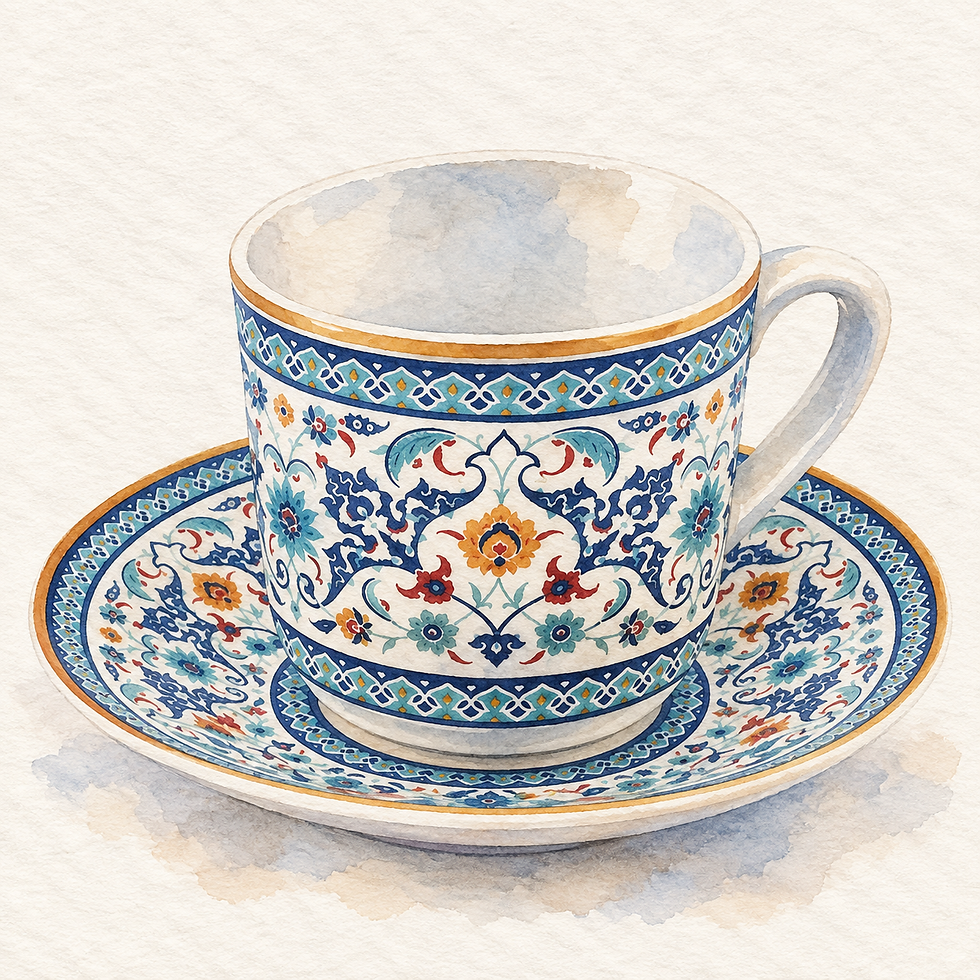
There is no single universal way people handle the foam or exact timing. Families and coffee drinkers have their own habits, and people can be surprisingly particular about them.
Stories Told Around the Coffeehouse
The coffeehouse was where the Ottoman city talked to itself out loud.
Meddahlar performed for audiences who listened closely and reacted as the story unfolded. They shifted between characters, voices, accents, and registers, and the audience was part of the performance. People laughed, interrupted, commented, and argued about what they had just heard.
Storytelling was one of the most common forms of entertainment in early modern Ottoman coffeehouses. By the late eighteenth and early nineteenth centuries, stories could also carry political associations, particularly among Janissary audiences.
Popular heroic stories such as the Hamzaname and tales of Ebu Müslim were performed for audiences who could identify strongly with their characters. Historian Avner Wishnitzer has shown how collective story listening could reinforce a shared Janissary identity during the politically turbulent decades around 1800.
Some surviving manuscripts preserve traces of the people who read and listened to these stories. Their pages contain comments and drawings, including human figures, weapons, and Janissary imagery.
The audience could become deeply involved. A storyteller could stop at a moment of suspense and leave the room discussing what might happen next. The story continued through the conversations around it.
This oral culture overlapped with news and politics. Stories, rumors, political discussion, handwritten texts, and ordinary conversation moved through the same coffeehouses.
The Fetva Wars
The legal debate around coffee was complicated from the start. Most scholars who addressed it called coffee mubah, permissible, though that conclusion took time and the discussion rarely stayed focused on the drink itself.
Ebussuud Efendi, şeyhülislam under Suleiman the Magnificent, issued fatwas against coffeehouses. His argument was about the beans: roasted black, they fell under the same legal category as charcoal, which was forbidden. Other scholars disagreed with this reasoning, but it gave enough legal cover for periodic bans. Coffeehouses closed. They reopened. This happened more than once. The bans kept not holding, and the underlying concern had less to do with theology anyway. Coffeehouses pulled men away from prayer, encouraged gambling and loose talk, and gave people somewhere to gather without oversight and say things about the state that the state did not want said.
The Şeyhülislam Who Wrote Sixty-Four Couplets About Coffee
Bostanzade Mehmed Efendi was born in Istanbul in 1536, from a scholarly family, and served as şeyhülislam under Murad III. At some point during this period he wrote a manzum fetva on coffee, a legal ruling in verse, sixty-four couplets.
Writing a fetva as poetry had precedent in Ottoman legal culture. Several şeyhülislams had done it. But Bostanzade's coffee fetva traveled unusually far. It got copied into poetry anthologies, passed around, and ended up in multiple manuscript versions that differ from each other because so many people recopied it by hand over the years. A text that keeps getting recopied is a text people wanted to keep. The coffee debate was serious enough for sixty-four couplets from the empire's chief religious authority, and apparently interesting enough that readers went on copying those couplets well after the specific legal argument had moved on.
The Devil's Drink, as Europe Called It
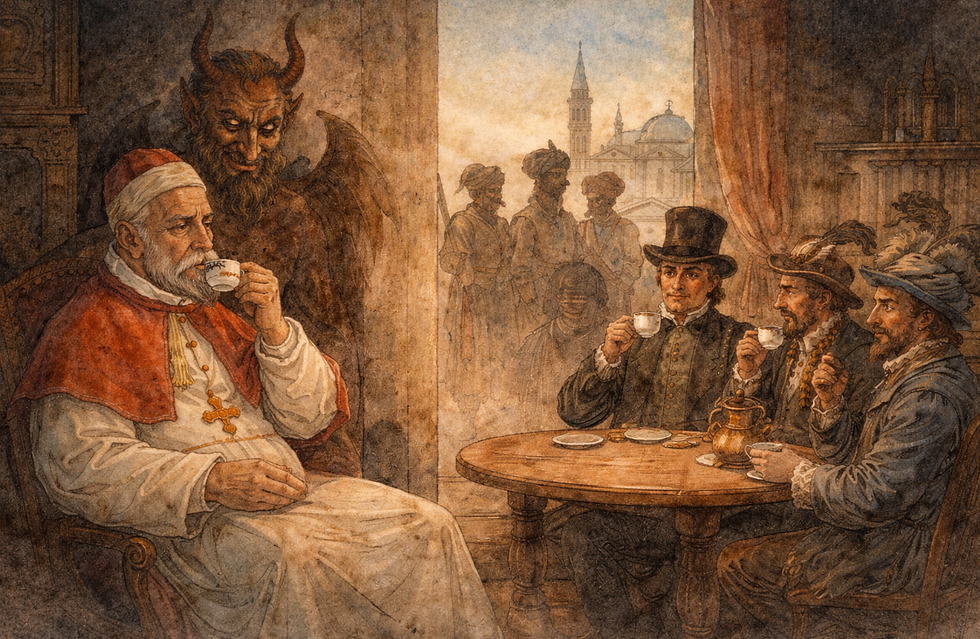
Coffee got to Europe through Venice in the early seventeenth century and spread further after the Ottoman siege of Vienna in 1683. It arrived carrying the suspicion that anything Ottoman-associated tended to carry at the time. The Church called it the Muslim drink, or in some accounts the devil's drink. Pope Clement VIII reportedly tasted it, approved it, and that was more or less the end of the theological objection on the European side.
European merchants and intellectuals then took up the coffeehouse model with very little changed from the Ottoman version. They did this quickly, given where the institution came from.
The Informers in the Corner
By the nineteenth century the state's approach had shifted. Historian Cengiz Kırlı's research shows the Ottoman government was stationing hafiyeler in coffeehouses to track public opinion. An informer in the corner, listening, reporting back. The kahvehane had become a place where opinion formed and the state wanted to know what that opinion was. People went to exchange news, argue about what was happening, say things they might not say in other company. The hafiye sitting there was the government's acknowledgment that conversations inside a coffeehouse had weight.
The Kıraathane and What Came After
Later Ottoman coffee culture also produced the kıraathane, a reading-oriented establishment whose name comes from kıraat, reading or recitation.
Newspapers, magazines, and books became increasingly important in these spaces during the nineteenth century. Older forms of oral exchange did not simply disappear. Print entered a social world already built around sharing information.
One person could read a newspaper and discuss it with everyone around him, turning printed news back into spoken news.
This became particularly significant as the Ottoman press expanded during the nineteenth century. Government newspapers and later privately produced newspapers circulated through urban spaces where reading could easily become a group activity.
Near Tahtakale, where Hakem and Şems first set up, you can still find a kahvehane where the tea comes in small glasses and the men at the tables seem to have been there for a while and are in no hurry to leave. The conversation moves slowly. It is not the same place, but some parts of the culture would still be recognizable to people who sat down over coffee centuries ago.
Vocabulary
kahvehane: coffeehouse; from kahve and hane, a house or place for coffee.
cezve: a small long-handled pot used to cook Turkish coffee.
fincan: a small cup used for Turkish coffee.
kahve tabağı: coffee saucer; the small plate under the cup.
pişirmek: to cook; the verb traditionally used for preparing Turkish coffee.
meddah: a storyteller who performed for live audiences, including in coffeehouses.
manzum fetva: a legal ruling written in verse.
mubah: permissible in Islamic law.
hafiye: informer or spy.
kıraathane: a reading-oriented coffeehouse associated particularly with newspapers, books, and conversation.
Add Learn Turkish with Seda as a Preferred Source on Google for more entries on Turkish language, history, and culture.
Frequently Asked Questions (FAQ)
Q: Was coffee ever officially banned in the Ottoman Empire?
A: Yes, several times. Coffeehouses were periodically closed by imperial order, most notably in the sixteenth century, and reopened each time. Enforcement was difficult, and the institution had spread too widely for any ban to hold.
Q: Why did religious scholars object to coffeehouses?
A: Mostly not because of coffee itself. Most scholars concluded coffee was legally permissible. The objections were about what happened inside: men skipping prayer, gambling, loose speech, and unsupervised gathering where political criticism circulated. Ebussuud Efendi's fatwa targeted the institution more than the drink.
Q: What is a cezve, and why does it matter in Turkish coffee culture?
A: A cezve is the small pot used to cook Turkish coffee. It matters because the drink is not filtered and is prepared slowly over heat, which shapes both the texture of the coffee and the language around it. Turkish uses the verb pişirmek, to cook, which places coffee close to everyday domestic life rather than mechanical preparation.
Q: Why is Turkish coffee served in such a small cup with a saucer?
A: The serving style is part of the tradition. The small cup slows the pace, and the saucer, or kahve tabağı, belongs to the presentation of the drink. Because the grounds remain in the cup, Turkish coffee is meant to be sipped carefully rather than consumed quickly.
Q: What is a kıraathane, and how is it different from a kahvehane?
A: The kıraathane was a reading house, a quieter version of the coffeehouse with newspapers and books rather than entertainment. The distinction was recognized in Ottoman sources and still shows up in how people in Türkiye today describe different kinds of public gathering places.
Sources and Further Reading
Avner Wishnitzer, "Rumour, Public Opinion and Print in Istanbul, 1780s–1830s," Past & Present, 2026.


Harika bir blog!
Reminds me how a small trick was used to make sure that the Catholic church does not ban chocolate for fasting periods, by providing the most bitter and awful version possible.
The history of Mehmet Efendi is great, did not know it!
Teşekkürler!
Çok ilginçti, paylaştığın için teşekkür ederim Seda abla!