What to Bring Home from Türkiye: Turkish Souvenirs, Food and Everyday Objects


For a reader in a hurry: People who spend time in Türkiye often go home with ordinary things they started using here: tea, coffee, soap, towels, kolonya, kuruyemiş, lokum, helva, a cezve or tea glasses. Turks living abroad often make the return journey with different luggage, including homemade salça, konserve, tarhana, dried foods and other things prepared by their families. Around these objects are Turkish words such as demli, hatır, bohça, ikram, sohbet, gurbet and nazar.
I have been teaching Turkish for many years now, to people from very different countries and backgrounds, and over that time I have been asked some wonderfully unexpected questions. Quite often they are about things that seem completely ordinary to me. Then someone asks about them, and I suddenly see something I have known all my life from an outsider’s point of view.
Street cats are a good example. Until students and people on social media started mentioning them to me, I had never really thought about the number of cats on our streets as something unusual. They were simply part of the city I knew. The same thing has happened with small habits at home, things we eat and drink, the way we welcome guests, and objects I had never thought needed an explanation.
I think this is one of the reasons I enjoy this work so much. Other people’s questions sometimes make familiar things look new to me as well. I answer some of those questions here on the website, and quite a few of my articles have grown out of conversations like these.
Today I wanted to do something a little different. Students who visit Türkiye sometimes ask me what they should take home with them. Of course, the answer changes enormously depending on where they visit, what they like, how much room they have in their suitcase and how much they want to spend. Still, there are certain things that come up again and again, so I thought I would gather some of them in one place.
Some are things you can eat or drink. Others belong in the kitchen or bathroom, or are simply objects people become fond of while they are here. Sometimes it is a peştamal that ends up in a bathroom somewhere else. For those who are learning Turkish from elsewhere and cannot visit Türkiye at the moment, I have also included a few places where some of these things can be found online.
Turkish people living abroad know another version of this suitcase. A visit to Türkiye can end with jars carefully packed between clothes because someone’s mother has made salça, reçel or konserve. There may be tarhana, dried peppers or eggplants, spices, nuts, tea or something from the family garden. What actually crosses the border depends on the destination country’s customs rules, but the packing itself is familiar.
Turkish Tea Culture: Çaydanlık and İnce Belli Glasses
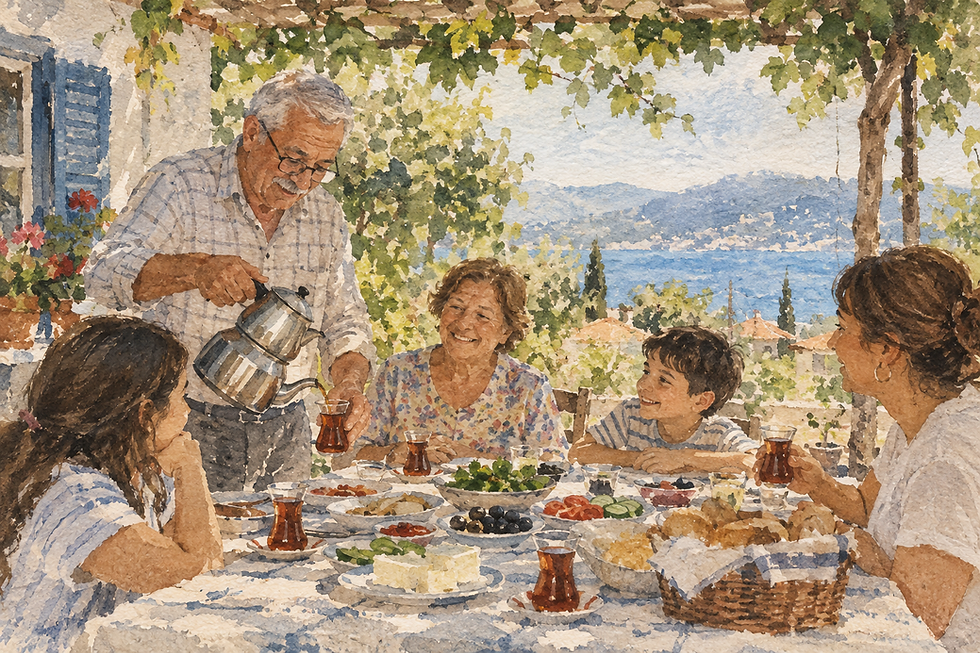
Tea appears almost everywhere in Türkiye: at breakfast, after a meal, during a visit, in offices and workshops, in shops and tea gardens, and on ferries crossing the Bosphorus.
Türkiye and Azerbaijan's shared tea culture was inscribed on UNESCO's Representative List of the Intangible Cultural Heritage of Humanity in 2022, with hospitality and social interaction at the center of the nomination.
At home, tea is commonly prepared in a çaydanlık, with strong tea brewing in the upper pot and hot water in the lower one. That makes it easy to prepare each glass differently. Someone might ask for their tea demli, strong and dark, or açık, with more hot water added.
The familiar narrow-waisted glass is an ince belli çay bardağı. Bel means “waist,” so ince belli literally describes the shape of the glass: “slender-waisted.”

İnce belli means slender-waisted, describing the glass most people picture when they think of Turkish tea.

A çaydanlık holds two stacked pots. Strong tea comes from the top, hot water from below, mixed to taste.

Most Turkish tea comes from Rize, on the Black Sea coast, known for its damp climate and hillside gardens.
Eventually, the tea glasses brought home from Türkiye find their way into the cupboard, and Çay koyayım mı? becomes part of another kitchen.
Around the Breakfast Table
A Turkish breakfast can spread across a table in small dishes: cheese, olives, tomatoes, cucumbers, eggs, honey, jam and bread, with the rest changing from household to household and region to region. Weekend breakfasts can remain on the table for a long time.
The word kahvaltı itself is commonly explained as developing from kahve altı, associated historically with eating before coffee. It is now so ordinary that the coffee hiding inside the word is easy to miss.
Small ceramic dishes belong naturally on this table. A bowl that looked decorative in a shop may later hold olives or reçel every morning.

Turkish Ceramic Bowls
Small painted bowls like these work easily into an everyday kitchen, for olives, jam, nuts, spices or small breakfast dishes. The patterns and colors vary, so a mixed set can feel quite natural on a Turkish breakfast table.
Sofra belongs to the same everyday vocabulary. Sofra kurmak means getting the table ready for a meal, while sofraya oturmak means sitting down to eat. The word can refer to the table or eating place itself, but it also carries the sense of the meal gathered around it.
For a food tour in Istanbul: Istanbul Taste of Two Continents Food Tour, Spice Market & Ferry
A Cezve, a Fincan and Hatır
Coffee was already part of Ottoman urban life centuries before black tea became the everyday drink it is in Türkiye today. Coffeehouses appeared in Istanbul in the sixteenth century and developed into places where people met, talked, listened and spent time. I wrote about that history separately in The Ottoman Coffeehouse Was Never Just About Coffee.
At home, coffee acquired other associations. It is served to guests, appears after meals and still has a place in some marriage customs. Turkish coffee culture and tradition was inscribed by UNESCO in 2013 including the preparation and the social customs that grew around it.
You need very little to make it: finely ground coffee, water and a cezve. It is served in a small fincan.
Then there is a sentence almost everyone in Türkiye knows: Bir fincan kahvenin kırk yıl hatırı vardır. A cup of coffee has forty years of hatır.
Hatır is one of those words that becomes less precise when pushed into a single English equivalent.
Hatır sormak means to ask after someone, while doing something hatır için means doing it out of regard for that person. In the coffee saying, hatır belongs to the relationship between the people who shared the coffee.
Turkish Coffee Essentials
A few essentials for making and serving Turkish coffee at home, from a traditional cezve to small fincan cups and Turkish coffee.

After the coffee is finished, the grounds may have another life. The cup is turned upside down onto its saucer and, once it has cooled, someone looks at the shapes left by the grounds. Kahve falı is still a familiar part of drinking coffee socially, and UNESCO includes coffee-fortune telling among the traditions associated with Turkish coffee.
Kolonya
Kolonya is an alcohol-based cologne, most traditionally scented with lemon. In Türkiye, the familiar bottles often say 80°, referring to their high alcohol content. It was already such an ordinary household product that during the COVID-19 pandemic, many people simply used the kolonya they already had at home for cleaning their hands.
Offering it to someone is part of everyday hospitality. A guest arrives, someone brings out the bottle, and you hold out your hands while a little kolonya is poured into your palms. In many homes this happens almost automatically, alongside offering tea, coffee or something to eat.
The word comes ultimately from eau de Cologne, although kolonya has had a long life of its own in Türkiye. You find it in homes, barbershops, restaurants, pharmacies and workplaces, and it is especially familiar during bayram visits. Lemon remains the classic scent, with many others now sold as well.
Kolonya tutmak is used for holding out the bottle and pouring it into someone's hands. Kolonya ikram etmek is to offer kolonya to someone, using the same ikram etmek heard when tea, coffee or food is offered to a guest.

Lemon Kolonya
A classic part of everyday hospitality in Türkiye. Lemon kolonya is traditionally poured into the hands during visits and is still found in many Turkish homes.
Soap, Peştamal and the Hamam Bohçası
A peştamal is the lightweight woven cloth traditionally associated with the hamam, while a kese is used for scrubbing the skin. Water is poured from the marble kurna with a hamam tası. Towels and combs belonged among the things someone might bring along too. The raised wooden nalın seen in museums today belong to the older material world of the hamam.
These things could travel together in a bohça, a cloth bundle once common in many parts of domestic life. A bride's çeyiz might include a carefully prepared hamam bohçası alongside the other textiles and belongings collected for marriage.
Going to the hamam could mean spending several hours with relatives, neighbors and friends. Women's hamams were places for bathing, conversation, eating and social occasions, and weddings had their own hamam customs.
The gelin hamamı was held shortly before a wedding. Historical accounts from Istanbul describe groups of women bathing and celebrating together, with food, şerbet, music and sometimes henna among the preparations. The details changed across periods and places.
Turkish Hamam Essentials
Peştamal, kese and olive oil soap are still among the most recognizable objects associated with the Turkish hamam.

Soap varies from region to region. Olive-oil soaps are common across Türkiye, while laurel soap is especially associated with Hatay and rose products with Isparta. Taken home, a peştamal, kese and a few bars of soap make a simple version of the old hamam bohçası.
Many historic hamams in Istanbul are still in use today.
For a hamam experience in Istanbul: Istanbul Ottoman Hamam Experience in the Old City
Tahin Helvası, Un Helvası and İrmik Helvası
Helva in Turkish can mean several quite different things. The one you are most likely to see packaged in a shop is tahin helvası, made mainly from tahini and sugar. It is firm and crumbly, usually cut into slices, and comes plain or with additions such as cocoa or pistachios.
Un helvası and irmik helvası belong in another part of the kitchen. Flour or semolina is browned slowly in fat before the other ingredients are added. Turkish uses kavurmak for this kind of cooking, and the verb has found its way into an expression with a much darker association: helvasını kavurmak.
In parts of Türkiye, un helvası is prepared and shared after a death and at later gatherings of remembrance. The expression helvasını kavurmak can therefore refer to someone's death without saying it directly. It is an old connection between a particular food, the act of preparing it and the language people use around death.
Helva had a place at rather livelier gatherings too. Ottoman helva sohbetleri were winter evenings of food and conversation, especially associated with accounts of elite life in eighteenth-century Istanbul. Poetry and music might be part of the evening, but the name itself is wonderfully ordinary: helva and sohbet. Sohbet etmek is still the everyday Turkish expression for sitting and talking with someone.
Lokum and İkram
A box of lokum is one of the easier things to carry home from Türkiye. Rose, pistachio, hazelnut and other varieties fill sweet-shop counters, while packaged boxes turn up everywhere from neighborhood shops to airport shelves. I wrote about its history separately in The Story of Lokum: From Ottoman Istanbul to Turkish Delight.
Turkish Lokum
Classic and flavored varieties of Turkish delight, including rose, pistachio and mixed boxes.

Lokum also belongs to the everyday language of ikram. When tea or coffee is brought to a guest, or a plate of lokum, nuts or fruit is put on the table, these can all be described as ikram. To offer them is ikram etmek.
An older Ramadan custom gives the idea of offering something to a guest an unusual name: diş kirası, literally “tooth rent.” In wealthy Ottoman households and palaces, guests could be given money or gifts after an iftar meal. Poorer guests were among those who might receive them.
The Blue Eye
The nazar boncuğu is easy to spot in Türkiye. It hangs beside front doors and from car mirrors, appears on jewelry and is often placed among a baby's belongings. In souvenir shops, the blue eye turns up on almost everything.
Nazar, however, is much older than the glass bead. Belief in the harmful effects of an envious or admiring gaze has existed across Anatolia and a much wider geography, and many different objects have been used as nazarlık. The blue glass bead familiar today also has a local craft tradition around İzmir. In Görece and Nazarköy, artisans still make the beads by hand in glass furnaces.
You will also hear nazar in ordinary conversation. Maşallah, nazar değmesin may follow a compliment about a baby, a new house or someone's good fortune. A nazar boncuğu may hang by the door in the same home without anyone spending much time discussing the belief itself.

Turkish Nazar Boncuğu
Blue glass nazar boncukları are found in Turkish homes, on jewelry and among everyday objects. I’ve collected a few examples here.
Rugs, Carpets and Kilims
A carpet takes more planning than a box of lokum or a bottle of kolonya, but halı and kilim still make their way home from carpet shops, bazaars and weaving towns across Türkiye. Smaller kilims and cushion covers are rather easier to fit into a suitcase.
Halı and kilim are not two names for the same thing. A halı has a knotted pile; a kilim is flat-woven. Both can be made from materials such as yün, wool, while finer pieces may also use ipek, silk. The work is done on a tezgâh, a loom, and dokumak is the Turkish verb for weaving.
Where a piece was made can be part of its identity. Hereke became known for the fine carpets produced there from the nineteenth century, including silk work associated with the Ottoman court. Uşak has an older wool-carpet tradition, while Bergama and Milas are also names you will encounter when looking at regional weaving in Türkiye. Techniques, materials and patterns differ considerably from one place to another.
For exploring Istanbul's Grand Bazaar: Shopping in the Grand Bazaar of Istanbul with a Local Friend
Copper and Çini
Bakır, copper, is still easy to come across in Turkish kitchens and bazaars, especially in cezve, bowls, trays and cooking pots. Older copper cookware was traditionally lined with kalay, tin, and periodically taken to a kalaycı to have the coating renewed. Kalaycı shops and traveling craftsmen were once much more familiar than they are today.
İznik and Kütahya are two of the names closely associated with Turkish ceramics. Çini usually refers to the glazed tiles seen on mosques, palaces and other historic buildings, although the same tradition also appears in decorative ceramic objects. Bowls, plates and tiles using these designs are still produced today, alongside newer interpretations.
Spices, Nuts and the Neighborhood Market
Spice shops are good places for the smaller things that disappear easily into a suitcase. Pul biber is used widely in Turkish cooking; isot, darker and associated especially with Şanlıurfa, has a more regional character. Sumak often turns up with onions and salads, while kuru nane, dried mint, goes into soups, yogurt dishes and sauces.
Then there is the kuruyemişçi, with jars and bins of nuts, seeds and dried fruit. Antep pistachios, Black Sea hazelnuts, dried Malatya apricots and leblebi, roasted chickpeas, are all familiar things to find there.
Turkish Spices & Pantry Staples
Pul biber, isot, sumac and dried mint are among the spices commonly found in Turkish kitchens. I’ve collected a few of them here, along with other Turkish pantry staples.

The Suitcase Going the Other Way
Turks living abroad often return from Türkiye with a different kind of luggage.
Homemade salça, reçel and konserve may be wrapped carefully between clothes, along with tarhana, dried peppers or eggplants, nuts, spices or something from the family garden. What can actually travel depends on the customs rules of the country they are returning to.
Gurbet is a familiar word in this context. It refers to living away from home or one's homeland, and it has a long history in Turkish songs, literature and everyday speech. I have written about the word separately in Untranslatable Turkish Words: Hüzün, Gurbet, and the Meaning Behind Them.
Once the suitcase is unpacked, the jars go into cupboards and the dried food into the kitchen. Eventually most of it is eaten. Then someone goes back to Türkiye and the same discussion begins again: how many jars there are, whether they will fit, and whether a mother really needed to make quite this much.
Vocabulary
çaydanlık – two-part pot used to brew Turkish tea
demli – strongly brewed, especially tea
sofra – a prepared eating place or the shared setting of a meal
cezve – small long-handled pot used to make Turkish coffee
hatır – regard, consideration or the memory of a kindness
kolonya – alcohol-based scented cologne commonly kept and offered in Turkish homes
bohça – cloth bundle used for wrapping belongings
peştamal – lightweight woven cloth associated with the hamam
çeyiz – belongings traditionally prepared for marriage
kavurmak – to roast or brown while cooking
ikram – something offered to a guest; the act of offering
nazar – the harmful or envious gaze, commonly associated with the evil eye
nazarlık – an object kept or worn for protection against nazar
kuruyemiş – nuts, seeds and dried fruits sold as snacks
gurbet – living away from home or one's homeland
Frequently Asked Questions (FAQ)
Q: What are useful things to bring home from Türkiye?
A: Tea glasses, a çaydanlık, cezve, coffee cups, peştamal, kese, soap, kolonya and small ceramics are all easy to keep using at home. Tea, coffee, lokum, tahin helvası and kuruyemiş travel well too, depending on the customs rules of the country you are entering.
Q: Why is kolonya offered in Türkiye?A: Offering kolonya is a familiar gesture of hospitality in Türkiye. A small amount is poured into the guest's hands, often when they arrive. It is especially common during home visits and bayram gatherings, and many Turkish households keep a bottle of lemon kolonya.
Q: Are tahin helvası and un helvası the same?
A: Tahin helvası is the firm, crumbly helva made mainly from tahini and sugar. Un helvası is made by slowly browning flour in fat before adding the other ingredients. İrmik helvası is prepared with semolina in a similar way.
Q: Is the nazar boncuğu mainly a souvenir?
A: Nazar boncukları are found far beyond souvenir shops. They hang in homes and cars, appear on jewelry and are often placed among a baby's belongings. The blue glass bead is connected with the much older belief in nazar, the harmful gaze.
Q: What was a gelin hamamı?
A: A gelin hamamı was a gathering held shortly before a wedding. Historical accounts from Ottoman Istanbul describe women gathering with the bride for bathing and celebration, sometimes with food, şerbet, music and henna. Customs varied by period and place.
Q: What do Turkish people living abroad take back from Türkiye?
A: Homemade salça, reçel, konserve and tarhana often find their way into suitcases, along with dried vegetables, spices, nuts and food from the family garden. What can be carried across the border depends on the destination country's import rules.
Sources
Turkish coffee culture and tradition, UNESCO Intangible Cultural Heritage
Traditional craftsmanship of Çini-making, UNESCO Intangible Cultural Heritage
Batılı Seyyahlar Gözünden Osmanlı'da Hamam Kültürü ve Kadın Hamamları, DergiPark
Nazar Boncuğu: From Art Glass to Folkloric Object, DergiPark
Çalış Minkan, F. (2025). "Geçiş Ritüellerinin Kültürel Kodları: Yiyeceklerle İlgili Atasözleri ve Deyimler." Ankara Anadolu ve Rumeli Araştırmaları Dergisi, 6(2), 369–390. DergiPark
Some Amazon and Viator links are affiliate links, which may earn me a commission at no additional cost to you.


This post is fascinating and it is refreshing to read that there are other options I did not even consider during my voyages to Turkey. Some of the items such as tea and lokum I most definetly returned with. In my research and during my first trip to Turkey, I noticed that at many currency exchange (Dovis) they also sold gold and silver bullion. Since, I collect coins I decided how much these items cost based on my allowance or budget ("bu ne kadar?"). Next, I would be given a price and asked how much in dollars and with a calculator I would be given a price. The variety of Turkish gold and silver jewelry is absolutely astounding! The craftsmanship…