Hürrem Sultan: When a Slave Became Structure

Updated: Sep 14

For readers in a hurry: Hürrem Sultan entered the Ottoman palace as an enslaved young woman from the Ruthenian lands north of the Black Sea. During the reign of Sultan Süleyman, she became his legal wife and Haseki Sultan, received an extraordinary income, wrote to him during his military campaigns and later corresponded with the king of Poland under her own seal. Her position also took physical form in Istanbul and Jerusalem, where foundations carrying her name supported public institutions. Her role in the struggle over the Ottoman succession, especially the execution of Şehzade Mustafa, remains harder to judge. The surviving evidence places her close to that conflict, while Süleyman made the final decision to execute his son. Letters and financial records bring us closer to the historical Hürrem, while the buildings carrying her name remain part of the cities where she once lived and worked.
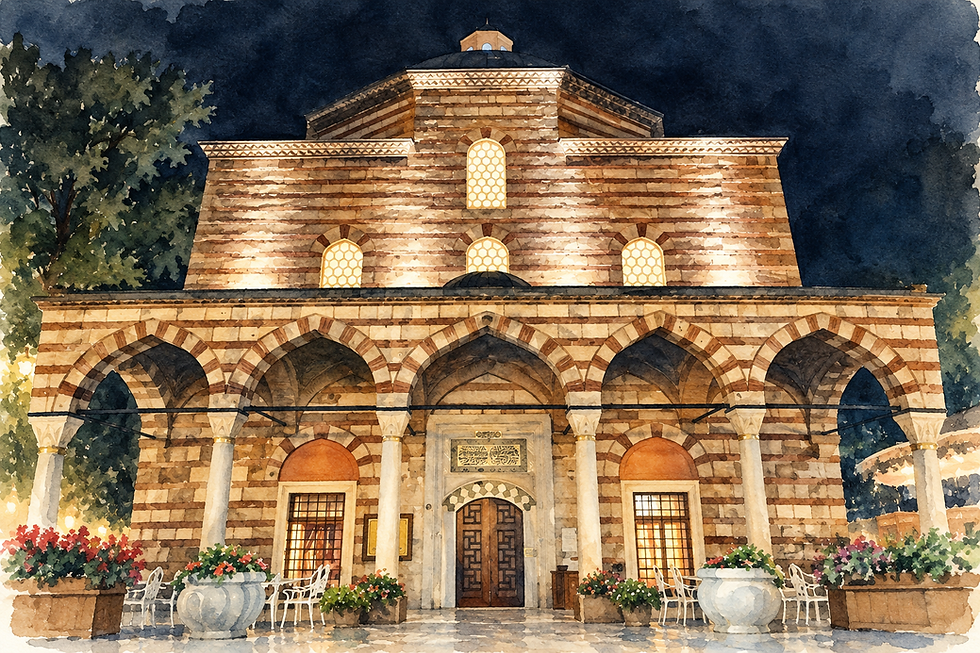
The courtyard between Ayasofya and Sultanahmet is rarely quiet. People cross the square between the mosques, stop for photographs and disappear into the streets around the old city. Between these famous monuments stands a long Ottoman bathhouse carrying another name: Hürrem Sultan Hamamı.
Mimar Sinan designed the hamam in the sixteenth century, close to the old Hippodrome and Hagia Sophia. Many visitors recognize Hürrem's name before they know anything about the building. For millions of people around the world, their first encounter with her came through Muhteşem Yüzyıl, or Magnificent Century.
If you came to Hürrem through the series, you probably remember the parts of her story that make good television. Her relationship with Süleyman runs through the series, while her rivalry with Mahidevran grows around the uncertain future of their children. Şehzade Mustafa's death eventually becomes one of the darkest moments in the story.
The historical record keeps some of these people and events, although it rarely gives them the clean beginning and ending that television can. Hürrem left no memoir.
Ottoman chroniclers wrote about the dynasty from their own positions, while
European ambassadors collected information from a palace whose private rooms they could not freely enter.
Other kinds of evidence have survived. Hürrem's letters still exist alongside financial records and foreign correspondence. The legal documents behind her charitable foundations also survive, and some of the buildings she commissioned still stand.
The hamam between Ayasofya and Sultanahmet is a good place to begin following them. Its location connects a woman who arrived in Istanbul as a captive with one of the most visible parts of the old imperial capital.
Before Hürrem
Hürrem was probably born in the Ruthenian lands north of the Black Sea, in territory then connected to the Kingdom of Poland and now within Ukraine. European writers later called her Roxelana or Roxolana, names connected with that Ruthenian origin.
Her original name is uncertain. Alexandra and Anastasia appear often in modern accounts, yet neither can be securely established from contemporary Ottoman evidence.
While she was still young, Hürrem was captured and entered the slave networks that connected the Black Sea region with the Ottoman world. The Crimean Khanate played a large role in this trade, and captives from Eastern Europe could eventually reach Ottoman cities and elite households.
Hürrem's journey brought her to the imperial household in Istanbul. There she received the name by which history remembers her. Hürrem is Persian in origin and carries associations with cheerfulness and joy.
Ottoman elite households commonly gave new names to enslaved women who entered them. The name on Hürrem's later mosques and foundations therefore came from the life she entered after her capture.
Very little can be said securely about her first years in the palace. Stories about exactly how she first attracted Süleyman's attention grew later around a relationship that soon became famous. By the 1520s, however, Hürrem was already taking a path very different from the usual one followed by a prince's mother.
The Palace System Hürrem Entered
Ottoman royal family life had developed around a dangerous question: which son would become the next sultan?
There was no simple rule that automatically gave the throne to the eldest son. Princes governed provinces as they grew older and built their own households. Their success could make them serious candidates for the throne, so the death of a sultan could begin a dangerous competition among his surviving sons.
By Hürrem's time, Ottoman dynastic practice usually linked a concubine's future to one prince. Once she had given the sultan a son, her life increasingly centered on that child's household and future. When the prince became old enough to govern a province, his mother normally went with him.
A prince's mother could hold considerable authority within his household. She helped manage the world around him while he learned to govern, and his success could eventually bring her back to Istanbul in a much higher position.
Hürrem's family developed differently. She had several children with Süleyman, including more than one son, and she continued to remain close to him. Their children included Mehmed, Mihrimah, Abdullah, Selim, Bayezid and Cihangir, although Abdullah died in childhood.
Her future was therefore connected with several possible heirs while her relationship with the reigning sultan continued. This was an unusual position for a woman in the Ottoman dynasty of that period.
The physical life of the royal family was changing during the same decades. The dynasty's women had long been closely associated with the Old Palace, or Eski Saray, while Topkapı Palace was the main residence of the sultan and a center of imperial government.
A major fire damaged the Old Palace in 1541. Later Ottoman tradition connected the fire with the movement of the imperial harem into Topkapı, although the change happened over a longer period. Records refer to spaces for women inside Topkapı before 1541, and the royal family's presence there expanded gradually.
Hürrem spent much of her adult life inside this changing palace world. The imperial family was becoming more present in the same palace where Süleyman received officials and governed.
Marriage and the Haseki Sultan
Sometime in the 1530s, Süleyman formally married Hürrem. The exact date remains uncertain, although contemporary observers recognized the marriage as unusual.
Ottoman sultans of this period generally had children with enslaved concubines and did not marry them. Islamic law did not permit a man to marry a woman while she remained his own slave, so Hürrem's marriage required her manumission first. By the time of the marriage, the woman who had entered the imperial household as a captive was legally free.
The palace also had a title for the unusual place she now occupied: Haseki Sultan.
Hürrem was the first woman whose position gave the title such importance within the Ottoman dynasty. Later sultans would also use it for their principal consorts.
Money offers a more concrete measure of her rank. Historian Leslie Peirce found that toward the end of Hürrem's career she received a daily stipend of 2,000 akçe.
The amount was extraordinary inside the imperial household. Peirce notes that after Hürrem's death, a stipend that high was given only to the valide sultan, the mother of the reigning ruler.
Hürrem herself never became a valide sultan. She died in 1558, eight years before her son Selim became Sultan Selim II.
A palace title can sound abstract after five centuries, while the financial record is remarkably precise. A daily payment of 2,000 akçe placed Hürrem very high in the financial hierarchy of the imperial household while Süleyman was still alive.
Hürrem in Her Own Letters
Some of the closest traces of Hürrem survive in letters sent to Süleyman while he was away from Istanbul.
Military campaigns could keep the sultan away from the capital for months. Hürrem wrote during these separations, and several of her letters survive in the Topkapı Palace archive. M. Çağatay Uluçay later published this correspondence in his work on letters from the Ottoman dynasty.
Her language is often intensely affectionate. She addresses Süleyman as canım pâresi sultanım, using an older form of can paresi. The expression carries the idea of someone being a piece of one's soul or life and still survives in Turkish in affectionate and literary language.
She also uses names that belonged to the shared literary culture of the Ottoman court.
In one letter she describes herself through Ferhad and Mecnun, two lovers whose suffering had been told for centuries across Persian and Turkish literature.
Mecnun had become mad through his love for Leyla. Ferhad belonged to the story of Ferhad and Şirin. Their names could carry an entire idea of painful separation for an Ottoman reader who already knew their stories.
The same letters can suddenly become very domestic. In one, Hürrem tells Süleyman what happened when a letter from him was read aloud. Mehmed and Mihrimah began to cry because they missed their father, and Hürrem writes about her own distress as she watched them.
For a few lines, the famous names belong to a household separated by a long military campaign. Mehmed and Mihrimah are children missing their father, while Hürrem is writing back to a husband who is far from Istanbul.
Her letters also carried news from the capital. During one campaign she wrote about an epidemic in Istanbul. In another letter she complained about the lack of reliable news from the army because rumors were spreading in the city.
She even tells Süleyman that people in Istanbul are asking for information because news has not arrived. Hürrem lived inside the imperial household and could write directly to a ruler who might be hundreds of kilometers away.
Her language has another history inside it because Turkish was not Hürrem's first language. Uluçay believed that some of her earlier letters were dictated to a scribe while her Turkish was still limited.
Palace correspondence could also pass through scribes who helped shape its written form. Hürrem had arrived in the Ottoman world from another linguistic environment, yet years later Turkish carried her family news and expressions of longing across the empire.
Süleyman as Muhibbî
Süleyman also wrote extensively. His chosen poetic name was Muhibbî, derived from an Arabic root associated with love.
A large body of his poetry survives. Love and separation appear throughout it, expressed through the shared vocabulary of Ottoman divan poetry. Christiane Czygan has studied this poetry beside Hürrem's letters and has also examined Hürrem's surviving correspondence in detail.
Ottoman love poetry did not work like a private diary. The lover and beloved belonged to a literary tradition with its own images and conventions, so the person behind an individual poem is often difficult to identify. Some poems have long been associated with Hürrem, while their language also belongs to the wider poetic world in which Süleyman wrote.
Hürrem's letters are different in form because they were sent to a named person during real periods of separation. Yet both belonged to a court where references to figures such as Ferhad and Mecnun were immediately understood by educated readers.
The relationship between Hürrem and Süleyman therefore survives in two very different kinds of language. Her letters come out of daily separation and family life, while Muhibbî's poetry belongs to a literary tradition that Süleyman practiced throughout his reign.
Roxelana in European Reports
Hürrem's rise attracted intense attention outside the Ottoman court.
European diplomats called her Roxelana and tried to explain the unusual position she had acquired beside Süleyman. Their reports became some of the most detailed contemporary accounts connected with her, although the imperial harem was a part of the palace these men could not freely enter.
Information reached them through officials and other contacts around the court. Rumor travelled through the same networks.
Stories of magic became especially persistent. European accounts claimed in different ways that Hürrem had bewitched Süleyman or used charms to hold his affection.
The rumors grew around a visible fact. Süleyman's relationship with Hürrem lasted for decades and eventually became a legal marriage. Foreign observers knew the result, while the private relationship between the couple remained beyond their direct observation.
European diplomatic reports therefore sit beside very different kinds of evidence.
Financial records contain Hürrem's salary, while her own messages survive in correspondence. Her public foundations left another record in legal documents and buildings.
The woman who emerges from those records is often quieter than the Roxelana of European rumor. Her historical life is found less in stories of enchantment and more in the ordinary paperwork of a very unusual position.
Letters Travelling North
Hürrem's correspondence eventually reached far beyond Süleyman.
Between 1976 and 1978, Turkish diplomat Nejat R. Uçtum served at the Turkish Embassy in Warsaw. During those years, he researched Ottoman documents in Polish collections and found four original letters in the AGAD archive: two from Hürrem and two from her daughter Mihrimah to King Sigismund II Augustus.
Uçtum later published the documents and reproductions in Belleten. Hürrem's letters carry her seal, and their contents allow the route of the correspondence to be followed quite closely.
The Polish king writes to Hürrem, and Hürrem reports his words to Süleyman. She then writes back with Süleyman's response.
One popular version of this story says Hürrem addressed Sigismund as kardeşim, "my brother," using the language of equality between rulers. Uçtum checked the surviving letters in the Polish archive and specifically rejected that claim.
Hürrem addresses Sigismund as Kıral Hazretleri (Kral Hazretleri in modern Turkish spelling). The comparison with brothers comes from Süleyman. Hürrem reports him remembering the previous Polish king by saying that the old king and he had been "like two brothers." Süleyman then hopes to have a relationship with the new king like that of father and son.
Hürrem also sent gifts with her reply. The list survives inside the letter itself: two sets of underclothes with shirts and waist ties, six handkerchiefs, and one towel for the hands and face.
She apologizes because the gifts are not good enough for the king and says that future ones will be prepared deliberately for him. Such objects could travel with diplomatic correspondence and become part of the personal exchanges connecting royal courts.
The direction of the correspondence carries its own history. Hürrem had been brought south from the Ruthenian lands as a captive. Decades later, letters carrying her seal were travelling north to the king of Poland.
Şehzade Mustafa and the Succession
Anyone who comes to Hürrem through Muhteşem Yüzyıl already knows the name Şehzade Mustafa.
Mustafa was Süleyman's eldest surviving son and the son of Mahidevran. He became an experienced prince and developed a strong following, especially among soldiers.
The Ottoman throne did not pass automatically to the eldest son. Several princes could remain possible successors, and each built his own reputation while governing a province. As Süleyman grew older, the future of the throne became a question that affected the present.
Hürrem had clear reasons to fear Mustafa's possible accession. Her own sons were also candidates for the throne, and Ottoman succession struggles could end violently for the brothers of the new sultan.
Her son-in-law Rüstem Paşa also stood close to the conflict. He was grand vizier and was married to Hürrem and Süleyman's daughter Mihrimah.
In 1553, during Süleyman's campaign in the east, Mustafa came to his father's camp. He was executed there on Süleyman's order.
Hürrem and Rüstem have been blamed for his death for centuries. Their interests in the succession were real, and contemporary reports connected them with the struggle around Mustafa.
Historian Zahit Atçıl has returned to the episode using Ottoman sources alongside European and Persian evidence. He argues that Mustafa had become so popular that Süleyman was beginning to lose authority to his own son while he was still on the throne.
The crisis therefore involved Süleyman's present authority as well as the future succession. Mustafa had supporters who could imagine him as the next ruler, while Süleyman was still very much the ruling sultan.
Hürrem's sons had their futures tied to the outcome, and Rüstem's political position placed him inside the same struggle. Süleyman faced a prince whose popularity had become politically dangerous.
Süleyman gave the order that ended Mustafa's life. The surviving sources preserve interests and accusations from several sides, while many private conversations remain beyond our reach. Hürrem's exact role in the final decision is still debated.
The succession continued to shape her family after Mustafa's death. Mehmed had already died in 1543, and Cihangir died in 1553. Hürrem herself died in 1558, before the rivalry between Selim and Bayezid reached its final stage.
Bayezid eventually fled to Safavid Iran and was executed in 1561. Selim became Sultan Selim II in 1566.
Hürrem spent much of her adult life surrounded by the uncertainty of Ottoman succession. She died eight years before one of her sons finally took the throne.
Haseki on the Map of Istanbul
Hürrem's name became part of Istanbul while she was still alive.
The clearest example is the Haseki Külliyesi, built in the district then known as Avratpazarı. From the nineteenth century onward, the area itself became known as Haseki.
The complex was designed by Mimar Sinan. According to the TDV İslâm Ansiklopedisi, it was his first work after becoming chief imperial architect.
The complex included a mosque and later expanded with buildings for education and public services. They were constructed over many years rather than as a single project.
The mosque was built in 1538–39. The madrasa and primary school followed a year later, while the imaret and hospital were built twelve years after the mosque.
What now appears under one name therefore developed across different stages of Hürrem's life. People used these buildings for ordinary needs, with students attending the school and food being prepared in the imaret.
Patients came to the hospital, while staff needed regular salaries. The buildings themselves also needed money for maintenance. A vakıf, an endowment supported by dedicated sources of income, financed this continuing work.
Jerusalem and the Vakıf
Hürrem created foundations in several parts of the empire. Her Jerusalem foundation is especially well documented.
The complex included a mosque and madrasa, together with an imaret. The public kitchen became one of the best-known parts of the foundation, and historian Amy Singer has studied its operation in detail.
Singer follows the imaret beyond the meals served inside the building. Grain and other supplies had to reach the kitchen, while workers needed to be paid. Income from properties assigned to the foundation financed these continuing expenses.
The institution therefore belonged to the economy around it. Farmers and merchants could become connected to the kitchen through the movement of food and money.
Paid employees depended on the foundation for work, while people arriving for meals depended on its continuing operation.
Hürrem's Jerusalem vakfiye, the legal document governing the endowment, survives in the Museum of Turkish and Islamic Arts in Istanbul. It dates from 1556–57 and consists of forty-nine pages written in Arabic on carefully prepared paper.
Süleyman's tuğra appears at the beginning. Hürrem's seal and the signatures of witnesses appear near the end.
The document describes expenses for the buildings and salaries for employees. It also records commercial properties and mills from Hürrem's holdings that were assigned to produce revenue for the endowment.
The income had already been organized so that the kitchen could continue after Hürrem's death. A visitor today can admire a mosque or hamam without seeing the paperwork behind it, yet an Ottoman foundation depended on this financial organization for its future.
Back to the Hamam
Hürrem died in Istanbul in 1558 and was buried at the Süleymaniye complex. Her türbe stands there today, close to Süleyman's later tomb.
By the end of her life, her name had become attached to places far beyond the rooms where her story began. Istanbul had the Haseki complex and the large double hamam near Ayasofya. Jerusalem had a foundation supported by income-producing properties and governed through a detailed legal document.
The surviving record becomes richer as her life progresses. Her earliest years remain uncertain, including the name she carried before captivity. Later, financial accounts record the 2,000 akçe stipend attached to her position, while her correspondence preserves words sent across long distances.
A letter to Süleyman brings Mehmed and Mihrimah into the room as children missing their father. Another group of documents follows Hürrem's seal all the way to Poland. In Jerusalem, forty-nine pages explain how property and money should keep a foundation working after its founder had died.
The title When a Slave Became Structure comes from this part of her life. Hürrem arrived in the Ottoman imperial household as an enslaved young woman. Over the following decades, her place in that world acquired a title and a large income. Her name then became attached to foundations with their own buildings and legal arrangements.
The famous questions around her have survived as well. People still argue over her relationship with Süleyman and her part in Mustafa's death. Muhteşem Yüzyıl has added another Hürrem to the many versions created since the sixteenth century.
The physical traces are still easy to encounter in Istanbul. Walk between Ayasofya and Sultanahmet and her name is there on the hamam almost five hundred years after her death. A few kilometers away, an entire neighborhood still carries the name Haseki.
Visit Hürrem Sultan Hamamı in Istanbul
The sixteenth-century Hürrem Sultan Hamamı still operates beside Hagia Sophia today. If you're visiting Istanbul, you can book a traditional hammam treatment inside the historic building designed by Mimar Sinan.
If you'd like to read more about Hürrem Sultan, Leslie Peirce's Empress of the East is the most accessible full biography in English, and her earlier academic study The Imperial Harem places Hürrem within the wider history of Ottoman royal women. For a fuller account of Süleyman's reign, André Clot's Suleiman the Magnificent situates Hürrem's story within the wider history of his rule.
The Turkish Around Hürrem’s Story
Hürrem’s story brings together words that still appear in Turkish today. Some belong to Ottoman court life, while others can be found in the names of places and institutions across Istanbul. They existed before Hürrem, but her life offers a historical setting in which their meanings become much more concrete.
Haseki, for example, was already a word before it became closely associated with Hürrem’s position at court. Today, Haseki is also the name of an Istanbul neighborhood, which later took the same name as the külliye she commissioned there.
Kanuni, meanwhile, is the name Turkish speakers commonly use for Sultan Süleyman, while many English-speaking readers first know him as Suleiman the Magnificent.
The foundations connected with Hürrem bring another group of older words into the story. A vakıf is an endowment, and a vakfiye is the legal document that sets out how such an endowment should operate. An imaret prepared and distributed food, while a külliye brought several institutions together around a religious complex. None of these began with Hürrem. They were already part of the Ottoman world in which she lived.
Her letters lead into a different area of Turkish. Can paresi still sounds affectionate today, although the form and language of Hürrem’s correspondence belong to an older literary world. Ferhad and Mecnun were also familiar figures long before her lifetime, and their names remained part of Turkish cultural language for centuries afterward.
Hürrem herself entered this linguistic world as an outsider. Turkish was one of the languages she acquired after arriving in the Ottoman Empire. Her earliest surviving correspondence may have depended heavily on scribes, but Turkish eventually became one of the languages she used to communicate across the distance between Istanbul and Süleyman’s campaigns.
For someone learning Turkish today, these words may first appear simply as vocabulary. In Istanbul, the same words can lead into neighborhood names and historical buildings, and from there into stories that began centuries before modern Turkish took its present form.
Vocabulary
Hürrem – A name of Persian origin associated with cheerfulness and joy. It became the Ottoman name by which Hürrem Sultan was known.
Kanuni – "The Lawgiver." Turkish historical memory usually refers to Sultan Süleyman as Kanuni Sultan Süleyman, while European history commonly calls him Suleiman the Magnificent.
cariye – An enslaved woman or concubine. In Ottoman palace history, the word belongs to a specific system of slavery and household organization.
haseki – A title associated with the sultan's principal consort. Hürrem's position gave the title exceptional importance during Süleyman's reign.
valide sultan – The mother of the reigning sultan. Hürrem never became valide sultan because she died before Selim II took the throne.
şehzade – An Ottoman prince who could become a future claimant to the throne.
akçe – A silver Ottoman coin used in salaries and accounts. Hürrem's stipend of 2,000 akçe a day places her very high within the financial hierarchy of the palace.
can paresi – An affectionate expression built around the idea of someone being a piece of one's soul or life. An older form appears in Hürrem's correspondence with Süleyman.
Muhibbî – The poetic pen name used by Sultan Süleyman. The name is connected with an Arabic root associated with love.
vakıf – An endowment supported by dedicated property and income, usually established for a religious or charitable purpose.
vakfiye – The legal document establishing a vakıf and setting out how it should operate.
imaret – An institution that prepared and distributed food, often within a larger Ottoman complex.
külliye – A group of related buildings organized around a mosque, often including schools or other public institutions.
türbe – A monumental tomb or mausoleum. Hürrem's türbe stands within the Süleymaniye complex in Istanbul.
Add Learn Turkish with Seda as a Preferred Source on Google for more entries on Turkish language, history, and culture.
Frequently Asked Questions (FAQ)
Q: Who was Hürrem Sultan?
A: Hürrem Sultan was the legal wife of Sultan Süleyman I and Haseki Sultan during much of his reign. She entered the Ottoman imperial household as an enslaved young woman from the Ruthenian lands and died in Istanbul in 1558.
Q: Was Hürrem Sultan Ukrainian?
A: Hürrem came from the Ruthenian lands north of the Black Sea, probably from territory that is now in western Ukraine and was then connected to the Kingdom of Poland. "Ruthenian" describes her historical setting more precisely than a modern national label.
Q: Was her real name Alexandra or Anastasia?
A: Her original name is uncertain. Alexandra and Anastasia appear in later traditions, but contemporary Ottoman evidence does not securely establish either name.
Q: What does Hürrem mean?
A: The name is Persian in origin and is associated with joy and cheerfulness. Hürrem used this name in the Ottoman world, and it later appeared on her foundations.
Q: Did Sultan Süleyman really marry Hürrem?
A: Yes. Their legal marriage is historically documented, although its exact date remains uncertain. Hürrem had entered the palace as an enslaved woman and was manumitted before the marriage.
Q: Are Hürrem's letters to Süleyman real?
A: Yes. Several letters from Hürrem to Süleyman survive in the Topkapı Palace archive. They contain affectionate language as well as family news and reports from Istanbul during periods when Süleyman was away on campaign.
Q: Did Hürrem write her letters herself?
A: Some of the correspondence probably passed through palace scribes. M. Çağatay Uluçay believed that scribal help was especially important in Hürrem's earlier letters, when her Turkish was still developing.
Q: Did Süleyman write love poems about Hürrem?
A: Süleyman wrote a large body of poetry under the name Muhibbî, including love poetry. Some poems have traditionally been associated with Hürrem. Ottoman divan poetry used a shared literary language, so the beloved in an individual poem is not always identified by name.
Q: Did Hürrem write to the king of Poland?
A: Yes. Nejat R. Uçtum found two original letters from Hürrem to King Sigismund II Augustus in the Polish Central Archives of Historical Records in Warsaw. He also found two letters from Mihrimah Sultan to the king.
Q: Did Hürrem call the Polish king kardeşim, "my brother"?
A: Uçtum specifically checked this claim and found no such address in the surviving Polish documents. Hürrem addresses Sigismund as Kıral Hazretleri (Kral Hazretleri in modern Turkish spelling). The comparison with brothers appears when Hürrem reports Süleyman speaking about his relationship with Sigismund's father.
Q: Did Hürrem Sultan have Şehzade Mustafa killed?
A: Hürrem had clear reasons to fear Mustafa's possible accession because her sons were also candidates for the throne. Contemporary accounts connect her and Rüstem Paşa with the struggle around Mustafa, but historians continue to debate the extent of her role. Zahit Atçıl places Mustafa's execution within a wider crisis in which the prince's popularity had begun to challenge Süleyman's own authority. Süleyman ordered Mustafa's execution in 1553.
Q: Did Hürrem become Valide Sultan?
A: No. Hürrem died in 1558. Her son Selim II became sultan in 1566, so she died eight years before she could have become the mother of a reigning sultan.
Q: What did Hürrem Sultan build?
A: Her major projects included the Haseki Külliyesi in Istanbul and a large foundation in Jerusalem. She also commissioned the Hürrem Sultan Hamamı near Hagia Sophia.
Q: Where is Hürrem Sultan buried?
A: Hürrem is buried in her türbe within the Süleymaniye Mosque complex in Istanbul, close to the later tomb of Sultan Süleyman.
Sources and Further Reading
Leslie P. Peirce, The Imperial Harem: Women and Sovereignty in the Ottoman Empire. Oxford University Press, 1993. A major study of Ottoman dynastic family structure, the imperial harem and the position of royal women.
Leslie P. Peirce, Empress of the East: How a European Slave Girl Became Queen of the Ottoman Empire. Basic Books, 2017. A detailed modern biography of Hürrem Sultan.
M. Çağatay Uluçay, Osmanlı Sultanlarına Aşk Mektupları. Uluçay published correspondence from the Topkapı Palace Museum Archive, including Hürrem's letters to Süleyman.
Nejat R. Uçtum, "Hürrem ve Mihrümah Sultanların Polonya Kıralı II. Zigsmund'a Yazdıkları Mektuplar." Belleten, vol. 44, no. 176, 1980, pp. 697–716.https://belleten.gov.tr/tam-metin/1639/tur
Zahit Atçıl, "Why Did Süleyman the Magnificent Execute His Son Şehzade Mustafa in 1553?" Osmanlı Araştırmaları / The Journal of Ottoman Studies, vol. 48, no. 48, 2016, pp. 67–103. DOI: 10.18589/oa.586488.https://dergipark.org.tr/tr/pub/oa/article/586488
Christiane Czygan, "From Slave to Queen: Hurrem Sultan's Agenda in Her Narration of Love (1526–1548)," in Naming, Defining, Phrasing Strong Asymmetrical Dependencies. De Gruyter, 2023.https://doi.org/10.1515/9783111210544-009
Amy Singer, Constructing Ottoman Beneficence: An Imperial Soup Kitchen in Jerusalem. State University of New York Press, 2002. A detailed study of Hürrem's Jerusalem imaret and the economic system supporting it.
Sema Doğan, "Haseki Külliyesi," TDV İslâm Ansiklopedisi.https://islamansiklopedisi.org.tr/haseki-kulliyesi
"Harem," TDV İslâm Ansiklopedisi.https://islamansiklopedisi.org.tr/harem
Endowment Charter (Waqfiyya) of Haseki Hürrem Sultan, Museum of Turkish and Islamic Arts, inventory no. 2192, AH 964 / 1556–57.https://islamicart.museumwnf.org/database_item.php?id=object;ISL;tr;Mus01;38;en
Affiliate disclosure: This article contains affiliate links. If you make a purchase or booking through one of these links, I may earn a commission at no extra cost to you.


Comments