Active, Passive, and Causative in Turkish: How One Verb Becomes Three Sentences

When you reach intermediate Turkish, one question starts appearing everywhere: who actually did this?
Turkish has a grammatical answer built directly into the verb. The same root word can tell you that someone did the action themselves, that the action happened with no one named, or that someone arranged for another person to do it. These three possibilities are called etken (active), edilgen (passive), and ettirgen (causative), and they are one of the most satisfying things to learn in Turkish because once the logic clicks, you start reading sentences very differently.
The question behind all three: Bu işi kim yaptı?
Before looking at suffixes, it helps to feel what each structure is actually doing.
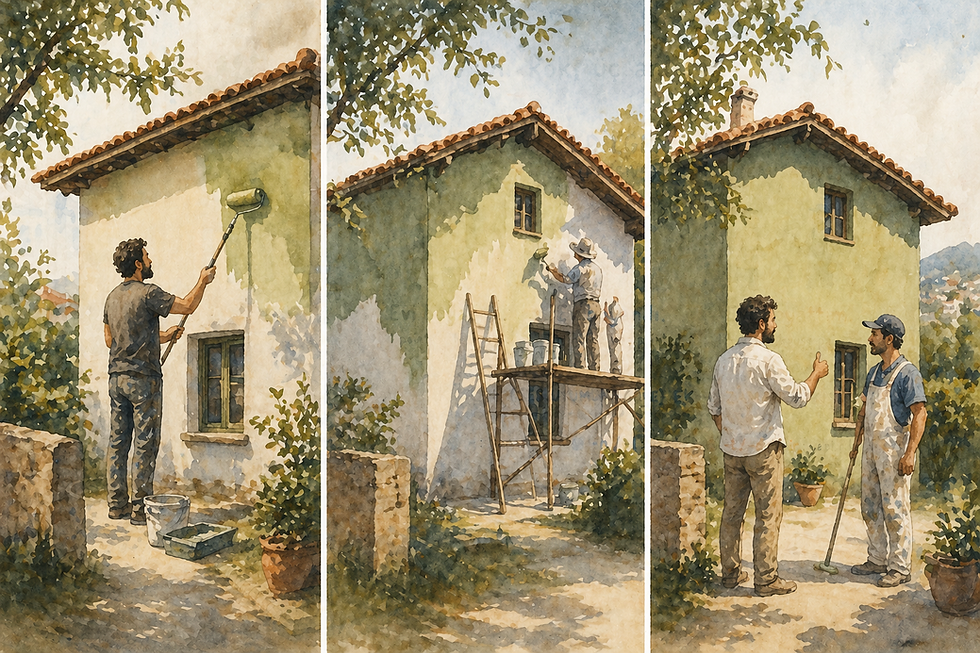
Imagine a freshly painted house. Three people are describing what happened.
The person who painted it themselves says: Evi boyadım. I painted the house.
The neighbor who just noticed it says: Ev boyandı. The house was painted. No idea who did it, or it does not matter.
The owner who hired someone says: Evi boyattım. I had the house painted.
The verb root boya- is in every sentence. What changes is the suffix that follows it. That small addition shifts the entire meaning.
And here is the important thing: this is not only a past tense phenomenon. Active, passive, and causative work across all tenses. The voice suffix always sits in the same place, right after the verb root, before anything else.
Where the suffixes sit
The order in a Turkish verb never changes:
Verb root → Voice suffix → Tense suffix → Person suffix
In the active, there is no voice suffix. The tense comes directly after the root. In the passive and causative, the voice suffix occupies that middle position, and everything else follows after it exactly as normal.
This means once you know the passive or causative suffix for a verb, you can put it into any tense you already know.
Etken — Active Voice
The subject does the action. The verb is the form you already know.
Tense | Turkish | English |
Evi boyadım. | I painted the house. | |
Evi boyuyorum. | I am painting the house. | |
Evi boyayacağım. | I will paint the house. | |
Evi boyarım. | I paint the house. |
The accusative suffix on ev stays in every sentence. Evi. The subject is acting directly on the object, so the object is marked.
More examples across different verbs:
Turkish | English |
Arabayı yıkıyorum. | I am washing the car. |
Mektubu yazacağım. | I will write the letter. |
Saçımı her sabah tararım. | I comb my hair every morning. |
Kapıyı kapattım. | I closed the door. |
Edilgen — Passive Voice
The doer disappears. What was the object becomes the subject, and the accusative suffix goes with it.
The suffix rule:
Now put that suffix into different tenses:
Tense | Turkish | English |
Past | Ev boyandı. | The house was painted. |
Present continuous | Ev boyanıyor. | The house is being painted. |
Future | Ev boyanacak. | The house will be painted. |
Aorist | Ev boyanır. | The house gets painted. |
Evi became ev in every sentence. The -i is gone because the noun is now the subject. This shift is one of the clearest signals in Turkish that a verb is passive: look for a noun that you would expect to have an accusative suffix, and find it without one.
More examples:
Turkish | English |
Mektup her gün yazılıyor. | The letter is being written every day. |
Kapı kapanıyor. | The door is being closed. |
Bu kitap çok okunur. | This book is read a lot. |
Yemek yarın yapılacak. | The food will be made tomorrow. |
Pencere açıldı. | The window was opened. |
One exception: If the verb root ends in -l, the passive suffix becomes -(I)n to avoid two consecutive l sounds.
bilmek → bilinmek (to be known)
bulmak → bulunmak (to be found)
A detail worth knowing: the reflexive reading
Some passive forms describe something the subject does to or for themselves.
Turkish does not use a separate suffix for this. Context tells you which reading applies.
Sentence | Meaning | Reading |
Araba yıkandı. | The car was washed. | Passive |
Ben yıkandım. | I took a shower. | Reflexive |
Kapı kapandı. | The door closed. | Passive or spontaneous |
Other common reflexive uses:
Turkish | English |
Giyindim. | I got dressed. |
Tarandım. | I combed my hair. |
Hazırlandım. | I got ready. |
Süslendim. | I got dressed up. |
Ettirgen — Causative Voice
The subject arranges for someone else to do the action. The causative suffix sits between the verb root and the tense suffix.
The suffix options: -t, -dır, or -ir / -er
Short roots and roots ending with a vowel tend to take -t. Longer roots and those ending with a consonant tend to take -dır. A smaller group takes -ir / -er. This group generally applies to single-syllable roots (like iç- or bit-).This is a tendency rather than a fixed rule, so learning each causative form alongside the verb itself is the most reliable approach.
Verb | Causative Form |
boyamak | boyatmak |
yıkamak | yıkatmak |
yazmak | yazdırmak |
temizlemek | temizletmek |
yapmak | yaptırmak |
kesmek | kestirmek |
okumak | okutmak |
içmek | içirmek |
bitmek | bitirmek |
İçmek becomes içirmek (to make someone drink, to feed). Bitmek becomes bitirmek (to finish something, to bring something to an end). These are best learned as fixed forms alongside the verb itself.
Now put those into different tenses:
Tense | Turkish | English |
Past | Evi boyattım. | I had the house painted. |
Present continuous | Evi boyatıyorum. | I am having the house painted. |
Future | Evi boyatacağım. | I am going to have the house painted. |
Aorist | Evi boyatırım. | I have the house painted. |
The accusative suffix returns here in every tense. Evi, arabayı, saçımı. In the causative, just as in the active, there is a direct object, and it is marked.
More examples:
Turkish | English |
Saçımı her ay kestiriyorum. | I get my hair cut every month. |
Arabamı tamir ettireceğim. | I am going to have my car repaired. |
Çocuğa kitap okuttum. | I made the child read a book. |
Raporu yarına kadar yazdıracağım. | I will have the report written by tomorrow. |
Annem bize her akşam yemek yaptırırdı. | My mother used to make us cook dinner every evening. |
All three, side by side across tenses
Past | Present Continuous | Future | |
Etken | Evi boyadım. | Evi boyuyorum. | Evi boyayacağım. |
Edilgen | Ev boyandı. | Ev boyanıyor. | Ev boyanacak. |
Ettirgen | Evi boyattım. | Evi boyatıyorum. | Evi boyatacağım. |
The voice suffix stays in the same place regardless of tense. Everything after it follows the normal conjugation rules you already know.
Negation: How to Say It Did Not Happen
The negative suffix in Turkish is -me / -ma. It follows vowel harmony and sits in the same position in every voice: after the voice suffix, before the tense suffix.
The full chain becomes:
Verb root → Voice suffix → -me/-ma → Tense suffix → Person suffix
In the active, where there is no voice suffix, negation comes directly after the root.
Voice | Active | Passive | Causative |
Affirmative | boya + dı + m | boya + n + dı | boya + t + tı + m |
Negative | boya + ma + dı + m | boya + n + ma + dı | boya + t + ma + dı + m |
Result | boyamadım | boyanmadı | boyatmadım |
Across tenses:
Tense | Etken | Edilgen | Ettirgen |
Past | Evi boyamadım. | Ev boyanmadı. | Evi boyatmadım. |
Present | Evi boyamıyorum. | Ev boyanmıyor. | Evi boyatmıyorum. |
Future | Evi boyamayacağım. | Ev boyanmayacak. | Evi boyatmayacağım. |
A few things to notice. The negative suffix always appears in the same position regardless of voice. In the passive, it follows the passive suffix: boyan + ma + dı. In the causative, it follows the causative suffix: boyat + ma + dı + m. The tense and person suffixes come after, exactly as in the affirmative.
One small phonetic note: in the present continuous, -me + iyor contracts.
Boyamıyorum looks different from boyamadım but the negation is the same suffix. The vowel shortens because -iyor absorbs it.
More examples:
Turkish | English |
Arabayı yıkamadım. | I did not wash the car. |
Araba yıkanmadı. | The car was not washed. |
Arabayı yıkatmadım. | I did not have the car washed. |
Mektubu yazmıyorum. | I am not writing the letter. |
Mektup yazılmıyor. | The letter is not being written. |
Saçımı kestirmedim. | I did not get my hair cut. |
Yemek yapılmayacak. | The food will not be made. |
The accusative suffix: when it appears and when it does not
Voice | Object takes -i? | Example |
Etken | Yes | Evi boyuyorum. |
Edilgen | No, object becomes subject | Ev boyanıyor. |
Ettirgen | Yes | Evi boyatıyorum. |
A quick way to test which voice you are reading: look for the accusative suffix first.
If there is an object with -i / -ı / -u / -ü, the verb is active or causative. A passive verb cannot have an accusative object because the object has already become the subject. If the -i has disappeared from a noun you would expect to see it on, you are almost certainly looking at a passive sentence.
This test works faster than analyzing the verb suffix itself, especially when the verb form is unfamiliar.
Quick Reference
Voice | Suffix | Who acts | Object takes -i? |
Etken | none | The subject | Yes |
Edilgen | -(I)l / -(I)n | No one named | No |
Ettirgen | -t / -dır / -ir | Someone else | Yes |
Vocabulary
Verbs used in this lesson
Turkish | English |
boyamak | to paint |
yıkamak | to wash |
yazmak | to write |
temizlemek | to clean |
yapmak | to make / to do |
kesmek | to cut |
tamir etmek | to repair |
okumak | to read |
içmek | to drink |
taramak | to comb |
giymek | to wear / to get dressed |
hazırlanmak | to get ready |
kapamak | to close |
açmak | to open |
bitmek | to end / to finish |
bitirmek | to finish something |
Grammar terms
Turkish | English |
etken | active voice |
edilgen | passive voice |
ettirgen | causative voice |
dönüşlü | reflexive |
özne | subject |
nesne | object |
ek | suffix |
kök | root |
belirtme hali | accusative case |
Everyday causative sentences
Turkish | English |
Saçımı kestiriyorum. | I am getting my hair cut. |
Arabamı yıkatacağım. | I am going to have my car washed. |
Elbisemi diktirdim. | I had my dress made. |
Çocuğa ödev yaptırıyorum. | I am making the child do homework. |
Raporu sekreterime yazdırırım. | I have my secretary write the report. |
Frequently Asked Questions (FAQ)
Q: The voice suffix always comes right after the verb root. Does anything ever go between them?
A: In standard Turkish, no. The order is consistent: root, then voice suffix, then tense, then person. This makes it easier to identify each suffix in a long verb form. Once you know where to look, the chain becomes readable.
Q: How do I know if a sentence is passive or reflexive?
A: Look at the subject. If it is a person and the verb describes something done to or for themselves, such as washing, dressing, or getting ready, the reading is reflexive. If the subject is an object and the doer is absent or unnamed, it is passive. Turkish uses the same suffix for both, so context is the only guide.
Q: Does the causative imply force or authority?
A: No. Saçımı kestirdim simply means you went to a hairdresser. Arabamı tamir ettirdim means you took it to a mechanic. The causative covers any situation where you arrange for something to be done, whether by paying, asking, or instructing.
Q: Can passive and causative be combined?
A: Yes. Ev boyattırıldı is grammatically real and means that someone, unspecified, arranged for someone else, also unspecified, to paint it. Turkish compresses that entire chain of delegation into a single word. This form appears more in written or formal Turkish than in everyday speech, but it also comes up naturally in workplace or bureaucratic contexts. If you ask your manager whether the office renovation was handled, boyattırıldı is a perfectly ordinary answer. Learners who reach this form usually find it more satisfying than intimidating.
Q: Why does -t sometimes appear doubled, like boyattım?
A: Two separate suffixes meet here. Reading the word as a chain makes it clear:
boya (root) + t (causative) + tı (past tense) + m (person) = boyattım
The t of the causative and the t of the past tense sit side by side. Each belongs to a different suffix.
Q: The passive vowel in yazıldı is -ı, but in boyandı it is -a. Why?
A: Vowel harmony. The suffix is -(I)l or -(I)n, where I is a placeholder for the high vowel that matches the last vowel of the root. Yaz has a, so the suffix becomes -ıl, giving yazıl-. Boya ends with a and takes passive -n with a buffer vowel, giving boyan-. The vowel in the suffix always follows the root.
Q: Is the causative common in everyday spoken Turkish?
A: Very common. Getting a haircut, having clothes made, taking your car somewhere, asking someone to prepare food, making a child do homework: all of these are expressed with the causative. It is practical, everyday vocabulary and worth learning early at intermediate level.


Learning a language is a labyrinth. But sometimes a “skeleton key” pops up which suddenly unlocks many doors. This is such a skeleton key. And Seda’s explanations are pellucid. Many thanks.