How to Make a Turkish Breakfast at Home: A Simple Kahvaltı Guide

Updated: 7 hours ago

For a reader in a hurry: A Turkish breakfast at home is a table of small plates built around tea. The weekday version is cheese, olives, tomatoes, cucumbers, bread and a glass or two of tea, and it takes about as long as the tea takes to brew. The weekend version adds a hot dish such as menemen or sucuklu yumurta, something sweet like honey with kaymak, and a lot more time at the table. The one piece of equipment you probably don't own is a two-tier çaydanlık. Everything else can come from an ordinary grocery store, although the cheese aisle may take some negotiation. Below is how the table is actually put together, with the Turkish words that come with it.
I watched a lot of American films growing up, where breakfast often meant orange juice and cereal.
That picture always felt distant from my own mornings. I never saw a bowl of cereal at our table or at the homes of people around us. Cereal has found its way into Turkish kitchens over time, but it has never taken the central place it has in many American households.
As I got older, I began to understand how good a Turkish breakfast can be. It was one of my favorite parts of childhood, and it still is. A proper kahvaltı sofrası can also rescue an evening when nobody feels like cooking dinner. Someone brews tea, brings out bread and cheese, slices a few tomatoes, and dinner is ready.
Tea is the key to the whole arrangement.
A Turkish kahvaltı starts at the stove. The çaydanlık goes on first, because the tea needs ten to fifteen minutes and almost everything else on the table needs five. By the time the water boils, someone has sliced the tomatoes and taken the cheese out of its brine. The table fills up in the order things are ready, and nobody waits for the eggs to start eating bread and cheese.
A Turkish breakfast is mostly assembled than cooked. Most of the table is ready with a little slicing and opening. Cheese and olives go into small dishes, tomatoes are cut, and bread is placed in the middle. If there are eggs, they arrive while the first glasses of tea are being poured.
At home, the table usually grows from what is already in the refrigerator. Türkiye's Ministry of Culture and Tourism lists cheese, olives, bread, eggs and jam among the usual breakfast foods. The same page names tea as the main drink and adds tomatoes, cucumbers, peppers and regional foods (Ministry of Culture and Tourism).
The çaydanlık goes on first
A çaydanlık is two pots stacked on top of each other. TDK's dictionary describes it as a kitchen utensil for preparing tea, usually in two parts and made of metal, sometimes with a porcelain demlik on top (TDK Güncel Türkçe Sözlük). The large lower pot holds water. The small upper pot, the demlik, holds the tea leaves.
The method is simple once you have seen it once:
Fill the lower pot with water and put the demlik, with dry tea leaves in it, on top. Set it over the heat.
When the water boils, pour some of it over the leaves in the demlik, enough to cover them generously. Refill the lower pot with fresh water.
Put the demlik back on top and turn the heat down low. The steam from the lower pot keeps the tea hot while it steeps. Leave it for ten to fifteen minutes.
To serve, pour some of the dark tea from the demlik into a glass, then top it up with hot water from the lower pot.
The ratio of dark tea to hot water is decided glass by glass. Açık means light, with more water. Koyu means strong, with more of the brew. The color people aim for has its own word, tavşankanı, literally "rabbit's blood." TDK lists it as a dark, bright red, and also as a description of tea brewed to exactly the right strength (TDK Güncel Türkçe Sözlük). The dictionary's example sentence has someone pouring tavşankanı tea into an ince belli glass, which is a fairly complete picture of the morning.
For leaves, look for a fine-cut Turkish black tea from the Rize region on the Black Sea coast. Turkish and Middle Eastern grocery stores usually carry it. As a starting point, try about one level tablespoon of leaves for every two glasses you plan to pour, then adjust. If the tea tastes bitter, it has steeped too long or on too high a heat. Milk is not added. Sugar, if anyone takes it, comes as cubes of kesme şeker on the saucer.
Tea as the default breakfast drink is more recent than many visitors assume. Turkish tea production was built up in Rize during the early Republic, and the first large tea factory there opened in 1947. I wrote about that history in How Did Türkiye Become a Tea Country?. In 2022, UNESCO inscribed the Culture of Çay, a joint nomination from Türkiye and Azerbaijan, on its Representative List of the Intangible Cultural Heritage of Humanity (UNESCO).
Stainless Steel Turkish Çaydanlık (Two-Tier Teapot)
A two-part teapot with a small demlik sitting on a larger water kettle, the standard setup in Turkish kitchens. If you cook on induction, check that the lower pot has an induction-ready base.

If you don't want to buy one yet, a small teapot resting on top of a saucepan of simmering water works on the same principle. It is less convenient to pour from, and it will tell you quickly whether you want the real thing.
The glass
Turkish tea is served in the ince belli bardak, the "thin-waisted glass," a small tulip-shaped glass that holds a little over 100 ml in the standard size. It sits on a small saucer, with a teaspoon and sugar cubes beside it. You hold it by the rim, because the body gets hot. The glass is clear so you can see the color, which is how people judge whether the tea is açık, koyu or tavşankanı before they taste it.
The small size is practical. Tea at a Turkish breakfast is drunk in several rounds, and a small glass stays hot until it is finished. In many homes and cafés, a teaspoon laid across the top of an empty glass signals that you don't want another one.
For the story of these glasses and the other things that sit on a Turkish table every day, see Objects of Ordinary Turkish Life.

İnce Belli Turkish Tea Glasses with Saucers
A set of small tulip-shaped tea glasses with matching saucers. Plain clear glass shows the color of the tea best.
The weekday table
On a weekday, kahvaltı is small and quick. A typical everyday table has:
beyaz peynir (white cheese), a few slices on a plate
zeytin (olives), black, green or both
a sliced domates (tomato) and salatalık (cucumber)
ekmek (bread), usually a white loaf bought fresh
tereyağı (butter) and either bal (honey) or reçel (jam)
tea
On a busy morning, the table may hold a boiled egg alongside the cheese, bread, and tea. On another day, there may be no egg at all. The food sits in small shared dishes in the middle of the table, and the tea is poured from the beginning.
The table itself is the sofra. At home, you might hear someone say sofrayı kurduk, meaning the table has been set, or sofrayı toplayalım, when it is time to clear it. The table, or sometimes the cloth spread on the floor, is the sofra. Small dishes for cheese, olives, jam, and other breakfast foods are often called kahvaltılık. This is where the little plates and bowls in the cupboard come out.
Cheese and olives outside Türkiye
This is where recreating the table abroad takes some adjusting.
Beyaz peynir is a brined white cheese, most commonly made from cow's milk in its everyday supermarket form, although sheep and goat versions exist. Outside Türkiye, the closest easy substitute is feta. Greek feta is usually sheep's milk and tends to be saltier and more crumbly. Bulgarian-style white cheese is often closer in texture. If the cheese is too salty, soak the slices in cold water for half an hour before serving.
Turkish and Middle Eastern grocery stores often carry Turkish brands of beyaz peynir directly.
Turkish Ezine-Style White Cheese
A brined white cheese for a Turkish breakfast table. Serve it in a small dish with bread and tea.

Kaşar is the second cheese you will see, a mild, semi-hard yellow cheese. Any mild semi-hard cheese can stand in for it on the plate. Some tables also have tulum peyniri, a crumbly, sharper cheese traditionally aged in a skin, but this one is harder to find abroad and the table works without it.
Aged Turkish Kaşar Cheese
A firm, mildly salty cheese that is often sliced for kahvaltı. Serve it with tomatoes, olives, and warm bread.

For olives, black olives from Gemlik, near Bursa, are the familiar breakfast olive in much of Türkiye. Any soft, cured black olive will do. Green olives are usually cracked and marinated. A little olive oil over the olives, with dried kekik (thyme) or pul biber (red pepper flakes), is common and makes supermarket olives taste more like a breakfast dish.

Turkish Black Olives
Large black olives in brine for a Turkish breakfast table. Serve them in a small bowl with white cheese, bread, and tea.
Eggs, from the everyday egg to the weekend pan
A boiled egg is the everyday default, and Turkish has precise words for how it is cooked. Rafadan is soft-boiled, with a runny yolk. Kayısı kıvamında means "apricot consistency," a yolk that is set at the edges and jammy in the middle. Katı is hard-boiled. When someone asks how you want your egg, those are the answers.
On weekends the eggs usually go into a pan.
Menemen is eggs cooked into tomatoes and green peppers. Soften chopped long green peppers (sivri biber) in olive oil or butter, add grated or finely chopped ripe tomatoes and cook until most of the liquid has gone, then add the eggs and stir gently until they are just set. Salt, and pul biber if you like. Whether menemen should have onions in it is a long-running household argument in Türkiye, and both versions are common. With the onion or without, the tomatoes matter most. Out-of-season tomatoes make a watery menemen, and a spoonful of tomato paste or a few canned tomatoes can help in winter.
Sucuklu yumurta is eggs fried with sucuk, a dry, spiced sausage usually made from beef. Slice the sucuk into thin rounds and fry them in a pan with no oil or very little, since the sausage releases its own fat. Crack the eggs over the sucuk and cook until the whites are set. Turkish grocery stores sell sucuk abroad, and it keeps well in the refrigerator.

Both dishes are traditionally cooked and served in a sahan, a small, shallow pan with two handles that goes straight from the stove to the table. People eat from it directly with bread. Sahanda yumurta simply means fried eggs cooked in a sahan.
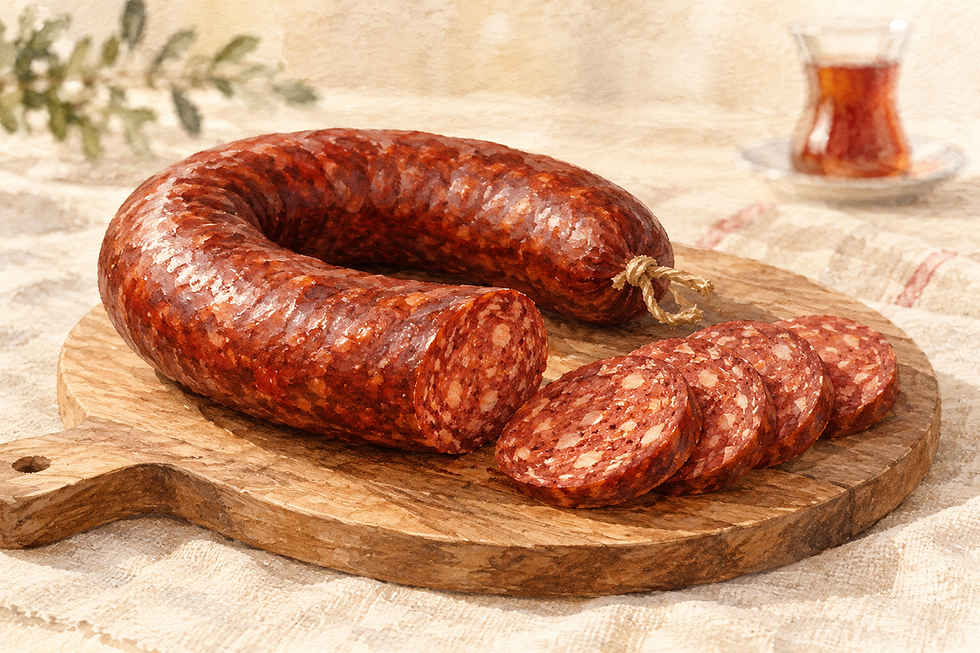
Turkish Beef Sucuk
A dried beef sausage seasoned with garlic and spices. Slice it and fry it with eggs for sucuklu yumurta.

Copper Sahan
A small, shallow pan with two handles for cooking and serving eggs. It goes straight from the stove to the table.
The weekend kahvaltı
The weekend breakfast uses the same structure as the weekday one, with more plates and a lot more time. It often starts later in the morning and can last well over an hour, with the çaydanlık refilled several times. Families often gather for it and on a Sunday it can replace lunch entirely.
The additions vary by household and region, but a weekend table might include a hot egg dish, a second or third cheese, fried pastries such as pişi (fried dough) or sigara böreği (thin rolls of yufka filled with cheese), simit bought from a bakery or street seller that morning, and several jams.
The sweet side of the table deserves its own mention. Bal kaymak is honey poured over kaymak, a thick cream skimmed from heated milk, eaten with bread. Outside Türkiye, British clotted cream is the closest widely available substitute. Jams are often made from fruit less common in English-speaking kitchens: vişne (sour cherry), incir (fig), ayva (quince), and gül (rose petal). In colder months, some tables have tahin pekmez, tahini mixed with grape molasses, which you stir together on your plate and eat with bread.
In restaurants, a large spread of many small plates brought to the table at once is called serpme kahvaltı, and TDK lists the phrase in its entry for kahvaltı (TDK Güncel Türkçe Sözlük). At home, a weekend kahvaltı looks like a smaller version of this and nobody expects twenty plates.
About the word
The usual explanation for kahvaltı is kahve altı, roughly "under coffee": the meal eaten before the day's first coffee, something to line the stomach. A 2018 conference paper on Turkish breakfast culture by Dilek Say, Mustafa Kadir Esen and Nuray Güzeler gives this derivation (Say, Esen and Güzeler, 2018). TDK's dictionary gives the meanings of the word without its origin, so I treat kahve altı as the standard account, and I haven't seen it documented with early written examples.
Either way, the coffee has since moved. At the everyday table, tea sits at the center of the meal and Turkish coffee, if it comes at all, comes after. For the older world of coffee in Ottoman city life, see The Ottoman Coffeehouse Was Never Just About Coffee.
Grammatically, the word behaves like any other noun. Kahvaltı etmek is "to have breakfast," kahvaltıda is "at breakfast" with the locative case -da, and kahvaltılık adds the -lık suffix to mean "things for breakfast."
What people say at the table
A few phrases come with the meal. Kahvaltı hazır is "breakfast is ready," usually called from the kitchen. Afiyet olsun is said to someone who is eating, roughly "enjoy your meal." Ellerine sağlık ("health to your hands") is said to whoever prepared the food. And bir çay daha? ("one more tea?") will be asked more times than you expect. The polite way to stop is the teaspoon across the glass, or teşekkürler, yeter ("thank you, that's enough").
Vocabulary
kahvaltı – breakfast
çaydanlık – two-tier Turkish teapot
demlik – the small upper pot where tea steeps
ince belli bardak – thin-waisted (tulip-shaped) tea glass
tavşankanı – tea brewed to the right deep red color
sofra – the table or cloth where a meal is laid out
beyaz peynir – brined white cheese
reçel – jam
sahan – small two-handled pan for eggs
Frequently Asked Questions (FAQ)
Q: What do Turks drink with breakfast?
A: Black tea, brewed in a çaydanlık and served in small ince belli glasses. It is drunk plain or with sugar, without milk, and usually in several rounds. Turkish coffee, when it is served, tends to come after the meal.
Q: Can I make Turkish tea without a çaydanlık?
A: Yes. A small teapot set on top of a saucepan of simmering water follows the same principle: brew strong tea in the upper pot, keep water hot below, and dilute each glass to taste. A real çaydanlık is easier to pour from and holds heat more evenly.
Q: What can I use instead of beyaz peynir?
A: Feta is the easiest substitute. Bulgarian-style white cheese is often closer in texture than Greek feta. If the cheese is very salty, soak the slices in cold water for about half an hour before serving.
Q: Does menemen have onions?
A: Some households make it with onions and some without, and the question is a well-known point of disagreement in Türkiye. Both versions are common. The essential ingredients are ripe tomatoes, green peppers and eggs.
Q: What is serpme kahvaltı?
A: Serpme kahvaltı is a large breakfast spread in which many small plates of cheese, olives, jams, spreads and hot dishes are brought to the table at once to share. It is mostly a restaurant format. A home weekend breakfast follows the same idea on a smaller scale.
Sources
TDK Güncel Türkçe Sözlük, entries "kahvaltı," "çaydanlık" and "tavşankanı." https://sozluk.gov.tr/
Say, Dilek, Mustafa Kadir Esen and Nuray Güzeler. "Türk Mutfağında Kahvaltı Kültürü." I. Uluslararası Akdeniz Sempozyumu, 2018. https://acikerisim.kapadokya.edu.tr/items/f603406e-29fa-4c1d-809c-a443ed836624
UNESCO Intangible Cultural Heritage. "Culture of Çay (tea), a symbol of identity, hospitality and social interaction." Inscribed 2022. https://ich.unesco.org/en/RL/culture-of-cay-tea-a-symbol-of-identity-hospitality-and-social-interaction-01685
As an Amazon Associate I earn from qualifying purchases.


Comments