with Seda
Sabahattin Ali
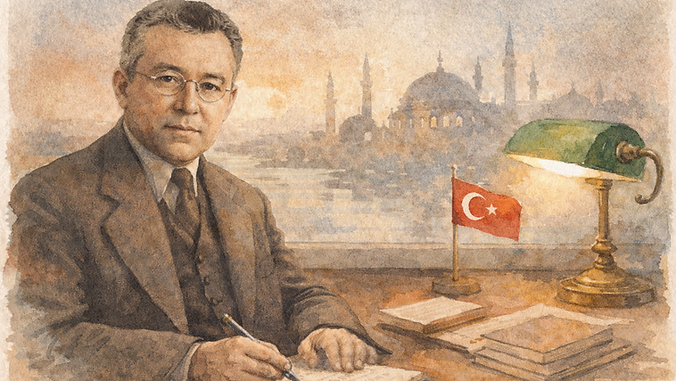
Sabahattin Ali (1907–1948) was born in Eğridere, then part of the Ottoman Empire (today in Bulgaria). His father was an officer. His childhood moved across small towns in Anatolia. Provincial life in his writing comes from the inside.
He studied at a teacher training school in İstanbul and was sent to Germany between 1928 and 1930 on a state scholarship. There, he read Russian writers such as Gogol, Tolstoy, and Chekhov through German. He read them in German. Their presence stayed.
After returning to Turkey, he worked as a teacher and translator. His career was repeatedly interrupted by investigations and prison sentences. These experiences remain close to his writing. His work turns inward. Pressure accumulates inside the character before it surfaces anywhere else.
Books
Kuyucaklı Yusuf (1937)
A provincial town structured by local authority. The central character moves within this structure without fully belonging to it. The pressure does not arrive all at once.
It gathers.
İçimizdeki Şeytan (1940)
Set among intellectual circles in İstanbul, the novel follows hesitation and postponed decisions.
“İçimde biriken hislerin birdenbire patlayarak, beni zerreler halinde dağıtacağından korkuyorum.”
“I am afraid that the feelings building inside me will suddenly explode and scatter me into pieces.”
Kürk Mantolu Madonna (1943)
A life reconstructed through a notebook. What is written becomes clearer than what was lived at the time.
“Dünyada en çok korktuğum şey, bir insanın beni anlamasıdır.”
“The thing I fear most in this world is being understood by another person.”
“Varlığı büyük boşlukları dolduracak mahiyette değildi; fakat yokluğu müthişti.”
“Her presence could not fill great emptinesses, but her absence was overwhelming.”
“Seni seviyorum. Deli gibi değil, gayet aklı başında olarak seviyorum.”
“I love you. Not madly, but with full clarity of mind.”
“Hayatta hiçbir zaman kafamızdaki kadar harikulade şeyler olmayacağını henüz idrak etmemiştim.”
“I had not yet understood that nothing in life would ever be as extraordinary as in our minds.”
Stories
His short stories move through villages, offices, and prisons. The situations remain simple. The tension builds slowly.
“İnsanlar nedense daha ziyade ne bulacaklarını tahmin ettikleri şeyleri araştırmayı tercih ediyorlar.”
“People tend to search for what they think they will find.”
From Canım Aliye, Ruhum Filiz (letters)
“Gözlerimi kapadığım zaman seni görüyorum diyorsun…
Ben gözlerim açıkken bile hep seni görüyorum.”
“You say you see me when you close your eyes…
I see you even when my eyes are open.”
Poetry
Some of his poems later reached wider audiences through music:
“Aldırma Gönül”
“Leylim Ley”
“Çocuklar Gibi”
The language stays clear.
The weight comes quietly.
Marko Paşa
With Aziz Nesin and Rıfat Ilgaz, he published Marko Paşa, one of the most widely read oppositional publications of its time.
The magazine was repeatedly shut down. Each issue carried consequences.
Death
In 1948, he attempted to cross the border into Bulgaria. He was killed by Ali Ertekin, who had agreed to guide him.
Although the case was officially closed, the circumstances continue to be discussed. His grave location is not definitively known.
Frequently Asked Questions (FAQ)
Q: Where should I start reading Sabahattin Ali?
A: Kürk Mantolu Madonna offers a clear entry point. The structure follows a notebook, and the language remains accessible while carrying emotional depth.
Q: Is his Turkish difficult?
A: The sentences are clear, but meaning often sits between lines rather than inside them.
Q: What can a learner gain from his writing?
A: His texts provide consistent sentence patterns and contextual vocabulary. They show how hesitation and emotional nuance are expressed in Turkish.
Q: Why is he still widely read today?
A: His characters hesitate, delay, and question themselves in ways that still feel familiar to readers today.