with Seda
İznik Gölü (Lake İznik)
The Lake That Holds What the Land Has Forgotten
You come down through the olive groves and the lake just appears.
It is wide. The hills on the far side look low and grey from the road. At the eastern end of the water there is a town, and the town is inside walls. The walls are Roman, then Byzantine, then Ottoman, and they are still there. People drive through them on the way to the bakery.
The lake is older than the walls.
What It Looks Like
A tectonic basin. The ground dropped, water came in, and the water has been there ever since. About thirty-two kilometres long, ten across. Sources put the deepest part somewhere between sixty-five and eighty metres, falling toward the southern shore.
The Samanlı range rises to the north, the Avdan to the south. In late afternoon you can see both in the water.
Reedbeds along the foreshore. Two streams come down from the mountains and spread into small deltas where they meet the lake. Olive groves on the eastern flats. Inside the walls, the streets still run on the grid the Romans drew.
In early summer the surface turns turquoise from algae. In autumn, slate.
Where It Is
Bursa province, eastern Marmara. The lake sits between İznik and Orhangazi districts. The town of İznik is at the eastern end.
Eighty kilometres by road from Bursa, two hundred from Istanbul. The city is only ninety kilometres away in a straight line, but you cannot get there in a straight line. The road takes the long way around the Gulf of İzmit.
Water enters mostly from two streams: Karasu in the northeast, Sölöz in the southwest. It drains through one narrow strait called Garsak, west toward the Gulf of Gemlik.
Oak and pine on the slopes above. Strawberry tree, mastic, laurel, and heather in the lower scrub.
What Lives in the Water
Some of the fish here are closely tied to this basin.
Alburnus nicaensis is one of them. The scientific name preserves the ancient Latin form of the city, Nicaea, inside the body of a small freshwater fish that the city itself stopped naming centuries ago. Other species in the basin are also documented as locally restricted. Biologists are still working out the full picture.
The wetlands around the lake hold 172 bird species, 24 reptile species, 8 amphibian species, and 37 mammal species. BirdLife International recognizes the lake as an Important Bird Area. In autumn the coots come in by the thousand. During the breeding season, the reedbeds and river deltas hold colonies of purple heron, squacco heron, little egret, night heron, pygmy cormorant.
Three butterfly species of conservation interest live here too: Glaucopsyche alexis, Lycaena dispar, Nymphalis xanthomelas. A plant called Rumex bithynicus, tied to Bithynian wetlands, grows in the area.
What Threatens the Lake
Water drawn for the olive groves and the fields. Agricultural runoff from those same fields. Illegal extraction for irrigation. Hunting. A dam on the Mahmudiye stream above the northeastern reedbeds has been starving the reeds, and the reeds are where the herons nest.
A wetland management plan has been in place since 2012, covering a wider area of about sixty-one thousand hectares. The lake used to supply drinking water. It does not anymore. Fishing continues, though crayfish and catfish are not what they were.
The Water's Other Names
In ancient Greek the lake was Askania. In Latin, Ascania. Strabo wrote that the plain around it was fertile and unhealthy in summer. Pliny the Elder knew it. So did Catullus, in a poem about leaving the fields of sweltering Nicaea behind.
The Iliad places the Phrygians here. They sent troops to King Priam at Troy, led by two brothers, Phorcys and Ascanius. The lake's old name probably goes back to the second brother. The line cannot be traced exactly.
The town became İznik through a phrase. People said "to Nicaea," eis Nikaia, often enough that the preposition and the place name fused. What came out the other end was İznik. The lake took its name from the town.
What the Lake Floor Holds
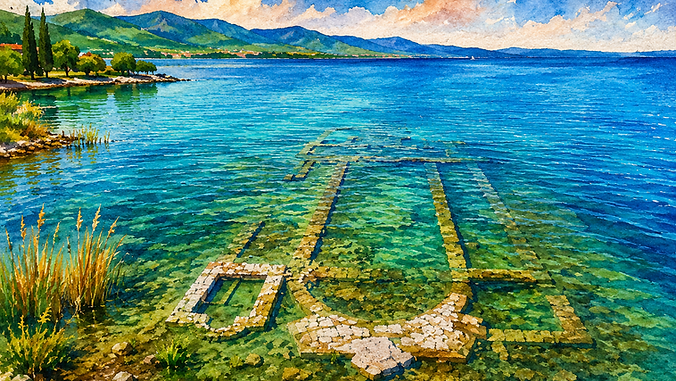
In 2014, government surveyors photographing the lake from a plane noticed something about twenty metres from the shore. An outline under the water. Walls. A floor plan.
Mustafa Şahin, an archaeologist at Bursa Uludağ University, identified it as a basilica. Late fourth or early fifth century. Built on the spot where a young Christian called Neophytos had been killed in 303, during the persecutions of Emperor Diocletian. Neophytos was sixteen. After Christianity became legal, a church went up on the lakeshore at the site of his death. It stood for several centuries. In 740 an earthquake brought it down. The lake covered the rest.
The team worked underwater for years. They found the three naves, terracotta tile tombs, oil lamps, coins. They found remains showing signs of violent death. Şahin started calling it a martyrs' graveyard. They have identified about three hundred graves.
Then the lake began to shrink.
Less rain, more extraction. By late 2025, parts of the basilica walls were above water. What the plane saw from the air in 2014 you could now see from the bank.
Pope Leo XIV came to İznik in November 2025, on his first trip abroad as pope. He stood by the water with Ecumenical Patriarch Bartholomew I and held a prayer service over the emerging walls. Together they recited the Nicene Creed in the town where it had been written, seventeen centuries earlier.
The Good Shepherd fresco found in a hillside tomb above the lake the same summer is part of the same story. The post Before Jesus Had Long Hair: İznik and the Early Image of Christ on this site goes into both finds in more depth.
The Words Inside the Name
The word İznik came from the Greek city name Nikaia prefixed with the preposition εἰς (eis, "to" or "into"). Turkish speakers compressed eis Nikaia into one word over centuries until the direction and the destination were the same. İznik.
Göl means lake. The -ü at the end of Gölü is a third-person possessive suffix that holds together a Turkish noun compound: the lake of, or named for, İznik. Van Gölü, Tuz Gölü, Salda Gölü all do the same thing.
Nicaea is still inside Alburnus nicaensis. The city left daily speech long ago, but it stayed in the scientific name of a small fish. Endemik, the Turkish word for endemic, came from the same Greek roots through Latin.
Sur (plural surlar) is a city wall, from Arabic. The gate facing the lake is Göl Kapısı. Kapı means door or gate. The same word appears in place names such as Topkapı, as well as in everyday expressions like ön kapı ("front door").
Katman means layer. Katman katman, layer by layer. Turkish doubles a word this way often: yavaş yavaş, slowly; az az, little by little. In İznik the word fits.
The Water and What It Carries
The basilica is visible because the lake is losing water. That part is hard to hold together.
For archaeology, the falling water feels like a discovery. For the lake, it is a warning. The fields around it need water. The reedbeds need water too. The herons, the fish, and the old stones are all caught in the same change.
What the lake gives back, it gives back by becoming less of itself.
Add Learn Turkish with Seda as a Preferred Source on Google for deeper insight into Turkish language, history, and culture.
Frequently Asked Questions
Q: What does "İznik Gölü" mean?
A: Göl means lake. The -ü at the end is a third-person possessive suffix that ties the two parts of the compound together: the lake of, or named for, İznik. The same structure appears in Van Gölü and Tuz Gölü. The word İznik itself came from the Greek city name Nikaia with the preposition eis ("toward") attached, compressed over centuries until both became a single Turkish word.
Q: How do you pronounce "İznik Gölü"?
A: The dotted İ is close to the "ee" in "see" but shorter. Göl uses the ö sound, which English does not have: round your lips for "o" and try to say "e" at the same time. The ü in Gölü works the same way: lips for "oo," tongue for "ee." A rough guide: eez-NEEK guh-LUE.
Q: Are there fish that live only in Lake İznik?
A: Yes. Freshwater fish closely tied to this basin are documented in the literature, including Alburnus nicaensis, whose scientific name preserves the city's ancient Latin name. The lake's biological distinctiveness is one of the reasons it holds nationally significant wetland status.
Q: What is the submerged basilica, and can you see it?
A: The Basilica of Saint Neophytos, built in the late fourth or early fifth century on the lakeshore, where a young Christian called Neophytos had been killed in 303. An earthquake in 740 brought it down, and the lake covered the ruins. In 2014, aerial photography found the outline of its walls about twenty metres from shore. The water has been falling, and parts of the walls are now visible from the bank. Excavations continue under Prof. Dr. Mustafa Şahin at Bursa Uludağ University. Public access depends on the excavation status.
Q: Why is the lake important for birds?
A: BirdLife International recognizes İznik Gölü as an Important Bird Area. The reedbeds and river deltas hold breeding colonies of purple heron, little egret, night heron, squacco heron, pygmy cormorant. In autumn, coots gather in the thousands. 172 bird species have been recorded in and around the lake, and the site sits in a migration corridor used during spring and autumn passage.
Sources
Özuluğ, M., Altun, Ö., Meriç, N., "On the Fish Fauna of Lake İznik (Turkey)," Turkish Journal of Zoology 29(4), 2005.
https://journals.tubitak.gov.tr/zoology/vol29/iss4/13/
Doğa Derneği, İznik Gölü Önemli Doğa Alanı.
https://dogadernegi.org/iznik-golu/
T.C. Tarım ve Orman Bakanlığı, İznik Gölü Sulak Alanı (Ekotaban). https://ekotaban.tarimorman.gov.tr/alan/1743
İznik Kaymakamlığı, İznik Coğrafi Yapı.
https://iznik.gov.tr/iznik-cografi-yapi
Bursa Uludağ Üniversitesi, İznik Gölü Bazilikal Kilise Sualtı Kazıları, publication list by Prof. Dr. Mustafa Şahin.
https://iznikbazilika.uludag.edu.tr/makaleler.html
Şahin, M., "Underwater Excavation at the Basilica Church in İznik Lake, 2019," International Journal of Environment and Geoinformatics 9(2), 2022. https://dergipark.org.tr/en/pub/ijegeo/article/790313
Turkish Minute / AFP, "Basilica emerges from Turkish lake, offering clues to early Church life," November 24, 2025.
Greek Reporter, "Ancient Roman Basilica Emerges From Lake in Turkey After 700 Years Underwater," November 25, 2025.
https://greekreporter.com/2025/11/25/ancient-roman-basilica-lake-turkey-years-underwater/
UNESCO World Heritage Centre, İznik (Tentative List). https://whc.unesco.org/en/tentativelists/5900/
Learn Turkish with Seda, "Before Jesus Had Long Hair: İznik and the Early Image of Christ."
https://www.learnturkishwithseda.com/post/early-image-of-christ-in-iznik
Classical references: Strabo, Geography; Pliny the Elder; Catullus; Homer, Iliad.