Why AI Keeps Getting Turkish Wrong


A student sent me a message last week. She had been practicing with an AI tool between our sessions, testing her output before sending it to me.
She wrote a sentence that included görüşmüşlermiş.
The tool corrected her. Confidently, with that clean formatting that makes every answer look like the final word.
She came to the lesson doubting something she had understood correctly. The tool had processed the word, produced a translation, and dropped an entire layer of meaning, the specific grammatical marker that tells you whether a statement reflects the speaker's direct knowledge, an inference, or something learned after the fact.
I have seen this happen for two years, across dozens of students. The errors cluster in the same places inside Turkish words. Once you understand why, the pattern is hard to unsee.
The Tokenization Problem
Subword tokenization algorithms like BPE or WordPiece build a vocabulary of character sequences ranked by frequency in training data. Common sequences are stored whole. Rare sequences get cut into smaller pieces. Morpheme boundaries are not modeled at any stage. The algorithm has no representation of what a suffix is, or where one grammatical unit ends and another begins. It tracks surface frequency.
That is the entire mechanism.
In languages where most grammatical information travels in separate words, this statistical segmentation creates relatively little friction. Four words, four tokens, four pieces of meaning.
Turkish builds meaning differently. A complete statement often lives inside a single word.
Take anlatamadıklarımızdansınız.
anlat (tell / explain)
a (reduced form of the abilitative construction derived from -ebil-, fused to the root in this context; part of the insufficient mood structure)
ma (negation)
dık (participial nominalizer: the thing that was or wasn't done)
lar (plural)
ımız (our)
dan (from / among)
sınız (you are, second person formal/plural)
anlat + a + ma + dık + lar + ımız + dan + sınız
"You are among the things we cannot put into words."
The -a- and -ma- are doing separate grammatical work. The -a- is not a standalone morpheme; it is the reduced form of the abilitative construction (-ebil-), fused to the root in this context. The -ma- negates it. AI tools often collapse both into a single negation unit, failing to read the internal logic of how the inability is actually built.
Because this word's full form is rare in frequency-ranked training data, the tokenizer is likely to cut it at statistically convenient points that have nothing to do with where the meaning lives. The model then reconstructs grammar from those fragments.
Agglutinative forms tend to increase token count relative to the meaning being expressed. This creates two compounding problems: context window pressure, as more tokens are consumed per sentence, and fragmentation of meaning across tokens, as grammatically related morphemes end up in separate units that the model must reconnect statistically rather than read structurally.
The Layer That Disappears
Görüşmüşlermiş is the word my student wrote correctly.
gör (see / meet)
üş (reciprocal: with each other)
müş (evidential past: it happened, based on evidence or prior knowledge)
ler (plural: they)
miş (evidential: I did not witness this, I am reporting what reached me, what I inferred, or what I came to realize afterward)
gör + üş + müş + ler + miş
The final -miş is not only about reported speech. It marks the speaker's epistemic position: they were not present, or they came to know this after the fact, or they are presenting the information as inference rather than direct observation. That last function, encoding post-event realization, is easy to miss when the suffix is reduced to a label. Without it, the sentence asserts a known fact. With it, the speaker positions themselves outside the event, at a variable distance, and that distance can signal anything from neutral reporting to quiet skepticism.
The tokenizer cuts this word at points unrelated to morpheme boundaries. The model may receive görüş, müşler, miş as separate units and reconstruct something grammatically plausible from them. What tends to disappear in that reconstruction is the evidential layer, the one that encodes where this knowledge came from and how certain the speaker is.
The Buffer Consonant Nobody Notices
Yapacaklarının is a form I introduce at intermediate level, when students begin reading formal written Turkish.
yap (do)
acak (future)
lar (plural: they)
ı (third person possessive: their)
n (pronominal n: buffer consonant between possessive suffix and case suffix) ın (genitive: of)
yap + acak + lar + ı + n + ın
That -n- exists to keep two vowels from colliding across a morpheme boundary. AI tools handle it inconsistently, sometimes absorbing it into the possessive, sometimes into the genitive, sometimes dropping it. Each reading produces a different grammatical parse of the whole word.
One of my students, an intermediate learner who reads Turkish news regularly, brought me a sentence from an article. She had asked an AI tool to break it down. The tool read yapacaklarının as a simple past form, shifting the time reference of the entire sentence. She had sensed something was wrong but could not locate the error.
We worked through the word suffix by suffix for about ten minutes. By the end she could read it alone. The problem was not that the answer was wrong. The problem was the speed and confidence of it. She had doubted her instinct before doubting the tool. In a different setting, with a teacher in front of her, that hesitation would have turned into a question. Here, it turned into silence.
What Happens With Advanced Forms
Söylemişlikleri appears in literary contexts, in formal prose, and occasionally in spoken Turkish when someone treats a set of past statements as a collective, examinable object.
söyle (say / tell)
miş (adjectival participle: not a tense marker here)
lik (nominalizer: builds an abstract noun expressing the state or experience of having done something)
ler (plural)
i (third person possessive: their)
söyle + miş + lik + ler + i
"Their having said it." The things they reportedly said, treated as a concrete noun.
Inside söylemişlik, the -miş is not carrying tense. It functions as a participial base, and -lik builds on top of it to create a noun expressing the state of having said something. AI tools tend to read -miş as a past tense marker and stop there. The nominalization disappears. The output offers a verbal event where Turkish constructed a noun.
Why More Data Does Not Fix This
Limited training data is a real factor in AI underperformance in Turkish. It explains part of the picture. It does not explain the structural problem underneath it.
The subword tokenizer builds its vocabulary from character sequence frequency. Most Turkish word forms, even common roots combined with standard suffixes, appear in far fewer combinations than their equivalents in morphologically simpler languages, so the tokenizer stores only the most frequent forms whole and cuts the rest into pieces. Adding more Turkish text to training improves how the model handles common forms. It does not change the fact that the tokenizer has no representation of morpheme structure and cannot be trained to have one within this architecture.
To the tokenizer, forms like gelmiş and gelmemiş are different character sequences, not structurally related words sharing a root and a negation morpheme. The system tracks surface frequency, not morphological logic. This is why better training data can improve fluency in common forms while leaving deeper structural errors largely intact.
Vowel harmony adds a separate layer of difficulty. The suffix commonly written as -miş also surfaces as -mış, -muş, and -müş depending on the vowel in the preceding syllable. These variants have different frequency distributions in training data, and the model may treat them as probabilistically distinct rather than as surface alternations of the same morpheme. This is a probabilistic effect, not a deterministic cause: frequency differences across variants likely influence model behavior in specific phonological environments, but they do not fully account for the errors. The interaction between tokenization and vowel harmony is real; the exact mechanism depends on context.
Training on more Turkish text makes the model a better guesser within that misaligned structure. The pieces still do not correspond to meaningful linguistic units.
What This Costs in the Classroom
My student who wrote görüşmüşlermiş correctly had internalized the evidential system well enough to produce the right form. The AI told her she was wrong. She trusted the tool.
Teaching grammar is the easier part of my work. Teaching a learner to calibrate trust, to know which AI outputs to question and which to use, is harder, because the tool presents every answer with the same authority regardless of how much structural work went into it. A learner still building their instincts has no reliable signal for when the confidence is earned.
The errors are not distributed randomly across Turkish. They concentrate around stacked suffixes, evidential markers, complex nominalizations, buffer consonants, and less frequent vowel harmony variants. These are the places where Turkish encodes the most meaning in the smallest space. They are also the places where fragment-based reconstruction produces the most consistent losses.
I wrote about this from a classroom perspective in an earlier post, focusing on what gets lost when AI processes Turkish at the level of meaning. The architectural explanation behind those failures is laid out clearly in a recent article by Hugues V.
Both address the same problem from different positions.
Frequently Asked Questions (FAQ)
Q: Can I work through these kinds of mistakes with someone who understands how Turkish actually builds meaning?
A: Some learners prefer to work through these patterns with guidance, especially once sentences become morphologically dense. In that case, they can look at the lesson options and approach on the Book a Lesson page, or reach out with specific questions before deciding.
Q: Why does AI make more mistakes with long Turkish words than short ones?
A: Longer words carry more suffixes, and frequency-based tokenizers are more likely to cut them at points that do not match morpheme boundaries. The model reconstructs grammar from those fragments, and the more suffixes involved, the more opportunities for that reconstruction to lose something. Context window pressure compounds this: more tokens per sentence means the surrounding sentence provides less structural support for the model's predictions.
Q: Is this mainly a training data problem?
A: Data volume is a real factor, but statistical segmentation misaligned with morphology is the structural issue. The tokenizer has no model of morpheme boundaries. Adding more Turkish text improves performance on frequent forms but does not resolve that mismatch. Vowel harmony variants like -miş, -mış, -muş, and -müş may compound this probabilistically, appearing with different frequencies in ways that influence model behavior without fully accounting for the errors.
Q: What kinds of meaning does AI most consistently lose in Turkish?
A: Evidential suffixes in stacked forms, the distinction between the abilitative construction -a- (derived from -ebil-) and negation -ma- in long chains, buffer consonants like pronominal -n-, and the function of -miş as a participial base inside nominalizations. These are the positions in Turkish word structure where sequence carries the most interpretive weight.
Q: Can I still use AI tools to practice Turkish?
A: Yes, with a clear sense of where the errors tend to appear. For basic structure checks and generating simple examples, AI tools are reasonably useful. The problems concentrate in morphologically dense words and in suffixes that carry evidential or relational meaning. Knowing where to expect errors makes the output more useful rather than less.
Q: What is the difference between görüşmüşler and görüşmüşlermiş?
A: Görüşmüşler presents the meeting as established information. Görüşmüşlermiş adds an evidential frame: the speaker is reporting what they learned indirectly, inferred, or came to realize after the fact. That final -miş does not add new content to the sentence. It repositions the speaker's relationship to what they are saying.
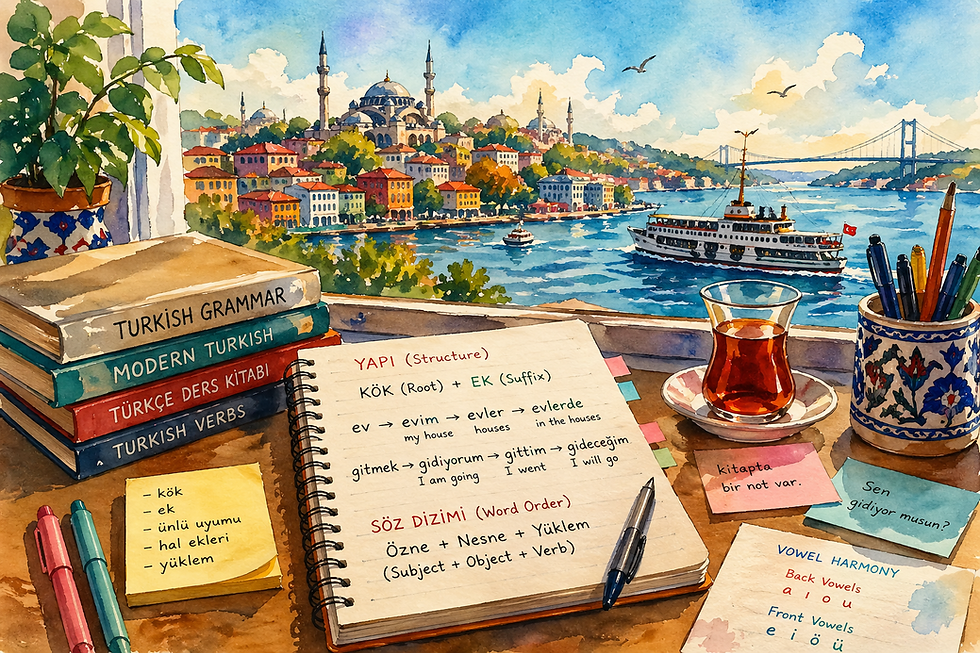


This is why I still only use Google translate. I just want to get an abstract of what I wrote. To spot major errors. Then I'm figuring out the rest with the assistance of my grammar notes or other trustable resources. I don't want to rely on Ai. I mean I could live without it before so I don't want to get dependent.