Turkish and Arabic: Clearing Up a Common Confusion

Updated: Sep 17

For readers in a hurry: Turkish and Arabic belong to entirely different language families. Turkish is a Turkic language; Arabic is a Semitic language within the Afro-Asiatic family. Their long contact, however, left Turkish with a large Arabic-derived vocabulary. For centuries, Arabic words entered Ottoman Turkish through religion, scholarship, administration, literature, and everyday life. Ottoman Turkish was also written in an Arabic-based script. These connections can make the two languages look much closer than they are. Their grammatical foundations developed separately. Arabic influence reached Ottoman grammar only in a limited area of formal written language, and those borrowed constructions largely disappeared from modern Turkish.
People learning Turkish often encounter this history before they know what to make of it. A word such as kitap has an Arabic origin. So do familiar words such as insan, dünya, hayat, and saat. Open an Ottoman manuscript and the visual connection becomes stronger: Turkish appears in a script derived from Arabic, surrounded by vocabulary of Arabic and Persian origin.
It is easy, then, to assume that Turkish developed from Arabic or that the two languages are closely related. Historically, they spent centuries in contact. Linguistically, their ancestry is separate.
Arabic belongs to the Semitic branch of the Afro-Asiatic language family, alongside languages such as Hebrew and Aramaic. Turkish belongs to the Turkic family, with relatives including Azerbaijani, Kazakh, Uzbek, and Turkmen. Their basic grammatical systems also work very differently. Turkish builds much of its grammar by attaching suffixes to a word stem, often in a regular sequence. Arabic makes extensive use of consonantal roots and morphological patterns, alongside prefixes and suffixes.
This distinction becomes especially useful when looking at Ottoman Turkish. Arabic contributed thousands of words, and educated Ottoman writers also borrowed some Arabic grammatical constructions for particular kinds of formal prose. Those constructions never replaced the underlying Turkish grammatical system. Modern Turkish retained many words of Arabic origin while leaving most of that learned grammatical borrowing behind.
So the interesting story is not whether Turkish and Arabic are related. It is what can happen when two unrelated languages remain in close cultural contact for centuries. Vocabulary can travel remarkably far while the basic architecture of a language remains recognizably its own.
The Linguistic Roots of Turkish and Arabic
Turkish and Arabic do not descend from a common ancestor. Arabic belongs to the Semitic branch of the Afro-Asiatic language family, while Turkish belongs to the Turkic family. The difference becomes especially clear when you look at how the two languages build words.
Arabic is often described through its root-and-pattern morphology. Many words are organized around consonantal roots associated with a broad field of meaning. The root k-t-b, for example, is connected with writing. From it come words such as kataba (he wrote), kitāb (book), and maktaba (library). Changes within and around the root help produce different words and grammatical forms.
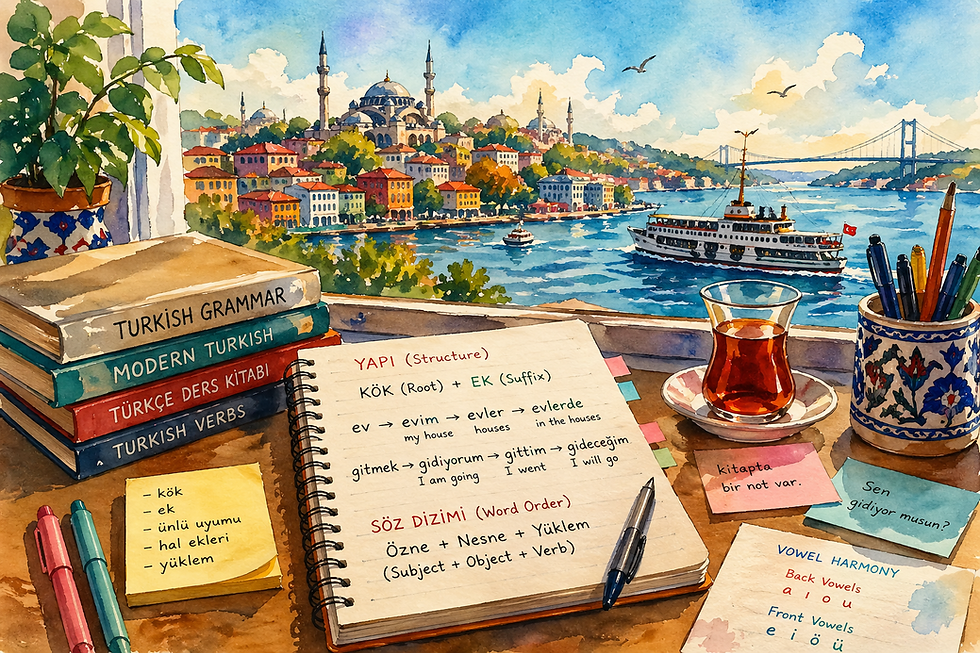
Turkish works differently. It is an agglutinative language, and much of its grammatical information is added to a relatively stable stem through suffixes. Those suffixes can mark things such as number, possession, case, tense, or person. This is the system introduced throughout this site's beginner grammar pages and explored in more detail in the grammar and suffix logic guide.
What happens to an Arabic word after it enters Turkish is a good way to see the difference. Arabic kitāb entered Turkish as kitap. In Turkish, the word follows Turkish morphology. Its Arabic origin does not give it Arabic grammatical behavior.
Take kitaplarımda, “in my books”:
kitap + lar + ım + da
book + plural + my + in
The borrowed noun sits at the beginning, and everything that follows belongs to Turkish grammar. The same sequence can be used with a native Turkic word such as
ev:
evlerimde
ev + ler + im + de
in my houses
This is one of the most useful distinctions between vocabulary and grammar when looking at Turkish and Arabic. A language can absorb a very large number of words from another language without adopting the system those words originally belonged to. Once kitap became part of Turkish, Turkish speakers could pluralize it, possess it, put it into different cases, and build larger forms from it using the same morphology they used elsewhere in the language.
A Thousand Years of Contact: How Words Traveled
Turkish and Arabic have been in contact for centuries, and that history is still visible in modern Turkish vocabulary.
The Dīwān Lughāt al-Turk, compiled in Baghdad between 1072 and 1074 by Mahmud al-Kashgari, gives us an early example. Kashgari wrote in Arabic for an Arabic-reading audience while documenting Turkic words, dialects, poetry, and expressions. By the 11th century, the two languages were already circulating within the same scholarly world.
Contact increased as Turkic-speaking communities adopted Islam. Arabic was widely used in religion, law, and scholarship, bringing vocabulary from these fields into Turkish. During the Ottoman period, Arabic and Persian words became especially prominent in administration, literature, and educated writing. The piece on Hürrem Sultan and Ottoman institutional structure looks at part of this Ottoman world from another angle.
Thousands of Arabic-origin words eventually became part of Turkish. According to one count based on the Turkish Language Association (Türk Dil Kurumu, TDK), 6,463 headwords in the modern Turkish dictionary are of Arabic origin. The exact number depends on the dictionary edition and how entries are counted, so it gives a sense of scale rather than a fixed total. It also says little about frequency. A common word used every day and a rare literary word each count as a single headword.
Formal Ottoman Turkish contained a considerably larger proportion of Arabic and Persian vocabulary than modern standard Turkish. The language reforms of the early Republican period replaced many Ottoman-era words with Turkish alternatives. Some Arabic-origin words disappeared from common use, while others remained part of the basic vocabulary.
Words that remained became part of the Turkish grammatical system. They take Turkish plural, possessive, case, and other suffixes just like the rest of the Turkish lexicon.
Arabic kitāb, for example, entered Turkish as kitap and can become kitaplar, kitabım, kitapta or kitaplarımda.
The loanwords piece on this site follows several Arabic and other borrowed words individually and looks at how they became part of everyday Turkish.
How Turkish Reshaped Arabic Words
Borrowing also changed the sound and shape of many Arabic words.
Classical Arabic allows certain word-final consonant clusters that Turkish tends to avoid. Linguists sometimes describe forms ending in two consonants without an intervening vowel as having a superheavy final syllable. When words with this structure entered Turkish, Turkish speakers often inserted a vowel between the final consonants.
Arabic ḥukm became Turkish hüküm. The same pattern appears in several other familiar words:
kufr → küfür
šukr → şükür
ẓulm → zulüm
jurm → cürüm
The inserted vowel gives each word a syllable structure that fits Turkish phonology more comfortably. The process is known as vowel epenthesis, the insertion of a vowel into a word.
These forms are useful because the history remains visible inside the modern Turkish word. Şükür still carries the consonantal sequence associated with Arabic š-k-r, while its Turkish form has been reshaped around Turkish pronunciation. The same process can be seen in hüküm and zulüm.
Arabic loanwords underwent other sound changes as they became established in Turkish, and Turkish suffixes were then added according to Turkish morphology. A word could therefore preserve a clearly Arabic etymology while developing a distinctly Turkish form and grammatical life.
Persian Alongside Arabic
Persian formed another important layer of Ottoman Turkish. Its influence is particularly visible in literature, poetry, court culture, and the vocabulary of everyday objects.
Modern Turkish words such as bahçe (garden) and pencere (window) came through Persian, along with many others that are now completely familiar to Turkish speakers.
Arabic and Persian also reached Ottoman Turkish through different historical routes and often overlapped. Arabic had a particularly strong presence in religious, scholarly, legal, and administrative vocabulary, while Persian had enormous prestige as a literary and cultural language. Ottoman writers drew freely on both. A single sentence could contain Turkish grammatical elements alongside words of Arabic and Persian origin.
The result was especially noticeable in formal written Ottoman Turkish, where the distance from everyday speech could be substantial. Vocabulary was only part of that difference. Persian also contributed some constructions that became characteristic of Ottoman literary and bureaucratic style.
Persian Grammar in Ottoman Turkish
One of the most recognizable was the Persian izafet construction. Izafet links nouns and modifiers through a connecting vowel, allowing phrases to be built according to a Persian model rather than the usual Turkish possessive pattern.
Ottoman writers used these constructions extensively in poetry, official documents, titles, and elaborate prose. They could also be extended into long chains, giving formal Ottoman writing some of its characteristic density.
A phrase such as derya-yı umman, “ocean of oceans,” illustrates the pattern. The connection between the words follows a Persian construction. Native Turkish would organize a comparable relationship through its own system of noun compounds and possessive marking.
Izafet belonged primarily to the learned written tradition. Its presence was strongest in Ottoman literary and administrative language, where knowledge of Persian formed part of an educated writer's repertoire. It became particularly productive in Divan poetry, whose language drew heavily on both Persian literary conventions and Arabic-Persian vocabulary.
As Ottoman Turkish gave way to the modern standard language in the twentieth century, izafet constructions largely disappeared from ordinary written Turkish. Many survive in historical expressions, names, titles, and phrases associated with Ottoman culture, so a modern reader can still encounter forms such as Devlet-i Aliyye or Servet-i Fünun without using the construction productively in everyday Turkish.
This part of Ottoman Turkish is a useful reminder that language contact can reach beyond individual words. Persian contributed vocabulary on a large scale and also left traces in the grammar of particular written registers. Modern Turkish developed without productive izafet, while the Ottoman texts preserve the period in which Turkish, Persian, and Arabic resources could all appear within the same written sentence.
A New Script for Turkish
For centuries, Ottoman Turkish was written in a modified form of the Arabic script. A page of Ottoman Turkish can therefore look immediately familiar to someone who reads Arabic, even though the language represented on the page is Turkish.
The script had originally developed for Arabic, whose sound system differs considerably from that of Turkish. Turkish has eight vowels, and vowel distinctions play an important role throughout the language. The Ottoman writing system represented many of those distinctions imperfectly, so reading often depended on knowing the word and its context.
In 1928, Türkiye adopted a Latin-based alphabet adapted to Turkish pronunciation. New letters such as ç, ğ, ı, ö, ş and ü allowed sounds and vowel distinctions to be represented much more directly. The change is covered in more detail on this site's Turkish alphabet page.
The alphabet changed quickly; the language itself continued. Turkish still formed words with suffixes, used vowel harmony, and followed the grammatical patterns that had developed over centuries. At the same time, the early Republican period brought broader changes to written Turkish. Vocabulary reform and changing literary styles gradually reduced many of the Arabic and Persian features associated with formal Ottoman prose.
Experience Ottoman Calligraphy in Istanbul
Work with a traditional reed pen and learn about the calligraphy used during the Ottoman period in this two-hour workshop with a local artist.

What Happened to Arabic Words in Turkish
Borrowing did more than change the sound and grammatical behavior of Arabic words. Their meanings could change too.
Some remained close to their earlier meanings. Others developed new associations through centuries of use in Turkish. That process produced words that may look familiar to an Arabic speaker while occupying a somewhat different place in a Turkish sentence.
Misafir comes from Arabic musāfir, associated with travelling. In modern Turkish, misafir is primarily a guest. The word belongs naturally to the language of visiting and hospitality: misafir gelmek, misafir ağırlamak, misafir odası.
Tabii has developed a particularly common conversational life in Turkish. Alongside meanings connected with “natural,” it is used constantly for “of course”:
Tabii, gelirim.
Of course, I'll come.
Şahıs remains a word for a person or individual, although its register is more formal than kişi or insan in contemporary Turkish. It appears readily in legal, administrative, and official contexts.
Acele has become part of a whole group of Turkish expressions. Speakers say acelem var when they are in a hurry, acele et when telling someone to hurry, and acele etme when asking them to slow down. An Arabic-origin word is functioning here inside expressions built with Turkish grammar.
These changes happened over generations of Turkish use. Once a borrowed word became established in the language, Turkish speakers used it in new situations, combined it with Turkish words and suffixes, and sometimes extended or narrowed its meaning. Its etymology records where it came from; its modern usage records what happened to it after it arrived.
The piece on hüzün, gurbet and other Turkish words looks more closely at the cultural and semantic histories that words can accumulate as they travel.
Two Different Sound Systems
The difference between Turkish and Arabic can also be heard in their sound systems.
Arabic has consonants produced deep in the throat, including pharyngeal sounds, as well as a series traditionally described as emphatic consonants. Turkish organizes much of its sound pattern around vowels. Its eight vowels interact through vowel harmony, which determines the form of many suffixes.
Borrowed words entered this Turkish sound environment and developed Turkish pronunciations. Arabic qalb, for example, became Turkish kalp. From there, the word behaves like any other Turkish noun:
kalp → kalpler → kalpte
The plural suffix appears as -ler, and the locative appears as -te. Their forms are determined by Turkish vowel harmony and consonant rules.
Other Arabic words underwent more visible changes. The forms hüküm, şükür, küfür and zulüm discussed earlier contain vowels inserted into consonant sequences that were possible in Arabic and less compatible with Turkish word structure. These adaptations became part of the Turkish forms of the words themselves.
For a modern Turkish speaker, kalp and hüküm are therefore Turkish words with Arabic etymologies. Their histories can be traced to Arabic; their pronunciation and grammatical behavior belong to the language in which they are now being used.
How Turkish Builds a Sentence
The contrast becomes broader when we move from individual words to sentences.
Turkish is predominantly a subject-object-verb language. The verb commonly comes at the end of the clause, while case suffixes show the grammatical role of nouns.
Adjectives generally precede nouns, possessive relationships are expressed through a combination of case and possessive marking, and grammatical information can accumulate at the end of a single word.
A sentence such as:
Öğretmen kitabı öğrenciye verdi.
The teacher gave the book to the student.
shows several parts of the system at once. Kitab-ı marks kitap as the definite direct object, öğrenci-ye marks the recipient, and ver-di carries the past-tense marking.
Word order contributes to the sentence, while suffixes carry much of the grammatical information.
Arabic organizes these relationships through its own combination of morphology and syntax. Its root-and-pattern morphology reaches into both word formation and grammatical inflection, and Arabic allows both verb-initial and subject-initial sentence structures. Adjectives normally follow the nouns they modify and agree with them in grammatical features.
This is why an Arabic-origin noun can feel completely at home inside a Turkish sentence without bringing Arabic syntax with it.
In Öğretmen kitabı öğrenciye verdi, kitap has an Arabic etymology. Everything that determines its role in that sentence is Turkish.
Reading Turkish Through Its Own Patterns
For learners, recognizing these patterns gives familiar Arabic-origin vocabulary a useful place within the larger system.
A word such as kitap can be learned together with the forms Turkish builds from it:
kitap
kitabı
kitaba
kitapta
kitaptan
kitabım
kitaplarımda
The stem has travelled through centuries of language contact. The forms surrounding it tell another part of its history: what Turkish speakers did with the word after it became theirs.
That combination appears throughout modern Turkish. Arabic contributed a substantial layer of vocabulary, Persian added another, and centuries of Ottoman culture brought those words into new settings and meanings. Turkish incorporated them into its own sound patterns, suffix system, and sentence structure.
A word can therefore carry more than one history at once. Kitap connects modern Turkish to centuries of contact with Arabic. Kitaplarımda shows what happened next.
Add Learn Turkish with Seda as a Preferred Source on Google for more entries on Turkish language, history, and culture.
Frequently Asked Questions (FAQ)
Q: Are Turkish and Arabic related languages?
A: No. Turkish belongs to the Turkic language family, while Arabic belongs to the Semitic branch of the Afro-Asiatic family. The many Arabic-origin words in Turkish are the result of centuries of contact between the two languages.
Q: Are Turkish and Arabic mutually intelligible?
A: No. A Turkish speaker and an Arabic speaker cannot normally understand each other simply by speaking their own languages. They may recognize individual words, especially vocabulary with an Arabic origin in Turkish.
Q: Does Turkish still use the Arabic alphabet?
A: No. Türkiye adopted a Latin-based Turkish alphabet in 1928. Ottoman Turkish had previously been written in a modified Arabic script.
Q: Why does Turkish have so many Arabic words?
A: Arabic had an important place in religion, law, scholarship, and education for centuries. Thousands of Arabic words entered Turkish during this long period of contact, and many remain part of everyday Turkish today.
Q: Did Ottoman Turkish borrow grammar as well as vocabulary?
A: Persian grammatical influence can be seen in formal Ottoman writing, especially in the izafet construction used extensively in literature, poetry, and bureaucratic language. Modern Turkish no longer uses izafet as a productive grammatical construction, although it survives in historical names and expressions.
Q: Was Ottoman Turkish more heavily influenced by Arabic than modern Turkish?A: Yes, especially in vocabulary. Formal Ottoman Turkish made extensive use of both Arabic and Persian words. Twentieth-century language reforms promoted Turkish alternatives for many of them, while a large number of older loanwords remained in use.
Q: Does knowing Arabic help with learning Turkish?
A: Arabic speakers may recognize a considerable number of Turkish words, although meanings and usage sometimes differ. Turkish grammar has to be learned through its own system of suffixes, vowel harmony, case marking, and sentence structure.
Turkish and Arabic have been in contact for centuries, but they belong to different language families and work in very different ways.
Arabic left a deep mark on Turkish vocabulary. Turkish grammar, however, follows its own structure.


For an English speaker who knows some Arabic, Turkish is a relief, because Turkish has very simple and straightforward consonant sounds, without the difficult Arabic consonants pronounced in the back of the throat or different placement of the tongue. The relationship between Turkish and Arabic is somewhat like the place of Latin in English, while Turkish words from Persian are somewhat analogous to the place of French words in English.