From Şifahane to Hastane: Turkish Healing Traditions and Medical Tourism in Türkiye

Updated: 4 days ago

For a reader in a hurry: Şifa means healing, and Turkish once named hospitals after it: darüşşifa, “the house of healing.” Edirne’s darüşşifa, completed in 1488, is famous for music. Most of that story comes from Evliya Çelebi, writing more than a century and a half later, and how systematically music was used there is uncertain. Turkish has always had names built on sickness too: bîmârhâne and later hastahane, now hastane. Outside hospitals, healing belonged to figures such as the kam of the early Turks and the ocaklı, a healer believed to have inherited permission to treat one illness, a practice fieldwork still records. Today, well over a million people a year visit Türkiye to receive health services, according to official figures. Since 2025, a regulation has set the rules for who may treat them.
I visited the darüşşifa of the Sultan Bayezid II complex in Edirne, and I was deeply impressed by it. I still remember the architecture and the way the rooms are arranged, with the central pool and its flowing water, and an atmosphere I find hard to name.
Before I went, I had read historical accounts, some of them associated with Evliya Çelebi, the seventeenth-century Ottoman traveler. They described food prepared for different conditions, medicinal herbs, game meat, and music played in different makam, the melodic modes of Ottoman music.
Standing there, I closed my eyes and imagined the place centuries ago. I imagined the sound of the water and the music and food being prepared for people who were ill. I imagined a place where healing meant attention to the whole person, beyond the treatment itself.
Then I found myself comparing it with modern hospitals. In a very human sense, this old building seemed to offer something many clinical spaces have lost: attention to atmosphere, to sound, to nourishment, and to what it feels like to be the person who comes for care. This is my impression. It is not a claim that the medicine practiced there was safer or more effective than medicine today. Knowing that does not make the feeling any weaker.
And then I started thinking about the words. A şifahane is a place of şifa, healing. A hastane is a place of the hasta, someone who is ill. What happened to şifa in the name of the place? When did our language move from a place where people seek healing to a place where sick people go? And does the way we name a building change how we picture the people inside it?
I wanted to see what the building and the words can actually tell us. That led me back through older forms of healing in Turkish history and then forward to modern Türkiye, where people from many countries now arrive specifically for treatment.
Part I: Şifa and Traditional Healing in Turkish History
The building in Edirne
Bayezid II laid the foundation of his complex in 1484, and it was completed in 1488.
The hospital's main hall is hexagonal, under a large dome with an opening at the top for light and air. A marble fountain stands at the center. The museum and UNESCO's description both identify a raised platform as the place where musicians played, positioned so the sound would reach the rooms. Care was free. Next to the hospital stood a medical school with eighteen domed rooms, and its students trained in the hospital (UNESCO Tentative List; Trakya University Health Museum). The architect is traditionally named as Hayreddin, though no document confirms it, and some researchers credit Yakub Şah.
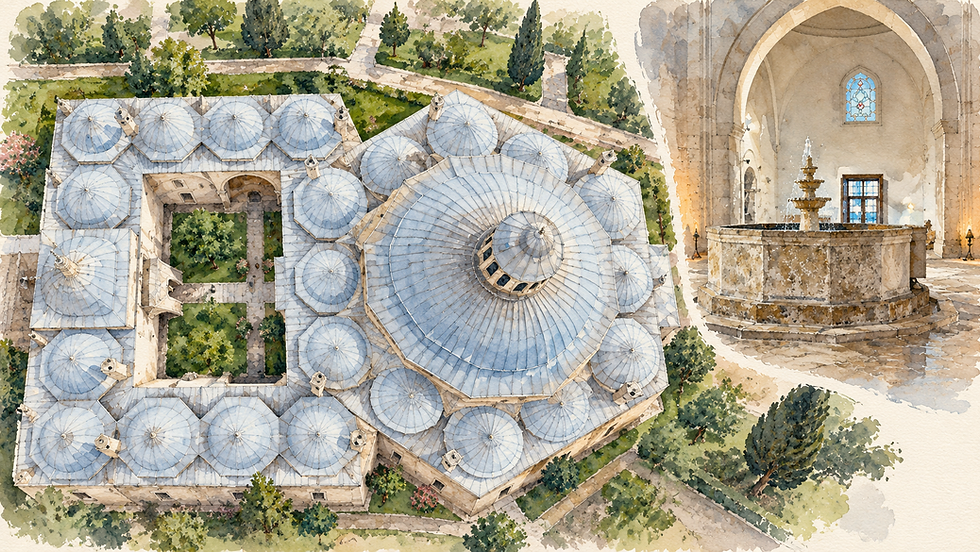
That much belongs to the building and its founding. Most of what people repeat about life inside it comes from someone who arrived much later.
Evliya Çelebi described the hospital in the seventeenth century, about 170 years after it opened. In the museum's English rendering of his account, the endowment provided for ten singers and players, who came three times a week to give short concerts for the patients (Trakya University Health Museum, Evliya Çelebi). He names the makams: neva, rast, dügâh, segâh, çargâh and sûzinak, and he writes that zengüle and bûselik nourish the patients' spirits. In spring, he says, patients were given jasmine, carnations, tulips and hyacinths, and the patients who were mad either ate the flowers or trampled them. Lovers, whose number grew in spring, were brought in on a doctor's order and chained to their beds with chains of silver and gold.
He also describes the water. Fountains around a large pool under the dome sent their spray up toward the middle of the vault, and each winter room had a window looking onto the pool and fountain. When I read that, I thought of the arrangement of rooms I remember.
The accounts I read before my visit also mentioned food prepared for the sick, including game meat, and medicinal herbs. Those details are not in the museum's rendering of Evliya, and I have not yet traced them to a source I can check, so I leave them here as something I read. Evliya enjoyed a good story, and he wrote long after the hospital opened. I have written about him and his love of words in The Man Who Heard Words Move.
The building became a health museum in 1997 and received the Council of Europe Museum Prize in 2004 (PACE). The complex has been on UNESCO's Tentative List since 2016. That is a list of sites a country is preparing to nominate, so the complex is not, as of now, a World Heritage Site (UNESCO).
Ottoman medicine and the makams
The idea that music could heal is older than Edirne. Ottoman physicians inherited a theory, going back to al-Fārābī and Ibn Sīnā (Avicenna), that music acts on the soul and on the balance of the body. Ottoman writers matched certain makams to certain illnesses. According to the historian of medicine Nil Sarı, rast was associated with paralysis, nevâ with sciatica, hüseynî with fevers, and zengüle and ırak with sersam, a delirious state. Only about twelve of some eighty modes were prescribed this way (Sarı, Muslim Heritage).
The best-known later text on the subject is by Gevrekzâde Hâfız Hasan Efendi, a physician who died in 1801. He wrote a treatise on treating ailments of the spirit with music. In another of his works, the section that pairs makams with illnesses is described in the TDV encyclopedia as "claimed to be transmitted" from an earlier poet-physician, Şuûrî Hasan Efendi, who died in 1693 (TDV İslâm Ansiklopedisi, "Hasan Efendi, Gevrekzâde"). Gevrekzâde wrote three centuries after Edirne's hospital opened. His tables tell us what Ottoman physicians thought music could do. They cannot tell us what was done in Edirne.
Nil Sarı, who has done more than anyone to bring this subject back into view, says that Turkish texts do not describe how music therapy was actually applied. She also reports that Şuûrî wrote that music therapy at Bayezid's hospital in Edirne had been given up because it had turned into entertainment (Sarı). The paintings of musicians playing for patients that circulate online are modern. Zengüle appears both in Evliya's Edirne and in the theoretical tables, which is a pleasing echo. No record shows a patient in that hall being prescribed zengüle for anything.
You may also meet the claim that Ottomans soothed the mentally ill with music while Europe burned them as witches. Both halves are wrong. Historians have largely abandoned the idea that the mentally ill were burned as witches in large numbers (Schoeneman 1982), and Ottoman asylums used chains, as Evliya himself records in Edirne.
Şifahane and hastane: what the words show
Darüşşifa comes from Arabic dār, "house," and şifā, "healing." The Turkish Language Association dictionary still lists it, marked as archaic, with two meanings: "hospital" and "psychiatric hospital" (TDK).
The names built on sickness are just as old. Bîmâristan combines Persian bîmâr, "sick," and -istân, "place." Seljuk sources also used dârülâfiye, "house of well-being." Ottoman sources used şifâhâne and bîmârhâne side by side, along with dârüssıhha, "house of health," and tımarhane. By the nineteenth century, hastahane was the word in official use, later shortened in speech to hastane (TDV, "Bîmâristan").
So Turkish speakers had both kinds of name for centuries. The word for the place of the sick did not suddenly push out the word for healing. It was always there beside it, and by the nineteenth century it was the official one. My question about what a name does to the people inside a building still stands. The history simply shows it is an old question, which Turkish answered both ways for a long time.
Older houses of healing
Edirne was one of many. In Kayseri, an inscription dates the Gevher Nesibe hospital and medical school to 602 in the Islamic calendar, 1205–06. The Seljuk sultan Gıyaseddin Keyhusrev I built it in memory of his sister, Gevher Nesibe, who is buried there. It has two adjoining courtyard buildings. The Gıyâsiye was the school for theory. The Şifâiye was the hospital, where students learned at the bedside. It had a courtyard pool, about eighteen patient rooms and a bath, as well as rooms identified as operating rooms. Today it houses the Erciyes University Museum of Medical History (TDV, "Gevher Nesibe Dârüşşifâsı ve Tıp Medresesi").
You will often read that it was the world's first medical faculty. I looked for the argument behind that phrase. It appears in the heading of the TDV encyclopedia page, but the article itself does not make the case, and I found no scholarly source that does. The building is remarkable without the superlative. The story of Gevher Nesibe's unhappy love, which guides often tell, is introduced in the same article as rivayet, tradition.
Women appear often in this history. In Divriği, the hospital beside the Great Mosque was founded in 1228–29 by Turan Melek, the wife of the local ruler. The mosque and hospital together are on UNESCO's World Heritage List (UNESCO). The hospital in Amasya, from 1308–09, was built by a freed servant of İlduş Hatun, wife of the Ilkhanid ruler Olcaytu (TDV, "Amasya Dârüşşifâsı").
Amasya also gives us a physician by name. Şerefeddin Sabuncuoğlu worked at its hospital for fourteen years. In 1465 he wrote a book on surgery in Turkish, the Cerrâhiyye-i İlhâniyye (often written Cerrahiyyetü'l-Haniyye), with drawings of procedures and instruments (TDV, "Sabuncuoğlu Şerefeddin"). It is among the earliest illustrated surgical works written in Turkish.
Bursa had eight hospitals by the late fourteenth century, and ruins remain of the one founded by Yıldırım Bayezid in 1390–94 (TDV, "Bîmâristan"). In Istanbul, endowment deeds list the staff by title: the reis-i etıbbâ or chief physician, the tabip, the kehhal or eye doctor, and the cerrah, the surgeon (İstanbul Tarihi). The same source records that patients in the Süleymaniye asylum were chained and beaten by attendants until nineteenth-century reforms.
Outside the hospital walls
The hospitals I have described were founded by rulers and their households. Healing outside their walls has its own vocabulary, and some of it is very old.
Kaşgarlı Mahmud's Divânu Lugâti't-Türk, the Turkish dictionary he wrote around 1072–77, records ot as both "herb" and "medicine." In modern Turkish ot is mostly grass or herb, but the old double meaning shows where medicine was expected to come from. Em also means medicine. Otaçı and emçi are physicians, and emle- means "to treat" (Dağı 2017). The dictionary also lists the kam, a healer and diviner.

One entry describes kovuç, an illness caused by a jinn. It is treated by splashing cold water on the patient's face, saying "kovuç, kovuç," and burning üzerlik (harmal seed) and aloewood so the smoke reaches the patient (Dağı 2017, citing the dictionary).
Şaman is a Tungusic word that European scholars spread. The Turkic word is kam.
Among Kazakhs and Kyrgyz, the baksı called and dismissed spirits with the kopuz, a stringed instrument also linked to Dede Korkut (TDV, "Şamanizm"). Whether shamanism was the religion of the early Turks is debated. Serdar Uğurlu argues that the older faith centered on Gök Tengri, the Sky God (Uğurlu 2012). Fuad Köprülü treated shamanism as a religion that shaped later Sufi orders. The TDV encyclopedia sets out these positions without settling them. What can be said is that the kam was a healer and ritual specialist among the early Turks.
Ocak: a hearth, a family, a hand
Ocak is a word with several worlds in it. In a kitchen it is the stove or hearth. In older households the hearth was tied to the ancestors: you did not spit on it or pour water over it, you did not give fire away from it after dark, and people swore oaths on it (TDV, "Ocak"). From the hearth the word spread to the family around it, so ocak also means a household or lineage.
In folk healing, an ocak is a family believed to carry the ability to cure one particular illness, and a member who practices is an ocaklı. TDV defines the ocaklı as someone "believed to have permission" (izinli) to cure an illness, and notes that ocaklılar may be women or men (same source). There are ocaks for jaundice, skin eruptions, cold sores, the evil eye and headaches.
Alevi tradition uses the same word for something else. An Alevi ocak is a sacred lineage of dede families, the religious guides of the community. These ocakzade dedes are regarded as descendants of the Prophet, with genealogies called şecere as proof. Traditionally they traveled to visit the families attached to them, the talip, to lead ceremonies and settle disputes (Yaman 2011). This is a religious institution, separate from the healing ocak, though the two share a word that begins at the hearth.
El vermek, literally "to give the hand," refers to passing on the permission to practice healing. The person who grants this permission el verir, while the person who receives it el alır and becomes authorized within the tradition to practice as an ocaklı.
In a survey from Denizli published in 1997, 89.1 percent of ocak healers said their ability was inherited and 10.9 percent said it came through permission (Durbilmez 2013). Practice varies by region. In Diyarbakır, both permission and a blood tie are expected, while in Silvan an ocaklı may give permission to someone outside the family
(Aslan 2025).

Payment worked differently too. Fieldwork from Kırşehir and Diyarbakır describes healers who set no price and work Allah rızası için, "for the sake of God," while accepting whatever gifts a family chooses to give (Sever; Aslan 2025). In Kırşehir, Mustafa Sever recorded an ocak for damak kaldırma, "lifting the palate," for children who eat poorly, and another that uses mud from a fresh molehill.
The practice continues today. According to the summary of a thesis from Kütahya, its author interviewed 473 ocak practitioners in the city and its districts, reaching 149 villages and covering 62 illnesses (Baysan 2016). In Elmadağ, near Ankara, fieldwork between October 2022 and November 2023 identified 131 informants and interviewed 95. Thirty-six declined, some because their husbands objected and some because they feared being reported to the authorities. The researcher recorded twenty kinds of ocak, including kurşun dökme, sarılık kesme ("cutting jaundice"), korku ("fright"), pamukçuk (thrush) and bakır basması, "copper pressing" (Uğurluel 2024). These are two local studies. They show the practice alive in particular places, and they cannot say how common it is across Türkiye. No national figure exists.
Bayram Durbilmez reads the ocaklı as a continuation of the old kam, pointing to fire, iron, water and sacred numbers in both (Durbilmez 2013). Those motifs appear in many folk traditions far from the Turkic world, so resemblance alone does not prove descent. The parallel I find more interesting is textual. The eleventh-century dictionary treats kovuç with üzerlik smoke, and fieldwork in Anatolia still records üzerlik fumigation against the evil eye (Durbilmez 2013).
Lead, water and a mother's milk
Nazar, the harm believed to come from an admiring or envious look, has its own healers and objects. The best known is the blue bead, the nazar boncuğu.

Turkish Nazar Boncuğu
Blue glass nazar boncukları are found in Turkish homes, on jewelry and among everyday objects. I’ve collected a few examples here.
Kurşun dökme, "pouring lead," is one of the remedies. Nilgün Çıblak describes the procedure. Lead is melted in a ladle and poured into a bowl of water held above the patient's head while prayers are recited. The shapes the lead takes are read for the source of the evil eye. It is usually repeated three times. Afterward the water is sprinkled on the patient and poured out at a crossroads, and the person pouring it does not look back (Çıblak 2004).

I remember having this done to me when I was about ten years old. At the time, one thing after another seemed to happen to me, and my mother and some of the older women in our neighborhood decided that someone must have given me the evil eye. They sat me down, held a large metal pot above my head, and poured molten lead into the water. Then they examined the shapes it made.
We were an Istanbul family, yet this old Anatolian tradition had found its way right to our doorstep. I still remember little Seda sitting beneath that pot, feeling even smaller as the lead hit the water with a frightening sound. I have no idea whether they found the evil eye in those shapes, but I am quite sure the experience left me with a fear of my own.
The TDV encyclopedia calls kurşun dökme a practice "inherited from the old Turks" and, in the same entry, a superstitious one (TDV, "Kurşun dökme"). In its entry on nazar, it links lead pouring to an older Turkic custom called kut dökme or kut koyma (TDV, "Nazar"). Kut is an old Turkic word for divine favor and good fortune, and both phrases use the verb dökmek, "to pour." The encyclopedia gives no early text describing kut dökme, though, so the connection is an interpretation. I would rather leave it as a possibility than build a history on a shared verb.
Dede Korkut preserves a very different image of healing. In the Boğaç Han story of Dede Korkut, the young hero lies wounded and Hızır appears. He strokes the wound three times and says, in the Dresden manuscript, "Tag çiçegi anan südi sana merhemdür": mountain flowers and your mother's milk are your ointment. Forty girls gather the flowers. On the third try the mother's milk comes mixed with blood, and the mixture goes on the wound (Acıduman & Arda 2011). Merhem, "ointment," is still everyday Turkish. Hızır returns every spring in Hıdırellez.
Mesir and warm water
Every March in Manisa, a paste made from 41 spices and herbs is scattered from the domes and minarets of the Sultan Mosque. The festival commemorates the recovery of Hafsa Sultan, mother of Süleyman the Magnificent, and UNESCO added it to the Representative List of the Intangible Cultural Heritage of Humanity in 2012 (UNESCO). Tradition credits the paste to Merkez Efendi, a Sufi scholar in Manisa. The TDV encyclopedia doubts that he was the hospital's physician or distributed mesir there, because the hospital was completed in 1539–40, after he had left the city (TDV, "Merkez Efendi"). His tomb in Istanbul's Zeytinburnu has a well whose water people have drunk against malaria (Köse & Ayten).
Traditional Manisa Mesir Macunu
Mesir macunu is still produced and sold in Türkiye today. This packaged version offers a small example of the spiced paste associated with Manisa's centuries-old mesir tradition.

Kaplıca comes from kapalı ılıca, "covered hot spring." In Bursa, the Eski Kaplıca is probably a Byzantine bath that was later converted, and the Çekirge bath dates to
1365–70 (TDV, "Kaplıca").
Part II: Medical Tourism in Türkiye Today
Who comes to Türkiye for medical treatment?
People travel to Türkiye for a wide range of medical treatments. According to USHAŞ, the state-owned company that coordinates international health services, 1,398,580 people visited Türkiye to receive health services in 2025, generating approximately $3.02 billion in revenue. In 2019, the number was 756,926. USHAŞ cites Türkiye's national statistics office, TÜİK, as the source of these figures (USHAŞ).
Major source markets include Germany, the United Kingdom, Russia, Azerbaijan and Iraq. Patients come for hair transplants, dental procedures, aesthetic surgery, eye treatments and more complex medical care, including orthopedics, cardiology and oncology (Milliyet Uzmanpara, HİB). Istanbul is particularly well known for hair transplantation, although reliable official figures for the number of procedures are not available.
One student, two trips and a video
My student Jonathan learned Turkish before traveling to Bursa for a hair transplant in July 2022. In his story on this site, he describes using a little Turkish in the operating room, introducing himself and asking for water. "That small exchange put the whole surgical team at ease," he writes. Bursa is also where Yıldırım Bayezid's hospital once stood and where the old baths still run.
On 13 November 2023, after that first trip, I published a video about hair transplants in Türkiye on my YouTube channel. I had researched the subject and wanted to gather official sources in one place, among them the HealthTürkiye portal and the Ministry of Health's list of authorized providers. From about 15:17, I interview Jonathan about his experience; in the video he appears under the name Mark. We talk about why he chose Türkiye and how the cost compared with the United States, how he chose where to go and why he chose a hospital rather than a clinic, how long he stayed, the best and worst parts, and what worried him before he came. He returned to Bursa in 2025.
His experience is one person's. It cannot show what is typical or what is safe for anyone else. The rules have also changed since 2023, so anything in the video about regulations describes that year.
Who may treat a foreign patient now
In the ocak, the right to heal passed through a family and was given by hand. For a foreign patient today, it passes through a certificate. I do not think one grew out of the other. One kind of authority rests on lineage and belief, the other on law and inspection.
A regulation published on 26 April 2025 sets the current rules (full text, Alomaliye). It requires the following:
Authorization certificates. Hospitals and clinics that treat international patients need a yetki belgesi, an authorization certificate, from the Ministry of Health. Agencies that arrange treatment need their own certificate from USHAŞ, and facilities may not work with agencies that lack one.
HealthTürkiye registration. All of them must be registered on the official HealthTürkiye portal, the platform run by USHAŞ (healthturkiye.gov.tr).
Accreditation. Hospitals are expected to have national accreditation by the end of 2026.
Prices. Prices follow tariffs set by the Ministry.
Complication insurance. The regulation requires complication insurance for surgical and interventional procedures performed in operating rooms. The Turkish Medical Association challenged the regulation in court. The Council of State suspended this clause in December 2025, then lifted the suspension in May 2026. That decision concerned only the suspension, and the case itself has not been decided (USTE). Because this can still change, patients should ask any provider directly what insurance covers them.
Two earlier rules still matter:
Hair transplants. Since 2018, the Ministry has said that only dermatologists, plastic surgeons and physicians certified in medical aesthetics may perform hair transplants, with nurses and technicians assisting (Habertürk).
VAT. Medical services to foreign patients are exempt from VAT, but aesthetic procedures, including hair transplants, are not (Muhasebe News).
What goes wrong, and what no one can count
The British government reports that it is aware of seven British nationals who died in Türkiye in 2025 following medical procedures, although it does not establish the cause of each death (GOV.UK). A 2026 review in BMJ Open identified 655 patients treated by Britain's National Health Service for complications after surgery abroad, 61 percent of whom had undergone surgery in Türkiye. Without reliable figures for the total number of people traveling for treatment, these cases cannot establish a complication rate (Cardiff University, ORCA).
Turkish and British medical professionals have also raised concerns about patient safety. In 2023, their respective associations of aesthetic plastic surgeons issued a joint checklist recommending that patients verify their surgeon's qualifications and choose an appropriate hospital (BAAPS and TSPRAS). The International Society of Hair Restoration Surgery has separately warned about hair transplants performed by unlicensed technicians (ISHRS).
Nothing in this post is medical advice, and none of it recommends treatment in Türkiye or anywhere else.
What the words carry
If you spend time in Türkiye, you will hear şifa long before you need a hospital. When someone hands you linden tea or a bowl of soup because you have a cold, they may say Şifa olsun, "may it bring healing." At the table you will hear Afiyet olsun, and sometimes both together, afiyet şifa olsun; I wrote about afiyet olsun separately.
When you mention that you have been ill, people say Geçmiş olsun, "may it be behind you" (more on geçmiş olsun). For someone who is still sick, they say Allah şifa versin, "may God grant healing." These wishes all end in the same form, olsun or versin, "may it be" and "may He give."
Hasta has a lighter side. In everyday speech, Galatasaray hastası is a devoted fan, and çikolata hastası is someone who cannot resist chocolate. Turkish also has aşk hastası, "lovesick," and I think of Evliya's lovers in Edirne, chained to their beds in spring.
From Healing Traditions to Modern Medicine
Atatürk is remembered for saying, “Beni Türk hekimlerine emanet ediniz,” meaning “Entrust me to Turkish physicians.” I understand the trust behind those words. I am generally grateful for the healthcare we have in Türkiye today.
In my experience, we can reach medical care relatively quickly, whether through public or private hospitals. Seeing a specialist does not necessarily mean waiting for months. Public hospitals provide free healthcare for people covered by Türkiye’s public health insurance system, although appointments can take longer and some services involve additional charges. Private hospitals generally offer faster access, but they can be expensive. We also have family physicians and many well-trained doctors. Of course, there are problems, and people's experiences vary. Still, when I think about healthcare in other countries, I appreciate what we have.
And yet, I wish we could bring a little of what I felt in Edirne into modern medicine. I wish our hospitals could pay more attention to the person experiencing the illness, to their surroundings and their state of mind, alongside the medical treatment they receive. I am grateful for modern medicine and everything it makes possible. I simply wish the places where we receive it could feel more human.
I sometimes imagine hospitals built like gardens of paradise, with courtyards, fountains, trees and sunlight, instead of the bright white, almost spaceship-like buildings we are used to. Places where a patient could look out of a window and see something beautiful, just as Evliya Çelebi described in Edirne centuries ago.

Perhaps this is an unrealistic wish in a world that moves so quickly, where even healthcare is increasingly shaped by the pressures of consumption and efficiency. But I still like to imagine a modern şifahane, with all the knowledge of contemporary medicine and some of that older attention to the human experience of healing.
And even if it remains a dream, what harm is there in putting that dream out into the universe?
Vocabulary
şifa – healing, recovery; the word in everyday wishes such as şifa olsun, said over soup or herbal tea
darüşşifa – "house of healing," the historical name for hospitals founded as endowments, like the one in Edirne
şifahane – "place of healing," another historical word for a hospital
hasta – sick person, patient; in casual speech also a devoted fan, as in Galatasaray hastası
hastane – hospital, from hastahane, "house of the sick," which became standard in the nineteenth century
makam – a melodic mode in Ottoman music; Ottoman medical writers linked some makams to particular illnesses
ot – grass, herb; in Kaşgarlı Mahmud's eleventh-century dictionary, also "medicine"
kam – healer and ritual specialist among the early Turks; the Turkic word behind what Europeans called a shaman
ocak – hearth or stove; a family line; a family believed to hold healing power; in Alevi tradition, a sacred lineage of dedes
ocaklı – a healer believed to have inherited permission to treat one particular illness
el vermek / el almak – literally "to give / take the hand"; the healer who passes on the permission to heal el verir, and the person who receives it el alır
nazar – the evil eye, harm believed to come from an envious or admiring look
kurşun dökme – pouring molten lead into water to read and remove the evil eye; a folk practice with no medical effect
merhem – ointment; Hızır's word in the Dede Korkut cure, still used every day
kaplıca – thermal bath, from kapalı ılıca, "covered hot spring"
yetki belgesi – authorization certificate; what a hospital in Türkiye needs to treat international patients
Geçmiş olsun – "May it be behind you," said to someone who is or has been ill
Allah şifa versin – "May God grant healing," said for someone who is sick
Frequently Asked Questions (FAQ)
Q: What does şifa mean in Turkish?
A: Şifa means healing or recovery. It appears in historical hospital names such as darüşşifa and şifahane, and in everyday wishes such as şifa olsun, "may it bring healing," and Allah şifa versin, "may God grant healing."
Q: What does şifahane mean, and how is it different from hastane?
A: Şifahane means "place of healing," and hastane comes from hastahane, "house of the sick." Ottoman Turkish used healing names and sickness names side by side for centuries, including darüşşifa and bîmârhâne. By the nineteenth century, hastahane was the word in official use.
Q: Was music really used to treat patients in the Edirne darüşşifa?
A: Evliya Çelebi, writing in the seventeenth century, describes musicians playing for patients there, and Ottoman medical writers linked certain makams to certain illnesses. Historians cannot say how systematically this was practiced, and one Ottoman physician reported that music therapy at Edirne was abandoned because it had become entertainment.
Q: Is the Edirne darüşşifa a UNESCO World Heritage Site?
A: No. The Sultan Bayezid II complex has been on UNESCO's Tentative List since 2016, which is a list of sites a country intends to nominate. The Great Mosque and Hospital of Divriği is the Anatolian hospital that is on the World Heritage List.
Q: What is an ocaklı in Turkish traditional healing?
A: An ocaklı is a folk healer believed to have inherited permission to treat one particular illness, such as jaundice or the evil eye. The permission is passed on through el vermek, "giving the hand." Field studies from Kütahya and Elmadağ show the practice continuing in parts of Anatolia.
Q: Is the Alevi ocak the same as a healing ocak?
A: No. An Alevi ocak is a sacred lineage of dede families who serve as religious guides. A healing ocak is a family believed to cure a particular illness. Both meanings grow from the word for "hearth," but they are separate traditions.
Q: How large is medical tourism in Türkiye?
A: According to USHAŞ, citing TÜİK, 1,398,580 people visited Türkiye in 2025 to receive health services, and health tourism revenue was about $3.02 billion. Other sources give different figures depending on how they count.
Q: What is HealthTürkiye?
A: HealthTürkiye is the official portal for international patients, run by the state-owned company USHAŞ at healthturkiye.gov.tr. Under the 2025 regulation, facilities and agencies treating international patients must be registered there, and it lists authorized providers.
Sources and Further Reading
Edirne and the makams
UNESCO Tentative List, Sultan Bayezid II Complex: https://whc.unesco.org/en/tentativelists/6117/
Trakya University Health Museum, Evliya Çelebi: https://saglikmuzesi-en.trakya.edu.tr/pages/evliya-celebi
Nil Sarı, “Ottoman Music Therapy,” Muslim Heritage: https://muslimheritage.com/ottoman-music-therapy/
TDV İslâm Ansiklopedisi, “Hasan Efendi, Gevrekzâde”: https://islamansiklopedisi.org.tr/hasan-efendi-gevrekzade
Words, hospitals and physicians
TDV İslâm Ansiklopedisi, “Bîmâristan”: https://islamansiklopedisi.org.tr/bimaristan
TDV İslâm Ansiklopedisi, “Gevher Nesibe Dârüşşifâsı ve Tıp Medresesi”: https://islamansiklopedisi.org.tr/gevher-nesibe-darussifasi-ve-tip-medresesi
UNESCO World Heritage, Great Mosque and Hospital of Divriği: https://whc.unesco.org/en/list/358
TDV İslâm Ansiklopedisi, “Sabuncuoğlu Şerefeddin”: https://islamansiklopedisi.org.tr/sabuncuoglu-serefeddin
Traditional healing
Fahri Dağı (2017), healing vocabulary in Divânu Lugâti’t-Türk: https://makale.isam.org.tr/bitstreams/3af316fa-3322-4628-bbed-829821bdb70a/download
TDV İslâm Ansiklopedisi, “Şamanizm”: https://islamansiklopedisi.org.tr/samanizm
TDV İslâm Ansiklopedisi, “Ocak”: https://islamansiklopedisi.org.tr/ocak
Ali Yaman (2011), “Alevilikte Ocak Kavramı: Anlam ve Tarihsel Arka Plan”: https://dergipark.org.tr/en/pub/tkhcbva/article/1157623
Bayram Durbilmez (2013), ocaklılar as folk healers: https://dergipark.org.tr/tr/download/article-file/155215
Nilgün Çıblak (2004), nazar and nazarlık: https://turkoloji.cu.edu.tr/HALKBILIM/nilgun_ciblak_nazarlik.pdf
Acıduman & Arda (2011), healing in Dede Korkut: https://cshd.org.tr/article/download/257/257/262
Medical tourism today
USHAŞ, Sağlık Turizmi Verileri (source: TÜİK): https://www.ushas.gov.tr/saglik-turizmi-verileri/
26 April 2025 regulation, full text: https://www.alomaliye.com/2025/04/26/uluslararasi-saglik-turizmi-ve-turistin-sagligi-hakkinda-yonetmelik/amp/
USTE, Council of State decision on complication insurance (May 2026): https://www.uste.org.tr/danistaydan-saglik-turizminde-komplikasyon-sigortasi-karari-zorunlulugun-onundeki-yurutmeyi-durdurma-karari-kaldirildi/
HealthTürkiye, about: https://healthturkiye.gov.tr/about-us
GOV.UK, Türkiye travel advice, health: https://www.gov.uk/foreign-travel-advice/turkey/health
BMJ Open rapid review (2026), Cardiff ORCA: https://orca.cardiff.ac.uk/id/eprint/184036
From Learn Turkish with Seda
Video, Considering a Hair Transplant in Turkey? (13 November 2023): https://www.youtube.com/watch?v=ajep0M6qEys
Learning Turkish for a Hair Transplant in Türkiye: Jonathan's Story: https://www.learnturkishwithseda.com/post/learning-turkish-hair-transplant-turkiye-jonathan-story
This article contains affiliate links. I may earn a small commission from qualifying purchases at no additional cost to you.


Comments