Mimar Sinan: Engineering Silence into Stone

Updated: Feb 4
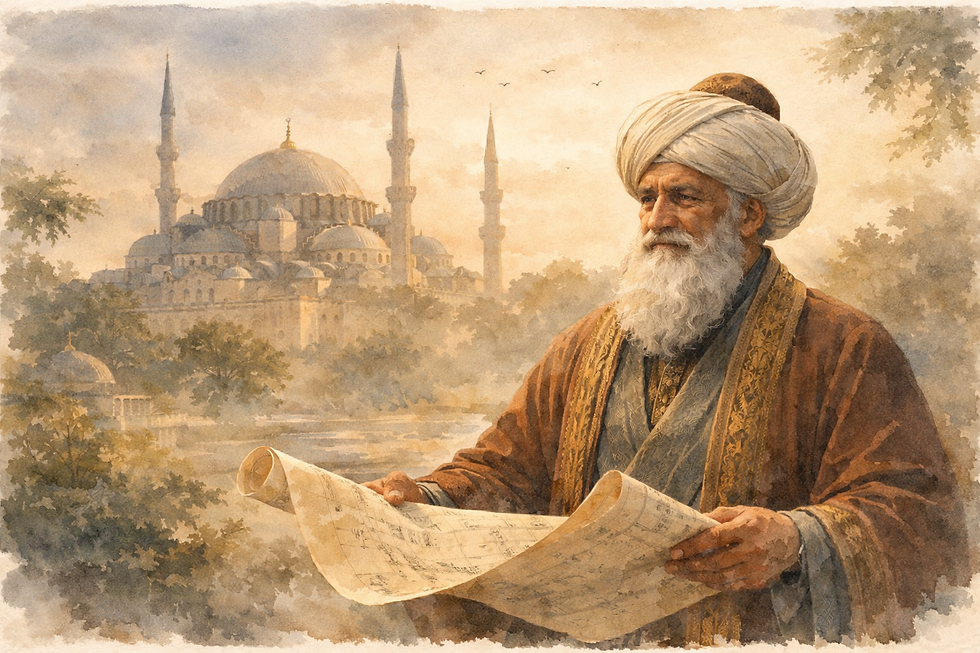
Walk through Istanbul long enough and you begin to notice something.The city is loud, layered, restless. Yet certain buildings seem untouched by this noise. They do not dominate the skyline. They do not demand attention. They simply remain.
Most of these structures share one name: Mimar Sinan.
Understanding Sinan is not about listing mosques or counting domes. It is about recognizing a way of thinking. His architecture reflects a mind trained to calculate before speaking, to solve problems quietly, and to let structure carry meaning without insisting on it.
For an advanced learner of Turkish, Sinan’s legacy offers more than architectural history. It reveals how intelligence, restraint, and long-term thinking are culturally valued.
From Military Engineer to Urban Intelligence
Sinan was not trained as an artist. His formation came from logistics, movement, and survival.
As a military engineer within the Janissary corps, his responsibility was simple and unforgiving: bridges had to stand, roads had to function, water had to move. There was no room for excess. Only solutions mattered.
This background shaped everything he later built. His mosques were never isolated monuments. They were parts of systems: water networks, schools, public kitchens, hospitals, and roads. Each structure served the city as a whole rather than competing with it.
This is why Sinan’s architecture feels organized rather than overwhelming. It reflects a mindset that values denge (balance) over display, and clarity over spectacle.
The Science of the Unseen
One of the most telling aspects of Sinan’s work is his attention to what cannot be seen.
In the Süleymaniye Mosque, dozens of hollow ceramic jars were embedded inside the dome. Their purpose was not symbolic. They formed a carefully designed acoustic system, ensuring that the human voice reached every corner of the space evenly, without force.
Equally deliberate was the is odası, the soot chamber. By calculating airflow with remarkable precision, Sinan directed smoke from thousands of candles into a single room. The collected soot was later used as ink for calligraphy, protecting the interior while serving another cultural function.
This approach reveals a philosophy: architecture should solve problems so effectively that its intelligence disappears into daily use. Mastery is present, but never loud.
Identity, Synthesis, and Cultural Continuity
Sinan’s background as a devşirme is not incidental. It is central to understanding his capacity for synthesis.
Born in Anatolia and raised within the Ottoman system, he encountered multiple architectural traditions early on. Byzantine arches, Seljuk geometries, Roman engineering solutions. Rather than choosing one, he absorbed them all.
He did not erase the past. He reorganized it.
What emerged was not a personal style, but a coherent architectural language capable of carrying centuries of weight.
Quiet Mastery
Sinan famously described his own work in stages. Süleymaniye was his kalfalık work. Selimiye was his ustalık.
In Turkish, ustalık does not simply refer to technical skill. It implies time, restraint, and judgment. Mastery is reached not through display, but through refinement.
His buildings have survived earthquakes that destroyed far newer structures. This endurance is not accidental. It reflects flexible systems, precise load distribution, and an intimate understanding of soil and stress.
In this sense, Sinan represents a cultural ideal: intelligence expressed through incelik, the ability to resolve complex problems with elegant restraint.
Why Sinan Still Matters
Sinan did not leave manifestos. He left systems.
His work reminds us that longevity comes from understanding limits, that visibility is not the same as significance, and that true mastery often feels effortless to those who experience it.
To study Sinan is to encounter a cultural logic where intelligence is quiet, solutions are structural, and meaning is embedded rather than announced.
Frequently Asked Questions (FAQ)
Q: Why is Mimar Sinan often described as an “usta” rather than a genius?
A: In Turkish culture, usta emphasizes experience, judgment, and refinement rather than raw talent. Sinan’s work reflects mastery shaped over time, not sudden brilliance.
Q: What makes Sinan’s buildings structurally different from later architecture?
A: His designs integrate flexible joints, balanced load systems, and careful soil analysis, allowing his buildings to withstand earthquakes and centuries of use.
Q: Why is Sinan important for understanding Turkish cultural values?
A: His architecture embodies "balance, restraint, and synthesis" values that extend beyond architecture into how intelligence and competence are traditionally expressed in Turkish culture.


Comments