with Seda
Karaman Lalesi (Tulipa cinnabarina)
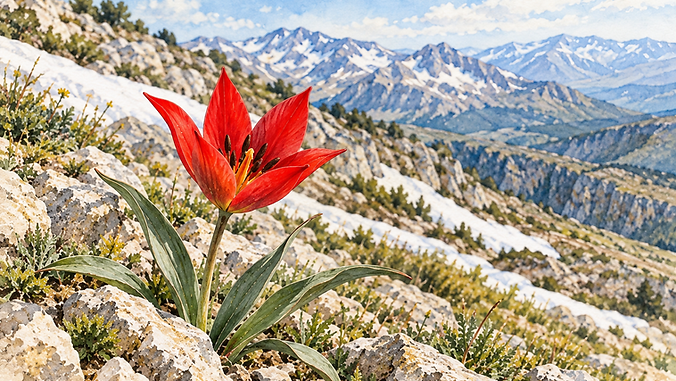
The Tulip That Was Named Twice
On 3 April 1990, on the mountain road between Ermenek and Hadım, four botanists stopped at around 1,750 metres and collected a red tulip. Their names were Kammerlander, Pasche, Persson and Zetterlund. They gave the plant a field number, 90-37, pressed it, and sent it to the herbarium of Göteborg University in Sweden (IPNI).
The label says Konya. Today the road runs between two provinces: Ermenek belongs to Karaman, and Hadım is still in Konya.
Ten years later the plant got its scientific name, Tulipa cinnabarina. Cinnabar is a red mineral, the one painters once ground to make vermilion.
In Turkish the flower is Karaman lalesi, the Karaman tulip.
For about a year, its Latin name said Karaman too.
What It Looks Like
Like other tulips, the Karaman tulip spends most of the year underground as a bulb. In spring, when the snow melts, it grows a few narrow leaves and a single red flower. The leaves collect energy from sunlight and store it in the bulb. When summer arrives, the leaves dry out, and the bulb remains underground until the following spring. Botanists call this kind of plant a bulbous geophyte.
The flower has six red parts called tepals. They look like petals, but botanists use a different term because the inner and outer parts are very similar.
In 2016, researchers described a closely related tulip from Muğla and compared it with the Karaman tulip. The Karaman tulip has broader outer tepals, larger pollen-bearing anthers and larger seed capsules. It also produces more stolons, underground stems that allow new bulbs to grow nearby.
More detailed measurements can be found in Karin Persson's original description from 2000 and a 2014 study of Turkish tulips.
Where It Grows
Kew records the plant only from Türkiye, in the south-southwest of the country. Persson's paper placed it more precisely. Its title presented two new bulbous species from the Central Taurus Mountains.
The Taurus are the long chain of mountains between Türkiye's Mediterranean coast and the high plateau of central Anatolia. On their southern side lies a rough upland called the Taşeli Platosu. Ermenek sits on it at about 1,250 metres, around 160 kilometres from the city of Karaman. Sarıveliler, to the west, lies higher, at an average of about 1,630 metres, and 85 kilometres from Alanya on the coast (Ermenek Araştırmaları II).
The scientific records cluster around this upland. The first plant came from between Ermenek and Hadım. A 2016 survey of Sarıveliler describes the tulip as a local endemic of that district.
There is also a photograph from the Antalya side, taken near Eğrigöl in Gündoğmuş on 23 May 2015 at about 2,050 metres (Ori Fragman-Sapir). It is a single observation, not a collected specimen, but it shows the plant flowering beside the last of the snow.
The two records cited here that give an altitude both lie above 1,700 metres. The provinces divide the area between them: Ermenek and Sarıveliler belong to Karaman, Hadım to Konya, and Gündoğmuş to Antalya.
In these mountains a yayla is a high summer pasture, the kind of place that can only be used once the snow has gone. The tulip runs on the same calendar. It flowers on ground that has only just been uncovered, then disappears into its bulb for the rest of the year.
Two Names, One Year
In 1990, botanists collected a red tulip from the mountains between Ermenek and Hadım. Ten years later, it received its scientific name, Tulipa cinnabarina, from the botanist Karin Persson.
But another group of botanists in Türkiye had been studying the same flower. Neriman Özhatay and Koçak named it Tulipa karamanica, after the Karaman region where it grows. Their description appeared in a book dated 2000, although the book was not published until 2001.
This created an unusual situation: one flower had two scientific names.
In botany, the name published first normally takes priority. Since Persson's description appeared earlier, Tulipa cinnabarina became the accepted name. Today, the Royal Botanic Gardens, Kew, lists Tulipa karamanica as a synonym, an alternative scientific name for the same plant.
The name karamanica still appears in some older research. And although it disappeared from the accepted scientific name, Karaman remains part of the flower's Turkish name: Karaman lalesi.
A Cousin Near Milas
In 2015, a biologist named Ayhan Toprak photographed a red wild tulip near Milas, in Muğla, and shared his photographs with tulip researchers. The following spring, botanists visited the area and collected specimens. They discovered that the flower was closely related to the Karaman tulip, but had some differences. In 2016, they named it Tulipa cinnabarina subsp. toprakii, in honour of Ayhan Toprak.
The flower grows near the village of Yusufça, at around 457 metres above sea level, among olive trees and red pines. It is known in Turkish as Milas Lâlesi. The Karaman tulip, by comparison, grows much higher in the Taurus Mountains, with the altitude records discussed here placing it above 1,700 metres.
The discovery also changed how botanists write the Karaman tulip's scientific name. It is now called Tulipa cinnabarina subsp. cinnabarina, while its relative near Milas is subsp. toprakii. Both belong to the same species, but grow in very different environments.
The Tulips Istanbul Wanted
The tulips that made Ottoman Istanbul famous were garden flowers, and the Karaman tulip has no place in their story. No source links it to the city's gardens. Their history is worth knowing all the same, because it shows how different a tulip could be when people shaped it.
Istanbul's florists wanted a very particular flower. The ideal İstanbul lâlesi was narrow and almond-shaped, with tepals drawn out into long, fine points like needles. The rounder European tulips they called kaba lâle, the coarse tulip (TDV İslâm Ansiklopedisi, "Lâle").
Breeding these flowers was serious work, done by named men. The first improved Istanbul tulip is credited to Ebüssuûd Efendi, the empire's chief religious scholar in the sixteenth century, who named it nûr-ı adn, the light of Eden. In the early eighteenth century, Şeyh Mehmed Lâlezârî wrote Mîzânü'l-ezhâr, "The Scale of Flowers," a guide to about twenty qualities a tulip needed before it could be called valuable. Handwritten lists of Istanbul varieties record around two thousand names. An album painted around 1725, the Lâle Mecmuası, shows about fifty of them in colour. Many of those varieties are now lost.
The tulip had entered Ottoman art long before. The TDV encyclopedia gives the tomb of Şehzade Mehmed in Istanbul, dated 1543, as its first appearance on tiles, part of a new floral style from the palace workshop of the designer Kara Memi. Over the next decades it spread across İznik tiles in mosques such as Rüstem Paşa and onto the silk velvets of Bursa. Then the fashion moved on. The motif grew rarer in the seventeenth century and had lost its importance by the eighteenth.
The years now called the Lale Devri, the Tulip Age, run from 1718 to 1730, under Sultan Ahmed III and his grand vizier Nevşehirli Damad İbrahim Paşa. By then the tulip's great century in art was already over. The tulip was a garden passion of the court and the wealthy. In 1720, the chronicler Râşid described a tulip illumination, a night garden lit for the flowers, held by İbrahim Paşa. The period ended in September 1730, when the Patrona Halil revolt killed İbrahim Paşa and forced Ahmed III to give up the throne.
Nobody at the time called it the Tulip Age. The name spread after 1913, when the historian Ahmed Refik published a series of articles under that title. Historians have argued over it ever since, about how unusual the court's spending really was and about what the age actually changed. Our article on the Ottoman Tulip Age and the Lale Devri follows that story to the Netherlands.
The two thousand names in those Istanbul lists all belonged to garden varieties. The wild plant shares something older with them, a family history. A 2026 study of tulip DNA, covering most of the world's species, traces the genus back to the broader region of Central Asia, where it diversified mainly within the last ten million years. The same work treats the garden tulip as a complex hybrid of cultivated origin, with several wild species in its ancestry. The Karaman tulip is one of the wild relatives that stayed in the mountains. The 2014 revision counted 17 tulip species in Türkiye.
The Tulip That Bows
Another Anatolian flower carries the word lale without being a tulip. The ters lale, the upside-down tulip, is Fritillaria imperialis, known in English as the crown imperial. It belongs to the same lily family as the tulips, but to a different genus. Its red or orange bells hang down from a tall stem under a crown of leaves.
Its names carry stories. In Christian tradition, reported from the mountains of Ergani in Diyarbakır, the flower is said to have bowed its head when Jesus was crucified, and its drops are read as the tears of Mary (CNN Türk, 2020). In another tradition it became a sign of mourning for Hasan and Hüseyin, and one of its Anatolian names is Kerbela (BirGün, 2015). It is also widely called ağlayan gelin, the weeping bride.
Inside each hanging flower, clear liquid collects at the base of the tepals. A 2018 study measured it as nectar from unusually large nectar glands, about 200 microlitres per flower on average, thin and watery (Roguz et al., 2018). In European gardens, blue tits and great tits have been seen drinking it and carrying pollen between flowers. The authors think birds are its main pollinators, though this has not been confirmed where the plant grows wild.
Kar, Kara, Karaman
Lale means tulip, and Karaman is the place. When Turkish puts two nouns together so that the first describes the second, the second noun takes a small ending. After a consonant it is -ı, -i, -u or -ü. After a vowel it is -sı, -si, -su or -sü. Lale ends in a vowel, so it becomes lalesi. This is the belirtisiz isim tamlaması, the indefinite noun compound. It names a kind of thing, here a tulip of the Karaman sort. Salda Gölü and Milas Lâlesi are built the same way.
The ending on lalesi looks just like the possessive "his" or "its," and in form it is the same suffix. Here it only marks the compound. A case ending shows the difference. I saw the Karaman tulip is Karaman lalesini gördüm. First comes the compound ending -si, then a linking -n-, then the object ending -i. In the plural, the compound ending moves to the end of the word: Karaman laleleri, Karaman tulips.
Add the genitive ending to the first noun and the meaning changes. Karaman'ın lalesi means Karaman's tulip, one particular tulip that belongs to Karaman, the kind of phrase you might use for a town's emblem. The plant's name uses the plain compound because it names a type.
The same pattern turns up all over this subject. Soğan means onion, and also bulb, so a tulip bulb is a lale soğanı. Barçın Yaylası, a summer pasture north of Sarıveliler, works the same way: yayla ends in a vowel, so it takes -sı.
Adjectives behave differently. A wild tulip is a yabani lale, and the upside-down tulip is ters lale. Yabani and ters are adjectives, so lale stays bare. This is a sıfat tamlaması, an adjective with a noun. Two flower names that sound alike follow two different rules.
Learners often hear kara, black, inside Karaman, and kar, snow, inside that. Snow would suit this tulip. But Karaman is a personal name. The city is named after Karaman Bey, whose dynasty, the Karamanoğulları, made Ermenek its first capital. The town itself was once called Laranda.
Oğul, son, drops its second vowel before a vowel ending, as in Karamanoğlu, son of Karaman. Before the plural -lar it keeps it, so the dynasty is the Karamanoğulları.
Taşeli, the upland where the tulip grows, is another compound, written as one word: taş, stone, and el, an old word for land, with the ending -i. Stone country.
Found Nowhere Else
The Karaman tulip grows naturally in a small part of the Taurus Mountains and nowhere else in the world. Plants found only in a particular region are called endemic. This makes the flower special to the area, but how much longer can it survive there?
We do not yet have a clear answer. There is no known global IUCN assessment for the Karaman tulip, and little published information about how many plants remain in the wild.
Its close relative, the Milas tulip, faces a more certain danger. In 2016, researchers estimated that only 600 to 750 plants grew in an area of about 1.2 hectares. Grazing animals and nearby mining roads threatened their habitat. The researchers classified it as Critically Endangered.
The mountains around Karaman are home to many other rare plants. A 2012 study identified 68 rare and endemic plants in the province, including 20 classified as critically endangered.
Researchers have also tried growing the Karaman tulip in a laboratory using pieces of its bulb, but the experiment was unsuccessful because the cultures became contaminated.
For now, the flower continues to grow in the mountains where botanists first collected it in 1990. Each spring, as the snow melts around Ermenek and Hadım, its red flowers return to the rocky slopes.
Frequently Asked Questions
Q: What does "Karaman lalesi" mean?
A: Lale means tulip, and Karaman is a city and province in south-central Türkiye. The ending -si on lalesi links the two nouns into a compound, so the name means "the Karaman tulip," a kind of tulip named after the place. The scientific name, Tulipa cinnabarina, refers to its red colour instead.
Q: How do you pronounce "Karaman lalesi"?
A: Roughly "kah-rah-mahn lah-leh-see." Every vowel is said fully and clearly, the r is lightly tapped, and the a sounds like the a in "father."
Q: Where does Karaman lalesi grow?
A: In the Central Taurus Mountains of southern Türkiye. Scientific records place it between Ermenek and Hadım at 1,750 to 1,800 metres and in the Sarıveliler district. A photograph from Gündoğmuş in Antalya shows it at about 2,050 metres.
Q: Is it endangered?
A: No global IUCN Red List assessment for subsp. cinnabarina could be found, and no published population study could be found. Being endemic does not by itself mean a plant is endangered. Its close relative near Milas was assessed as Critically Endangered in 2016.
Q: What is the difference between Karaman lalesi and Milas Lâlesi?
A: They are two subspecies of the same tulip. Karaman lalesi (subsp. cinnabarina) grows high in the Central Taurus. Milas Lâlesi (subsp. toprakii), described in 2016, grows a few hundred metres above sea level near Milas in Muğla, on open slopes and in an olive grove.
Q: Was Karaman lalesi grown in Ottoman gardens during the Tulip Age?
A: No evidence links this wild tulip to Ottoman gardens. The tulips admired in Istanbul during the Lale Devri (1718–1730) were bred garden varieties with long, needle-pointed tepals. Karaman lalesi received its first scientific name only in 2000.
Sources and Further Reading
Tulipa cinnabarina K.Perss., International Plant Names Index (type information)
Tulipa cinnabarina subsp. cinnabarina, Plants of the World Online, Royal Botanic Gardens, Kew
Tulipa cinnabarina subsp. toprakii, Plants of the World Online, Kew
Persson, K. (2000), Two new bulbous species from the Central Taurus Mountains of Turkey, The New Plantsman 7: 200–208
Özhatay, N. & Koçak (2001), Tulipa karamanica, in Güner, A. et al. (eds.), Flora of Turkey and the East Aegean Islands 11: 324 (dated 2000, published 2001)
Eker, Babaç & Koyuncu (2014), Revision of the genus Tulipa L. (Liliaceae) in Turkey, Phytotaxa 157: 1–112
Muşmal et al. (eds.) (2018), Ermenek Araştırmaları II, Karamanoğlu Mehmetbey Üniversitesi
Sezer (2012), Karaman ilinin endemik ve nadir bitkileri, thesis, Selçuk University
Bazı yabani Tulipa türlerinde in vitro soğancık üretimi, thesis, YÖK Açık Bilim
Baytop, Kurnaz & Derman (2003), "Lâle," TDV İslâm Ansiklopedisi 27: 79–81
From Ottoman Istanbul to the Dutch Tulip Fields, Learn Turkish with Seda
Hz. İsa'ya ağladığına inanılan ters laleler açtı, CNN Türk (2020)
Photographic record near Eğrigöl, Gündoğmuş, Ori Fragman-Sapir