with Seda
Keçileri kaçırmak
Literal Translation
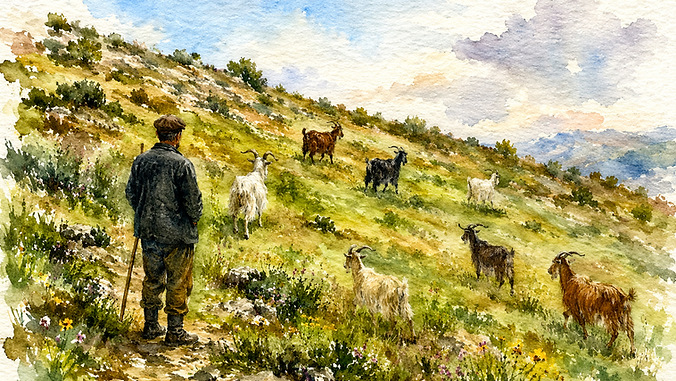
It literally means “to lose the goats.”
Meaning and Usage
“Keçileri kaçırmak” describes a moment when someone’s behavior moves beyond control. The person no longer holds their thoughts, reactions, or judgment in a steady way. Others can see the shift.
The verb form matters here. In Turkish, kaçırmak carries the sense of letting something slip away or failing to keep hold of it. The idiom does not simply describe something that happens. It suggests that something that should have been managed is no longer being held together. There is a quiet sense of responsibility within the expression.
The plural form also shapes the meaning. It is not one goat, but all of them. The image points to a full dispersal rather than a small deviation. For this reason, the idiom is used for a clear and noticeable loss of balance, not a minor moment of distraction.
In daily speech, it often appears with a softer tone. It can describe stress, exhaustion, or emotional overload. A person may not be permanently unstable. The idiom marks the point where inner pressure becomes visible to others.
Example Usage
Turkish:
Bu kadar stresle çalışırsan sonunda keçileri kaçıracaksın.
English:
If you keep working under this much stress, you will eventually lose control.
Cultural Note
The choice of “goat” is not accidental. In Anatolian pastoral life, goats are known for their independence. They scatter easily, resist control, and require constant attention. Sheep move with the group. Goats move on their own.
This gives the idiom a grounded realism. The mind is compared to something that already tends to wander. Control is not a fixed state. It is something that must be maintained.
The image also carries an economic weight. In traditional village life, losing animals meant losing livelihood, stability, and status. The idiom places mental collapse on the same level as material loss. Both represent a serious break in one’s ability to function.
There is also a social dimension. When goats scatter, it is visible. Others see it. In the same way, “keçileri kaçırmak” frames mental imbalance as something expressed outwardly, observed within a community.
Unlike some other expressions, this idiom does not point toward recovery. There is no common phrase for “gathering the goats again.” The focus remains on the moment of dispersal.
Interested in more Turkish idioms and expressions?
Explore the full collection on Learn Turkish with Seda.
Frequently Asked Questions (FAQ)
Q: Does “keçileri kaçırmak” imply responsibility?
A: Yes. The verb suggests that something that should have been controlled is no longer being held, which adds a subtle sense of responsibility to the expression.
Q: Why are goats used in this idiom?
A: Goats are known for being independent and difficult to control, which makes them a fitting image for thoughts or impulses that scatter easily.
Q: Is this stronger than “aklını kaybetmek”?
A: It is different in tone. “Aklını kaybetmek” feels more abstract, while “keçileri kaçırmak” is more visual and socially observable.
Q: Can it describe temporary situations?
A: Yes. It is often used for moments of stress or emotional overload, not only for permanent conditions.
Q: Is there an opposite expression?
A: There is no common idiom that describes “gathering the goats again.” The expression focuses on the moment of losing control.